
COVID-19
Trudeau government back in court to appeal ruling against its use of the Emergencies Act


From LifeSiteNews
“Legal thresholds do not bend, much less break, in exigent circumstances. We are putting this and future governments on notice: even in times of crisis, no government is above the law”
Prime Minister Justin Trudeau’s government is again in court to claim its use of the Emergencies Act to stop the 2022 Freedom Convoy was warranted, in appeal of a ruling from last year which found its use of the act was unjustified.
Today, the Canadian Civil Liberties Association (CCLA) noted in a press release that it is before the Federal Court of Appeal “to defend its historic victory for the rule of law.”
“While the extraordinary powers granted to the federal government through the Emergencies Act are necessary in extreme circumstances, they also threaten the rule of law and our democracy,” said Anaïs Bussières McNicoll, who serves as the Director of the Fundamental Freedoms program at the CCLA.
McNicoll said that the CCLA will be urging the “Federal Court of Appeal to reject the federal government’s attempt to relax the thresholds necessary for invoking the Act’s extraordinary powers.”
“Legal thresholds do not bend, much less break, in exigent circumstances. We are putting this and future governments on notice: even in times of crisis, no government is above the law,” concluded McNicoll.
In January of 2024, Canada’s Federal Court announced that the use of the EA by the Trudeau government in early 2022 to shut down Freedom Convoy, which was calling for an end to COVID mandates, was a direct violation of the nation’s Charter of Rights and Freedoms and thus was “not justified” and “infringed” on the rights of protesters.
The January 2024 decision by Federal Court Justice Richard Mosley saw the judge write, “Having found that the infringements of Charter sections 2(b) and 8 were not minimally impairing, I find that they were not justified under section 1.”
Shortly after the court ruling, the Trudeau government announced that it would appeal Mosley’s ruling, claiming the federal court “erred in fact and law in declaring that the Regulations infringed subsection 2(b) of the Canadian Charter of Rights and Freedoms.”

Notably, in the Federal Court of Appeal, where the case is now being heard, 10 out of the 15 judges were appointed by Trudeau.
The CCLA said that the government’s use of the EA “which had never been invoked before in Canada,” allowed the federal government to “enact wide-reaching orders without going through the ordinary democratic process—but only once stringent legal thresholds are met.”
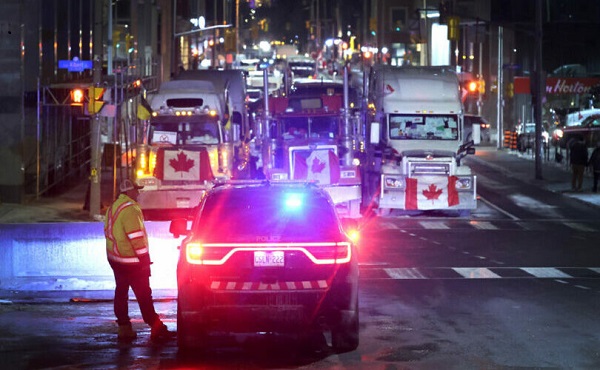
In early 2022, the Freedom Convoy saw thousands of Canadians from coast to coast come to Ottawa to demand an end to COVID mandates in all forms. Despite the peaceful nature of the protest, Trudeau’s government enacted the EA on February 14, 2022.
During the clear-out of protesters after the EA was put in place, one protester, an elderly lady, was trampled by a police horse, and one conservative female reporter was beaten by police and shot with a tear gas canister.
Trudeau revoked the EA on February 23.
In the lead-up to the protest, Trudeau had disparaged unvaccinated Canadians, saying those opposing his measures were of a “small, fringe minority” who hold “unacceptable views” and do not “represent the views of Canadians who have been there for each other.”
In another Freedom Convoy court battle, protest leaders Tamara Lich and Chris Barber underwent a year-long criminal trial which concluded last September.
Both Lich and Barber will have their verdicts announced on March 12, 2025, as LifeSiteNews has reported.
Lich and Barber face a possible 10-year prison sentence for a slew of non-violent crimes, details of which LifeSiteNews has reported on extensively.

From LifeSiteNews
A judge ruled that the Ontario Court of Justice is already ‘satisfied’ with Chris Barber’s sentence and taking away his very livelihood would be ‘disproportionate.’
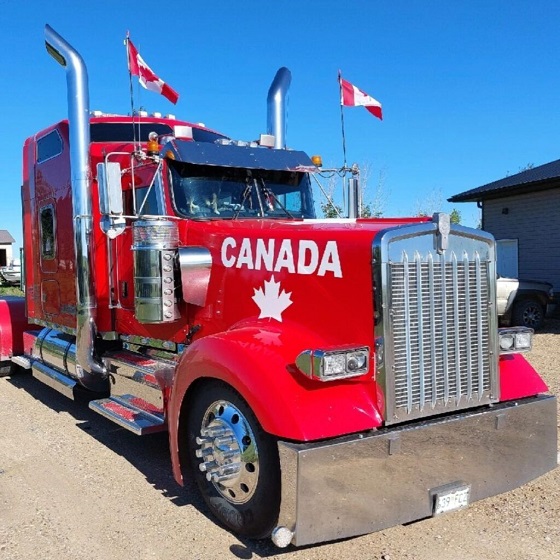
A Canadian judge has dismissed a demand from Canadian government lawyers to seize Freedom Convoy leader Chris Barber’s “Big Red” semi-truck.
On Friday, Ontario Court of Justice Judge Heather Perkins-McVey denied the Crown’s application seeking to forfeit Barber’s truck.
She ruled that the court is already “satisfied” with Barber’s sentence and taking away his very livelihood would be “disproportionate.”
“This truck is my livelihood,” said Barber in a press release sent to LifeSiteNews.
“Trying to permanently seize it for peacefully protesting was wrong, and I’m relieved the court refused to allow that to happen,” he added.
Criminal defense lawyer Marwa Racha Younes was welcoming of the ruling as well, stating, “We find it was the right decision in the circumstances and are happy with the outcome.”
John Carpay, president of the Justice Centre for Constitutional Freedoms (JCCF), said the decision is “good news for all Canadians who cherish their Charter freedom to assemble peacefully.”
READ: Freedom Convoy protester appeals after judge dismissed challenge to frozen bank accounts
“Asset forfeiture is an extraordinary power, and it must not be used to punish Canadians for participating in peaceful protest,” he added in the press release.
As reported recently by LifeSiteNews, the Canadian government claimed that Barber’s truck is an “offence-related property” relating to his involvement in the 2022 protests against Canada’s COVID mandates.
At this time, the court ruling ends any forfeiture proceedings for the time being, however Barber will continue to try and appeal his criminal conviction and house arrest sentence.
Barber’s truck, a 2004 Kenworth long-haul he uses for business, was a focal point in the 2022 protests. He drove it to Ottawa, where it was parked for an extended period of time, but he complied when officials asked him to move it.
On October 7, 2025, after a long trial, Ontario Court Justice Perkins-McVey sentenced Barber and Tamara Lich, the other Freedom Convoy leader, to 18 months’ house arrest. They had been declared guilty of mischief for their roles as leaders of the 2022 protest against COVID mandates, and as social media influencers.
Lich and Barber have filed appeals of their own against their house arrest sentences, arguing that the trial judge did not correctly apply the law on their mischief charges.
Government lawyers for the Crown have filed an appeal of the acquittals of Lich and Barber on intimidation charges.
The pair’s convictions came after a nearly two-year trial despite the nonviolent nature of the popular movement.
From LifeSiteNews
Protestor Evan Blackman’s legal team argues Trudeau’s Emergencies Act-based bank account freezes were punitive state action tied directly to protest participation.
A Freedom Convoy protester whose bank accounts were frozen by the Canadian government says a judge erred after his ruling did not consider the fact that the funds were frozen under the Emergencies Act, as grounds for a stay of proceedings.
In a press release sent out earlier this week, the Justice Centre for Constitutional Freedoms (JCCF) said that Freedom Convoy protestor Evan Blackman will challenge a court ruling in his criminal case via an appeal with the Ontario Superior Court of Justice.
“This case raises serious questions about how peaceful protest is treated in Canada and about the lasting consequences of the federal government’s unlawful use of the Emergencies Act,” noted constitutional lawyer Chris Fleury. “The freezing of protestors’ bank accounts was part of a coordinated effort to suppress dissent, and courts ought to be willing to scrutinize that conduct.”
Blackman was arrested on February 18, 2022, during the police crackdown on Freedom Convoy protests against COVID restrictions, which was authorized by the Emergencies Act (EA). The EA was put in place by former Prime Minister Justin Trudeau’s Liberal government, which claimed the protests were violent, despite no evidence that this was the case.
Blackman’s three bank accounts with TD Bank were frozen due to his participation in the Freedom Convoy, following a directive ordered by Trudeau.
As reported by LifeSiteNews, in November of this year, Blackman was convicted at his retrial even though he had been acquitted at his original trial. In 2023, Blackman’s “mischief” and “obstructing police” charges were dismissed by a judge due to lack of evidence and the “poor memory of a cop regarding key details of the alleged criminal offences.”
His retrial resulted in Blackman getting a conditional discharge along with 12 months’ probation and 122 hours of community service, along with a $200 victim fine surcharge.
After this, Blackman’s application for a stay of proceedings was dismissed by the court. He had hoped to have his stay of proceedings, under section 24(1) of the Charter of Rights and Freedoms, allowed. However, the judge ruled that the freezing of his bank accounts was legally not related to his arrest, and because of this, the stay of proceedings lacked standing.
The JCCF disagreed with this ruling, noting, it “stands in contrast to a Federal Court decision finding that the government’s invocation of the Emergencies Act was unreasonable and violated Canadians’ Charter rights, including those targeted by the financial measures used against Freedom Convoy protestors.”
As of press time, a hearing date has not been scheduled.
In 2024, Federal Court Justice Richard Mosley ruled that Trudeau was “not justified” in invoking the Emergencies Act.
In early 2022, the Freedom Convoy saw thousands of Canadians from coast to coast come to Ottawa to demand an end to COVID mandates in all forms. Despite the peaceful nature of the protest, Trudeau’s federal government enacted the EA in mid-February.
After the protesters were cleared out, which was achieved through the freezing of bank accounts of those involved without a court order as well as the physical removal and arrest of demonstrators, Trudeau revoked the EA on February 23, 2022.

Alberta Next Panel calls to reform how Canada works

Canadian government launches trial version of digital ID for certain licenses, permits
Georgia county admits illegally certifying 315k ballots in 2020 presidential election

End Supply Management—For the Sake of Canadian Consumers
-
International2 days ago
Georgia county admits illegally certifying 315k ballots in 2020 presidential election
-
 Energy2 days ago
‘The electric story is over’
-
 Energy2 days ago
The Top News Stories That Shaped Canadian Energy in 2025 and Will Continue to Shape Canadian Energy in 2026
-
 Daily Caller1 day ago
US Halts Construction of Five Offshore Wind Projects Due To National Security
-
 Alberta1 day ago
Alberta Next Panel calls for less Ottawa—and it could pay off
-
 Daily Caller1 day ago
While Western Nations Cling to Energy Transition, Pragmatic Nations Produce Energy and Wealth
-
 Fraser Institute2 days ago
Carney government sowing seeds for corruption in Ottawa
-
 Bruce Dowbiggin1 day ago
Be Careful What You Wish For In 2026: Mark Carney With A Majority