
National
Red Deer Volleyball stars named to First All-Tournament National teams



Red Deer Polytechnic Athletics is proud to announce The Granary Kitchen RDP Athletes of the Week:
1. Tess Pearman – Queens Volleyball
Hometown – Ponoka, AB
Bachelor of Education Elementary (3rd year)
Tess Pearman provided the Red Deer Polytechnic Queens Volleyball team with energy and strong play at the Canadian Collegiate Athletic Association (CCAA) National Championship. The Alberta Colleges Athletic Conference (ACAC) Women’s Volleyball South All-Conference team selection was instrumental in helping the Queens earn bronze in Charlottetown. Pearman was also selected to the CCAA Women’s Volleyball First All-Tournament team.
In the national championship quarter-final, the student-athlete from Ponoka recorded a match high 11 kills in a sweep over the Mount Saint Vincent Mystics, Atlantic Collegiate Athletic Association (ACAA) Champions (25-19, 25-19 and 25-16). In a CCAA semi-final, Pearman accumulated a team high 15 kills in a setback against the Vancouver Island University (VIU) Mariners, (PACWEST Wildcard) who eventually won their fourth consecutive CCAA title (23-25, 19-25 and 24-26). She was extremely efficient on the left side (0.467 hitting percentage) and was named the Queens Player of the Game.
The third-year outside hitter had another solid performance in the Queens’ dominant three set victory over Les Rouges de Saint-Boniface (Manitoba Colleges Athletic Conference Champions) in a national bronze semi-final (25-13, 25-17 and 25-9). The Bachelor of Education Elementary student led the team with three service aces, and added six kills (0.357 hitting percentage), and 10 digs.
In the bronze medal match, Pearman accumulated 15 kills in a five set victory over the Lynx d’Édouard-Monpetit, Réseau du sport étudiant du Québec Champions (16-25, 25-22, 17-25, 25-21 and 15-12).
Pearman’s leadership and skill helped contribute to a memorable 2021/2022 season for the Queens Volleyball team. The squad remarkably went 22-1 during the regular season and playoffs, achieving ACAC gold and national bronze.

2. Cody Boulding – Kings Volleyball
Hometown – Prince George, BC
Bachelor of Kinesiology (3rd year)
Cody Boulding was an effective leader and player for the Red Deer Polytechnic Kings Volleyball team at the CCAA National Championship in Quebec. The six-foot-five middle helped guide the Kings to a national bronze medal and was selected to the CCAA First All-Tournament team.

The RDP Kings nearly completed a comeback against the host Limoilou Titans in the CCAA Quarter-final match. Down two sets and trailing in the third, the Kings pushed the Titans to five sets, but couldn’t complete the rally (19-25, 21-25, 25-23, 25-16 and 10-15). The Bachelor of Kinesiology student totaled 10 kills, two aces and a block, and was named the Kings Player of the Game.
The ACAC Men’s Volleyball South All-Conference team member provided a presence at the net and from the service line in the Kings’ three set victory over the Canadian Mennonite University Blazers, Manitoba Colleges Athletic Conference Champions, in the national bronze quarter-final (25-17, 25-11 and 25-17).
The Red Deer Polytechnic Kings swept the St. Thomas Tommies, Atlantic Collegiate Athletic Association Champions, in a CCAA bronze semi-final (25-20, 25-18 and 25-18). Boulding contributed five kills and three of the Kings’ 10 service aces.
In the bronze medal final, Boulding recorded two kills and four blocks in the Kings’ four set victory over the Redeemer Royals, Ontario Colleges Athletic Association Wildcard (25-21, 25-16, 23-25 and 25-20). Boulding brought a hardworking effort throughout the entire 2021/2022 campaign. He set an example on and off the court and was important to the Kings’ success, earning ACAC gold and CCAA bronze.
For more information on Red Deer Polytechnic Athletics, the student-athletes and teams, please visit: rdpolytechathletics.ca.


From Energy Now
By Margareta Dovgal
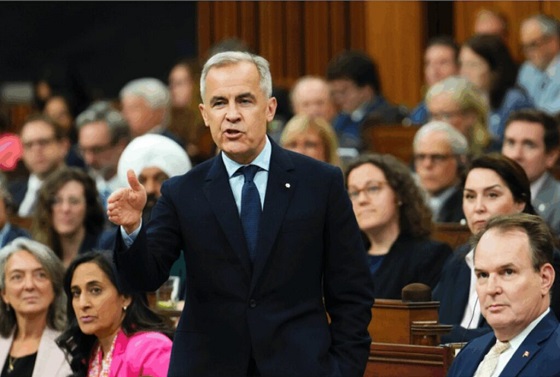
Playing politics with pipelines is a time-honored Canadian tradition. Recent events in the House of Commons offered a delightful twist on the genre.
The Conservatives introduced a motion quoting the Liberals’ own pipeline promises laid out in the Memorandum of Understanding (MOU) with Alberta, nearly verbatim. The Liberals, true to form, killed it 196–139 with enthusiastic help from the NDP, Bloc, and Greens.
We all knew how this would end. Opposition motions like this never pass; no government, especially not one led by Mark Carney, is going to let the opposition dictate the agenda. There’s not much use feigning outrage that the Liberals voted it down. The more entertaining angle has been watching closely as Liberal MPs twist themselves into pretzels explaining why they had to vote “no” on a motion that cheers on a project they claim to support in principle.
Liberal MP Corey Hogan dismissed the motion as “game-playing” designed to “poke at people”.
And he’s absolutely right to call it a “trap” for the Liberals. But traps only work when you walk into them.
Indigenous Services Minister Mandy Gull-Masty deemed the motion an “immature waste of parliamentary time” and “clearly an insult towards Indigenous Peoples” because it didn’t include every clause of the original agreement. Energy Minister Tim Hodgson decried it as a “cynical ploy to divide us” that “cherry-picked” the MOU.
Yet the prize for the most tortured metaphor goes to the prime minister himself. Defending his vote against his own pipeline promise, Carney lectured the House that “you have to eat the entire meal, not just the appetizer.”
It’s a clever line, and it also reveals the problem. The “meal” Carney is serving is stuffed with conditions. Environmental targets or meaningful engagement with Indigenous communities aren’t unrealistic asks. A crippling industrial carbon price as a precondition might be though.
But the prime minister has already said the quiet part out loud.
Speaking in the House a few weeks ago, Carney admitted that the agreement creates “necessary conditions, but not sufficient conditions,” before explicitly stating: “We believe the government of British Columbia has to agree.”
There is the poison pill. Handing a de facto veto to a provincial government that has spent years fighting oil infrastructure is neither constitutionally required nor politically likely. Elevating B.C.’s “agreement” to a condition, which is something the MOU text itself carefully avoids doing, means that Carney has made his own “meal” effectively inedible.
Hodgson’s repeated emphasis that the Liberal caucus supports “the entire MOU, the entire MOU” only reinforces this theory.
This entire episode forces us to ask whether the MOU is a real plan to build a pipeline, or just a national unity play designed to cool down the separatist temperature in Alberta. My sense is that Ottawa knew they had to throw a bone to Premier Danielle Smith because the threat of the sovereignty movement is gaining real traction. But you can’t just create the pretense of negotiation to buy time.
With the MOU getting Smith boo’ed at her own party’s convention by the separatists, it’s debatable whether that bone was even an effective one to throw.
There is a way. The federal government has the jurisdiction. If they really wanted to, they could just do it, provided the duty to consult with and accommodate Indigenous peoples was satisfied. Keep in mind: no reasonable interpretation equates Section 35 of the Charter to a veto.
Instead, the MOU is baked with so many conditions that the Liberals have effectively laid the groundwork for how they’re going to fail.
With overly-hedged, rather cryptic messaging, Liberals have themselves given considerable weight to a cynical theory, that the MOU is a stalling tactic, not a foundation to get more Canadian oil to the markets it’s needed in. Maybe Hodgson is telling the truth, and caucus is unified because the radicals are satisfied that “the entire MOU” ensures that a new oil pipeline will never reach tidewater through BC.
So, hats off to the legislative affairs strategists in the Conservative caucus. The real test of Carney’s political power continues: can he force a caucus that prefers fantasy economics into a mold of economic literacy to deliver on the vision Canadians signed off on? Or will he be hamstrung trying to appease the radicals from within?
Margareta Dovgal is managing director of Resource Works Society.

From the Frontier Centre for Public Policy
New script, same budget playbook. Nothing in the Carney budget breaks from the Trudeau years
Prime Minister Mark Carney’s first budget talks reform but delivers the same failed spending habits that defined the Trudeau years.
While speaking in the language of productivity, infrastructure and capital formation, the diction of grown-up economics, it still follows the same spending path that has driven federal budgets for years. The message sounds new, but the behaviour is unchanged.
Time will tell, to be fair, but it feels like more rhetoric, and we have seen this rhetoric lead to nothing before.
The government insists it has found a new path, one where public investment leads private growth. That sounds bold. However, it is more a rebranding than a reform. It is a shift in vocabulary, not in discipline. The government’s assumptions demand trust, not proof, and the budget offers little of the latter.
Former prime ministers Jean Chrétien and Paul Martin did not flirt with restraint; they executed it. Their budget cuts were deep, restored credibility, and revived Canada’s fiscal health when it was most needed. Ottawa shrank so the country could grow. Budget 2025 tries to invoke their spirit but not their actions. The contrast shows how far this budget falls short of real reform.
Former prime minister Stephen Harper, by contrast, treated balanced budgets as policy and principle. Even during the global financial crisis, his government used stimulus as a bridge, not a way of life. It cut taxes widely and consistently, limited public service growth and placed the long-term burden on restraint rather than rhetoric. Carney’s budget nods toward Harper’s focus on productivity and capital assets, yet it rejects the tax relief and spending controls that made his budgets coherent.
Then there is Justin Trudeau, the high tide of redistribution, vacuous identity politics and deficit-as-virtue posturing. Ottawa expanded into an ideological planner for everything, including housing, climate, childcare, inclusion portfolios and every new identity category.
The federal government’s latest budget is the first hint of retreat from that style. The identity program fireworks are dimmer, though they have not disappeared. The social policy boosterism is quieter. Perhaps fiscal gravity has begun to whisper in the prime minister’s ear.
However, one cannot confuse tone for transformation.
Spending still rises at a pace the government cannot justify. Deficits have grown. The new fiscal anchor, which measures only day-to-day spending and omits capital projects and interest costs, allows Ottawa to present a balanced budget while still adding to the deficit. The budget relies on the hopeful assumption that Ottawa’s capital spending will attract private investment on a scale economists politely describe as ambitious.
The housing file illustrates the contradiction. New funding for the construction of purpose-built rentals and a larger federal role in modular and subsidized housing builds announced in the budget is presented as a productivity measure, yet continues the Trudeau-era instinct to centralize housing policy rather than fix the levers that matter. Permitting delays, zoning rigidity, municipal approvals and labour shortages continue to slow actual construction. These barriers fall under provincial and municipal control, meaning federal spending cannot accelerate construction unless those governments change their rules. The example shows how federal spending avoids the real obstacles to growth.
Defence spending tells the same story. Budget 2025 offers incremental funding and some procurement gestures, but it avoids the core problem: Canada’s procurement system is broken. Delays stretch across decades. Projects become obsolete before contracts are signed. The system cannot buy a ship, an aircraft or an armoured vehicle without cost overruns and missed timelines. The money flows, but the forces do not get the equipment they need.
Most importantly, the structural problems remain untouched: no regulatory reform for major projects, no tax-competitiveness agenda and no strategy for shrinking a federal bureaucracy that has grown faster than the economy it governs. Ottawa presides over a low-productivity country but insists that a new accounting framework will solve what decades of overregulation and policy clutter have created. The budget avoids the hard decisions that make countries more productive.
From an Alberta vantage, the pivot is welcome but inadequate. The economy that pays for Confederation receives more rhetorical respect, yet the same regulatory thicket that blocks pipelines and mines remains intact. The government praises capital formation but still undermines the key sectors that generate it.
Budget 2025 tries to walk like Chrétien and talk like Harper while spending like Trudeau. That is not a transformation. It is a costume change. The country needed a budget that prioritized growth rooted in tangible assets and real productivity. What it got instead is a rhetorical turn without the courage to cut, streamline or reform.
Canada does not require a new budgeting vocabulary. It requires a government willing to govern in the country’s best interests.
Marco Navarro-Genie is vice-president of research at the Frontier Centre for Public Policy and co-author with Barry Cooper of Canada’s COVID: The Story of a Pandemic Moral Panic (2023).


Common Vaccines Linked to 38-50% Increased Risk of Dementia and Alzheimer’s

Trump DOJ seeks to quash Pfizer whistleblower’s lawsuit over COVID shots

Alberta introducing three “all-season resort areas” to provide more summer activities in Alberta’s mountain parks

The $50 Billion Question: EVs Never Delivered What Ottawa Promised
-
 Community2 days ago
Charitable giving on the decline in Canada
-
 Business2 days ago
Canada’s recent economic growth performance has been awful
-
 Alberta2 days ago
Canada’s New Green Deal
-
 armed forces2 days ago
Ottawa’s Newly Released Defence Plan Crosses a Dangerous Line
-
 Indigenous1 day ago
Residential school burials controversy continues to fuel wave of church arsons, new data suggests
-
 Alberta1 day ago
Alberta’s huge oil sands reserves dwarf U.S. shale
-
 Health1 day ago
Saskatchewan woman approved for euthanasia urged to seek medical help in Canada rather than US
-
 Business2 days ago
COP30 finally admits what resource workers already knew: prosperity and lower emissions must go hand in hand