
Opinion
Our country has lost its way

March 7, 2019 – Red Deer, AB
Opinion from Terry Loewen
Canada has lost its way in so many different areas. I’m not sure what the brave men and women that fought 2 world wars would be thinking right now, but I’m sure they wouldn’t be impressed and probably heart broken!
I’m not sure how this country has become so divisive in such a short period of time, but it is extremely concerning to me. There is plenty of room to disagree and debate with each other, but this pure hate is something I’ve never seen in my 48 years on this earth. It seems people have fallen so far right or so far left, there is no common ground. I believe all common sense has vanished and I consider common sense one of the most important tool per see that one can use in most situations. Whether its business, personal, political, environmental or any other decisions you may make or think about, common sense will usually lead you to the right answer.
Whether it is in Canada or the U.S., people are throwing absolute non-sense ideas around, trying to persuade their Countrymen to come to their far tilted side and its wrong in my opinion. If you believe full-heartedly that Climate Change is a major issue, fine, but do your research and come up with a sensible solution. Don’t come out as a leader and say no more fossil fuels in 10 years and no more cattle! If you believe that the Oil Sands in Alberta are an issue, then do your research on the project and come up with solutions rather than just protest its existence.
All parts of Canada have major challenges, whether its economical, social, environmental or anything else, that need to be addressed. Being stubborn and divisive is not going to help the best interests of society. Let’s come together as a nation and show empathy to one another, use common sense, find common ground. Find and implement solutions! That’s what Canada is about. Not what is happening right now.
What is disgraceful is the actions of our leaders! They have taken an Oath to do what’s in the best interest of the people they serve, and may I remind them, pay their salary. They may belong to a political party and I understand that parties have certain beliefs, but that doesn’t mean every belief is a fit for your Constituents! They are to vote what is best for their people, not their party! That is what they took the Oath to do and if they don’t do it, they should be thrown out of office. Yes, there are times that the people don’t have all the facts and may not understand all the issues, but not many and certainly not all are that way.
The very fact that there are Premier’s and a Prime Minister in this Country that are not only NOT following the Oath they’ve taken, but they are outright lying to the people they serve. Its frankly extremely insulting! For them to think they can stand up in public and try and shove so many untruthful remarks to us Canadians down our throats is repulsive.
The Prime Minister is now using the words “erosion of trust”! He’s not talking about himself if you can belief that? The situation that is at the forefront now is should the government let a company off the hook for illegal activities to save jobs? Are we in a corrupt country? It seems like a dream to me that this is the basis of this most recent lie and deception of the people of Canada. The answer is extremely simple, NO! NO, it is not alright to give a free pass to a company on illegal activity. It sets precedent for every other company in this country to do the same thing. As well, if the government is going to protect 9000 jobs for this company, it damn well better protect every other job in Canada, big or small! We all know this isn’t possible so follow the laws. Its unbelievable that the people in power, that are responsible to make and uphold the laws are trying to give free passes to people breaking the law. UNBELIEVABLE!
It is truly time for the people of this Country to stand up and take our rights back to fair and honest representation. I don’t have all the solutions, but I believe if someone is sworn into office and they are dishonest and corrupt in anyway, they should be removed from power immediately and put in jail! This isn’t a case of a person going to work and not doing their job, this is outright criminal in my opinion.
In conclusion, it’s time for our leaders to come clean, do what’s right for all provinces and territories; all Canadians. Let’s get on with rebuilding this Country that millions of human beings gave their life for. I’ve always been extremely proud to say I’m a Canadian, but right now I’m embarrassed! Enough self interest and everyone from the top down, need to use some common sense and get this Country back to being Proud, Strong and Free.

International
Network of Nonprofits with Marxist and CCP Ties, and Elected Socialists Race to Counter Washington’s Narrative of the Maduro Raid



In the first hours after the raid, accounts associated with that ecosystem pushed a blunt claim: the United States had launched an “illegal bombing” of Caracas and carried out the “kidnapping” of Venezuela’s leaders
Within hours of the Trump administration’s surprise extraction operation in Venezuela, commentary surrounding President Nicolás Maduro’s arrest for alleged narco-state conspiracies metastasized into something Trump’s war cabinet could not control with stealth helicopters, radar jamming, or the world’s most effective special forces units: a narrative war in support of Maduro, waged at internet speed by organizations that already had templates, coalitions, and street logistics in place — and that have demonstrated well-oiled campaigns in support of causes such as Hamas, the Iranian regime, and China’s geopolitical aims in recent years.
Using the language of illegality, imperialism, sovereignty, and kidnapping, the narrative surged online and spilled into public demonstrations.
It came from a familiar set of hubs: the People’s Forum in Manhattan; Code Pink, a veteran anti-war group; and a set of allied media accounts including BreakThrough News that, for years, have moved from international flashpoint to international flashpoint with a consistent ideological lens.
It is a tightly aligned cluster of voices that reporting from The New York Times has connected previously to Marxist billionaire Neville Roy Singham, who lives in Shanghai and is part of Beijing’s global United Front funding and media-messaging ecosystem, according to reporting cited by U.S. Congressional leaders.
 |
In the first hours after the raid, accounts associated with that ecosystem pushed a blunt claim: the United States had launched an “illegal bombing” of Caracas and carried out the “kidnapping” of Venezuela’s leaders — framing the operation less as a law-enforcement action than an imperial seizure.
The People’s Forum published early messaging calling the strikes “illegal,” and allied organizers circulated “Emergency” calls for rallies under a single slogan — “No War on Venezuela” — directing supporters to gather in public squares, including Times Square, and to replicate the model in dozens of cities.
Code Pink, amplifying the same call, promoted a national list of actions while issuing statements that described the U.S. operation as an “act of war” and a dangerous escalation.
By Monday, January 5, at least 100 pro-Maduro rallies had been documented across North America, with the bulk in the United States and additional events in Canada and Mexico, many clustered around a coordinated “day of action” on January 3–4.
The organizing architecture was equally consistent: long-standing socialist and anti-war groups, including the Party for Socialism and Liberation, and mobilization infrastructure associated with The People’s Forum and BreakThrough News.
On Saturday, January 3, by daybreak, the message discipline was visible across platforms: the same “illegal” framing; the same sovereignty language; the same depiction of the raid as a prelude to regime change; the same mobilization graphics; the same cluster of organizations amplifying one another.
And as the protests moved from the screen to the street, a set of prominent elected officials—especially those aligned with the Democratic Socialists of America orbit and adjacent progressive coalitions—adopted language that strongly resembled the overnight framing pushed by these activist nodes.
Zohran Mamdani, the newly elected mayor of New York City, called the raid a “blatant act of war” and argued it violated “federal and international law,” adding that the United States was “bombing another country, kidnapping its president,” without congressional authorization.
Representative Rashida Tlaib of Michigan condemned what she called an “illegal and unprovoked bombing” and “kidnapping” — language that mirrored the slogans being broadcast by the activist coalition infrastructure.
Representative Alexandria Ocasio-Cortez, in posts that ricocheted across social media and were widely re-shared, framed the Trump administration’s Venezuela action not as a narcotics case but as a familiar American pattern: “It’s not about drugs,” she wrote. “It’s about oil and regime change,” casting the raid as “ratings & distraction” politics rather than enforcement.
North of the border, at least two Canadian New Democratic Party figures used closely aligned rhetoric. Heather McPherson, a senior NDP foreign-affairs critic, issued a condemnation that described the operation in the language of sovereignty and international law, warning against a U.S. escalation.
Don Davies, current NDP leader, argued publicly that the U.S. action lacked lawful authorization and amounted to aggression — a message that tracked closely with the activist coalition’s claims of illegality and imperial overreach.
From Britain, Jeremy Corbyn posted: “The US has launched an unprovoked and illegal attack on Venezuela. This is a brazen attempt to secure control over Venezuelan natural resources. It is an act of war that puts the lives of millions of people at risk — and should be condemned by anyone who believes in sovereignty.”
On the other side, representing Pax Americana, the bipartisan House Select Committee on the Chinese Communist Party moved almost immediately to cast the episode as a geopolitical victory over Beijing’s footprint in the Western Hemisphere. In a statement distributed by Representative John Moolenaar of Michigan, the committee’s chairman, the committee portrayed Maduro as “a Chinese ally.”
“China’s partnership with Maduro propped up an authoritarian ruler who worked with our nation’s adversaries and hurt the American people,” Moolenaar stated, adding, “China is actively working against us in Central and South America and those who choose to work with Xi Jinping should note that he could not save Maduro from defeat.”
Meanwhile, as the online battle over “kidnapping” and “illegal bombing” was still hardening into its first slogans, the Justice Department put a very different narrative into the public record — one that framed the same Venezuelan leadership the protest ecosystem was now defending as the apex of a long-running, hemispheric criminal enterprise, embedded in — and facilitating — a wider political economy of protection and profit along the cocaine route north.
In the superseding indictment unsealed in federal court in Manhattan, prosecutors alleged that Nicolás Maduro Moros and senior figures in his circle, including his wife, Cilia Flores, a powerful politician and lawyer seen by some Venezuelan journalists as the true brain behind Maduro’s brawn, abused positions of state power for more than a quarter century, corrupting Venezuelan institutions to move “tons” — and later “thousands of tons” — of cocaine toward the United States while enriching political and military elites.
(Maduro and Cilia Flores plead not guilty in their first appearance in federal court in New York Monday.)
The indictment alleges that between 2004 and 2015, Maduro and Cilia Flores trafficked cocaine — including shipments that Venezuelan law enforcement had previously seized — using armed military escorts and state-sponsored gangs known as colectivos to protect the operation and enforce discipline, including kidnappings, beatings, and murders of those who threatened the enterprise, which included multiple justice ministers.
The filing is explicit that Venezuela—while not a significant cocaine producer—became the predominant state-protected logistical hub in the Western Hemisphere for narcotics trafficking and money laundering, with alleged links to leftist narco-terror groups such as the Revolutionary Armed Forces of Colombia (FARC).
But Venezuela is not treated as an isolated narco-state. Prosecutors alleged that transshipment points in Honduras, Guatemala, and Mexico “relied on a culture of corruption,” in which traffickers paid portions of their profits to politicians who protected and aided them—and that those “cocaine-fueled payments” were then used to maintain and augment political power.
In its “overt acts” section — backed, prosecutors allege, by recorded meetings and DEA informants — the indictment sketches a pipeline in which narcotics profits were not only protected by political and military power, but used to fund political campaigns for Maduro’s network and Cilia Flores herself.
Between approximately 2014 and 2015, prosecutors alleged, a Venezuelan National Guard captain on Margarita Island coordinated hotels, transportation, women, and food for visits by Venezuelan officials — including Maduro’s son, Nicolás Ernesto Maduro Guerra (“The Prince”), who visited the island approximately twice monthly. Maduro Guerra, prosecutors alleged, arrived on a Falcon 900 owned by Venezuela’s state oil company, PDVSA, and before leaving, the plane would be loaded — sometimes with the assistance of armed sergeants — with large packages wrapped in tape that the captain understood were drugs.
Prosecutors also pointed to recorded-meeting evidence involving two relatives of Maduro Moros.
Between October 2015 and November 2015, the two men agreed during recorded meetings with DEA confidential sources to dispatch multi-hundred-kilogram cocaine shipments from Maduro Moros’s “presidential hangar” at the Maiquetía Airport.
In those recorded meetings, prosecutors alleged, the men said they were “at war” with the United States. They discussed the so-called “Cartel of the Suns,” which refers to generals, and their connection to a “commander for the FARC” who was “supposedly high ranked.”
They also indicated, prosecutors alleged, that they were seeking to raise $20 million in drug proceeds to support a campaign by Cilia Flores tied to the late-2015 National Assembly election — with one of the relatives referring to Maduro Moros as his “father” and stating they wanted him to “take control again” of the National Assembly.
Prosecutors noted that, in November 2016, the two Maduro relatives were convicted at trial of conspiring to import cocaine into the United States.
The filing also lays out a sequence of episode-level logistics that prosecutors appear to use as proof-of-method — the kind of granular detail meant to survive cross-examination.
For example, in 2006, prosecutors alleged, Venezuelan officials dispatched more than 5.5 tons of cocaine from Venezuela to Mexico on a DC-9 jet. They alleged that Diosdado Cabello Rondón, then-director of Venezuela’s military intelligence agency, and Hugo Armando Carvajal Barrios, a retired general and military intelligence boss under former president Hugo Chávez, and Venezuelan National Guard Captain Vassyly Kotosky coordinated the shipment with other regime members. Carvajal Barrios, prosecutors noted, pleaded guilty in June 2025 to narco-terrorism.
The cocaine, prosecutors alleged, was transported in approximately five vans to the hangar reserved for the Venezuelan president at Simón Bolívar International Airport in Maiquetía, where members of the Venezuelan National Guard loaded it onto the plane, which departed using a flight plan National Guard Captain Vassyly Kotosky approved in exchange for bribes.
Prosecutors also alleged direct Venezuelan state-to-Colombian insurgent dealings in the form of weapons and safe-passage facilitation.
In 2007, prosecutors alleged that, at former general and military intelligence leader Carvajal Barrios’s direction, Venezuelan General Cliver Alcalá Cordones delivered to FARC leadership four crates of weapons from the Venezuelan government, including 20 grenades and two grenade launchers. Prosecutors noted that Alcalá Cordones pleaded guilty in June 2023 in New York to conspiring to provide material support to the FARC, a designated foreign terrorist organization.
And prosecutors alleged that between 2022 and 2024, Cabello Rondón, then-director of Venezuela’s military intelligence agency, regularly traveled to clandestine airstrips controlled by Colombia’s National Liberation Army, a leftist guerrilla insurgency, near the Colombia-Venezuela border to ensure cocaine’s continued safe passage in Venezuelan territory.
From these jungle airstrips, the cocaine was allegedly dispatched out of Venezuela both on flights approved by Venezuelan military officials and on clandestine flights designed to avoid detection by law enforcement or militaries in South and Central America.
The Bureau is a reader-supported publication.
To receive new posts and support my work, consider becoming a free or paid subscriber.
Contours of Iranian, Russian, and Chinese backing in Latin proxy states
Taken together, the filing’s theory is that the raid’s targets are not merely accused traffickers, but alleged architects of a state-backed system in which official status, diplomatic cover, military logistics, armed gangs, and bribery are fused into an enterprise that, prosecutors allege, is mirrored by — and financially interlocks with — corrupt political protectors and elites across the Western Hemisphere, where the Trump administration has vowed to reassert its political and security dominance.
In one of the more recent episodes described in the superseding indictment, prosecutors connect Maduro’s alleged state-protected trafficking apparatus to Héctor Guerrero Flores, known as “Niño Guerrero,” whom they identify as the leader of Tren de Aragua.
The filing alleges that between roughly 2006 and 2008, Guerrero Flores worked with Walid Makled, described as one of Venezuela’s largest traffickers, and that members of the Venezuelan regime helped protect Makled’s cocaine shipments as they moved from San Fernando de Apure to Valencia, before being flown from Valencia’s international airport to Mexico and other points in Central America for eventual distribution to the United States.
The superseding indictment does not name Tareck El Aissami, the longtime Venezuelan power broker who served as interior and justice minister and later held senior national posts. But Makled’s trafficking network has been tied to El Aissami in separate U.S. government action: in 2017, the U.S. Treasury Department sanctioned El Aissami under the Foreign Narcotics Kingpin Designation Act, alleging that he received payment for facilitating drug shipments linked to Makled and tying him to coordination and protection for other traffickers, including shipments connected to Mexican cartel networks.
Beyond the narcotics record, El Aissami has also been the subject of sustained security analysis that has pointed to Venezuela’s deepening ties with Middle Eastern state and non-state actors — particularly Iran — and to allegations that Hezbollah-linked facilitators exploited identity-document systems in Venezuela.
The Justice Department’s superseding indictment against Maduro and his co-defendants does not allege an operational Iran or Hezbollah role as part of the charged conspiracy.
Still, the broader Western Hemisphere dimension of Venezuela’s alleged networks — and the way Latin American power can be leveraged by larger hostile states — has been underscored in pointed political commentary from Canada.
In a post on X, Jason Kenney, the former Conservative federal immigration minister, offered a broader national-security frame to the Justice Department’s portrait of Venezuela as a protected trafficking platform.
Kenney said that while in office he received one of the most “fascinating” briefings of his tenure — from a foreign intelligence agency — on connections between Venezuela and Hezbollah, which he called an Iranian terror proxy. He said the officials “showed me the receipts.”
Kenney said he was walked through an alleged pipeline in which the Venezuelan regime imported raw cocaine sourced from the Revolutionary Armed Forces of Colombia, then worked with the Quds Force of Iran’s Islamic Revolutionary Guard Corps to ship it on “dark” aircraft to Beirut. There, he wrote, the drugs were processed in Hezbollah facilities in Lebanon’s Bekaa Valley, then shipped onward to Europe, with proceeds used to finance Hezbollah operations, including weapons procurement. When he questioned how an Islamic movement could justify narcotics trafficking, Kenney said he was shown religious rulings that treated drug sales to nonbelievers — and the use of the profits to fund “the struggle” — as permissible.
He added that the same briefing described Canada as a weak link in the Latin-Iranian laundering chain: Hezbollah-linked actors, he wrote, were said to be buying stolen vehicles with cash from criminal gangs and shipping them out of the Port of Montreal for resale in West Africa. This is a system first exposed in prior reporting from The Bureau, sourced from senior U.S. officials who complained Canada’s federal police stonewalled Washington’s DEA unit requests to crack down on the Hezbollah networks set up in Canadian laundering hot spots from Windsor and Toronto and Montreal to Vancouver, Halifax, and elsewhere.
The Bureau’s sources in the U.S. said they assessed Hezbollah agents in Latin America were making calls that suggested leaders of the drug trafficking schemes were in Canadian cities. Recent Canadian government reporting has generally affirmed the vulnerabilities.
Kenney also said the foreign intelligence service’s broader concern was that Canada was being too lax in permitting Iranian and Hezbollah agents to enter the country — a warning he said prompted a 2008 trip to Damascus to work with Canadian officials on tougher visa screening for applicants from Lebanon and Iran.
Kenney argued that cooperation between Caracas and Tehran has only deepened since then, pointing to Iran’s support for Venezuela with arms, oil-sector assistance, and help marketing sanctioned crude — and casting Venezuela as an Iranian base of operations in the Western Hemisphere. His conclusion was blunt: stable democratic governments in both Iran and Venezuela, he wrote, would represent a major gain for global peace and security, including for Canada.
And in a post responding to The Bureau’s prior reporting on the superseding Maduro indictment, Senator Leo Housakos, Conservative Party leader in the Senate, argued that “the evidence has been clear for years” that Beijing has aligned itself with dictators across Central and South America, using Venezuela, Cuba, and other authoritarian partners, he wrote, “as a base” to project pressure against North America.
He framed those “attacks” as a blend of drug trafficking, illegal immigration, money laundering, and a sustained campaign of misinformation aimed at Western democracies — and cast China’s Communist Party as “leading the way” for a broader bloc that includes Russia, Iran’s Islamic Revolutionary Guard Corps, and Turkey, in what he described as an effort to undermine free societies.
The cumulative effect, he warned, is a threat environment democracies “haven’t seen since” the Second World War.
That message is bolstered by Congressional leader John Moolenaar’s statement, in which he said the CCP Select committee will continue “to investigate how China is trying to threaten America’s national security interests in the Western Hemisphere, and we will work within Congress and alongside the Trump Administration and our allies to prevent it.”
So this is the collision of ideologies and contested facts that will be adjudicated in two different venues, under two different standards.
One part — the Justice Department’s allegations about trafficking, corruption, and violence — is designed to be tested in court, by evidence rules, cross-examination, and the burden of proof.
The other part — the “kidnapping” and “illegal bombing” narrative, the sovereignty or imperialistic regime change frame, will be tested in a different tribunal: the court of public opinion, where legitimacy is fought out through media ecosystems, protest turnout, and, ultimately, elections, in nations that allow citizens to choose their governments.
The Bureau is a reader-supported publication.
To receive new posts and support my work, consider becoming a free or paid subscriber.


Adin Hill. Jordan Binnington. Logan Thompson. Sam Montembeault. Four goalies considered for Canada’s Olympic mens hockey roster.
One of these players is not like the others. In fact, one of them is unlike anyone else on Canada’s team announced last week. Sam Montembault— who was on the Four Nations roster last February— would have been the only French Canadian player on the roster. The absence of Quebec players marks the first time no Quebeckers made a Canadian Olympic team. (They’ve averaged four players per Olympics post 1998.)
It’s no better at the junior level as only Caleb Desnoyers made Canada’s roster for the 2026 World Junior championships in Minnesota. Who knows if a couple of French players might have saved them from a third-straight ignominious exit at the WJC.
How is it that the province that has produced so many stars is now reduced to no Quebec players representing the country? Montreal author Brendan Kelly called the shutout an “indictment of Hockey Quebec… Why is it that the province is not producing NHL stars any more? Quebec is not producing the goalies like it used to?”

What is surprising is how little competition there is in Quebec for that Olympic berth these days. Hockey is blood and bone (sang et os) in Quebec. Always has been going back to the days of Aurel Joliat. It was built on the legacies of Rocket Richard, Jean Beliveau, Mario Lemieux and Vincent Lecavalier.
On defence there was Denis Potvin, Serge Savard, Jacques Laperriere and Guy Lapointe. There have been great goalies such as Jacques Plante, Bernie Parent and Patrick Roy. Now?
It’s probably safe to say the best French Canadians in the NHL at the moment are Jonathan Marchessault and Pierre-Luc Dubois. But they were hardly favourites to play in Turin. Ditto Calgary’s Jonathan Huberdeau, who once scored 115 points in 2022-23. Last February’s Four Nations Canadian roster had the single Quebec product— and that was goalie Montembeault.
It’s not like the QMJHL doesn’t produce players. Three star Maritimers on the Olympic squad— Sidney Crosby, Nathan MacKinnon and Brad Marchand— are products of the Quebec League. Since the NHL began allowing teams to send players to Olympic rosters, Canada has averaged four Quebec-born players per squad and each year featured at least one goalie from the province.

And it’s not like there are no Quebec players in the league. Last year, 6.1 percent of the NHL was Quebec-born players. That was the second-most of any region behind only Ontario (17.6 percent), and it’s up from the 5.3 percent from last season. And yet, you wouldn’t know it if you looked at the overall stats.
To find the root of the drought you can look at the draft where only one French Canadian player— Alex Lafreniere— has been taken No. 1 overall since Marc-Andre Fleury was taken in 2003. (No one seriously considered Lafreniere for Team Canada.) In 2025 three QMJHL players went first round. In 2024 none. In 2023 none. In 2022, two. In 2021 four (one non Quebecker). You get the idea.
Now look back a decade or longer. Only one French Canadian other that Dubois went in the first round in 2016. Just one French Canadian went in the 2017 first round, two in 2015, none in 2014, Drouin and three others in 2013, none in 2012, Huberdeau in 2011 and none in 2010.
As Boston star Michel Bergeron showed, you don’t have to be a first rounder to become a star. It’s also true that prospects are emerging from everywhere in the world, and so French Canadians— who used to have better odds— are having to compete in a far bigger talent pool. But that hasn’t kept the OHL from turning out a motherlode of young stars.
The culture of hockey in Quebec is in turmoil. Former Montreal goalie Jocelyn Thibault resigned as head of Hockey Quebec, citing a “resistance to change” among the regional associations.
There are many other factors in play. Access to elite training, cost, warmer winters eliminating outdoor rinks, cultural preferences for other sports— all play some part. But as we said in 2019, “the days when Canadiens GM Sam Pollock getting the top two French Canadians as protected draftees was considered a steal are long gone.”
Bruce Dowbiggin @dowbboy is the editor of Not The Public Broadcaster A two-time winner of the Gemini Award as Canada’s top television sports broadcaster, his 2025 book Deal With It: The Trades That Stunned The NHL And Changed Hockey is now available on Amazon. Inexact Science: The Six Most Compelling Draft Years In NHL History, his previous book with his son Evan, was voted the seventh-best professional hockey book of all time by bookauthority.org . His new poetry collection In Other Words is available via brucedowbigginbooks.ca and on Kindle books at https://www.amazon.ca/dp/1069802700

Land use will be British Columbia’s biggest issue in 2026

Rulings could affect energy prices everywhere: Climate activists v. the energy industry in 2026

The Global Push for Government Mandated Digital IDs And Why You Should Worry
The Rise Of The System Engineer: Has Canada Got A Prayer in 2026?
-
 Energy2 days ago
The U.S. Just Removed a Dictator and Canada is Collateral Damage
-
 Haultain Research2 days ago
Trying to Defend Maduro’s Legitimacy
-
 International2 days ago
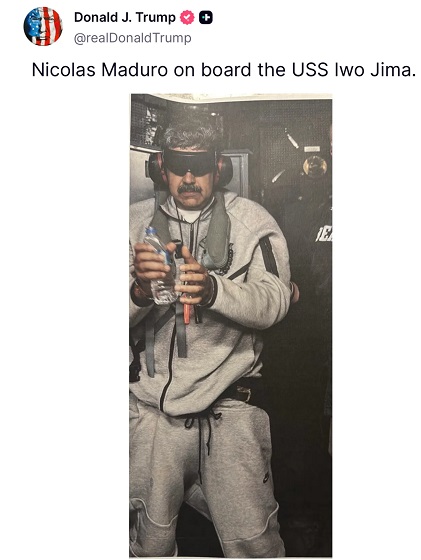
US Justice Department Accusing Maduro’s Inner Circle of a Narco-State Conspiracy
-
 Daily Caller1 day ago
Trump Says US Going To Run Venezuela After Nabbing Maduro
-
International2 days ago
U.S. Claims Western Hemispheric Domination, Denies Russia Security Interests On Its Own Border
-
 Business1 day ago
Virtue-signalling devotion to reconciliation will not end well
-
International2 days ago
“It’s Not Freedom — It’s the First Step Toward Freedom”
-
 Opinion1 day ago
Hell freezes over, CTV’s fabrication of fake news and our 2026 forecast is still searching for sunshine