
Alberta
Introducing Neil MacDonald’s HOMEGROWN and a feature on Canadian gem Mike Plume


At Todayville we welcome guests to our platform to help entertain and enlighten our readers on a host of topics. In this article we welcome Neil MacDonald. An accomplished musician in his own right, Neil has been part of Edmonton’s music scene for many years. He’s also shared the stage with some of our best and most-beloved Canadian artists. Neil has decided he’d like to use some of his time during isolation to promote artists from the region. Watch for Neil’s articles over the coming weeks.

In the meantime, I’m going to kick this off. Today of course, the music industry is being decimated. Live venues, concerts, festivals, even busking – they’re the lifeblood of musicians and virtually everything is cancelled for the foreseeable future. While we are in this funk it’s hard to imagine a world with live music venues filled with your favourite artists. But maybe we can use this time to learn more about the great artists that we don’t hear everyday on the radio, but who create amazing music and tell unique Canadian Stories.
So while we are all sitting around in isolation and waiting for Neil to pen some stories, I thought I’d feature an artist that I’ve been familiar with for a long time, but really lost touch with. While Neil and I were talking about some of the artists that he could feature, he reminded me of his friend Mike Plume and how Mike is the perfect example of the kind of artist Neil feels should get more attention and appreciation.
Here’s a bit of what I’ve learned about Mike Plume.

Mike Plume was born in Moncton, New Brunswick in 1968, or as he says “… in the year of the White Album.”
Mike was born in Moncton, New Brunswick in 1968, or as he says “… in the year of the White Album.”
A fixture around Edmonton for a long time. he’s been living in Nashville and touring for many years. Now back in our city, he signed a record deal with Edmonton’s Royalty Records last last year and is getting set to release a new 10 track album entitled Lonesome Stretch of Highway. You can stream a couple of tracks from the new album here.
While we wait for the new release, watch a favourite of mine called 8:30 Newfoundland. You’ll like the nod to one of Canada’s most-enduring earworms … the Hinterland Who’s Who.
Here is a great rundown of Mike’s career and story from his Facebook page. Reading through this, you will realize how much you’ve missed if you don’t know who Mike Plume is.
This tribute to Stompin’ Tom Connors was written in mere hours Stompin after Connors’ death in 2013. Mike was invited to perform it at Connors’ funeral.
“Writing a song is like building a chair,” says Mike Plume. “You can build one in about 5 minutes, and you can sit on it, but you might get splinters. I can write a song in 5 minutes, but by the time I think it’s done it could be a year and a half. I just keep running my hand over it, to see where I get the splinters.”
Produced by 6 time Grammy winner, Brent Maher, who has produced numerous multiplatinum artists ranging from The Judds to Johnny Reid (with Elvis, Ike and Tina, Kenny Rogers and more in between) and Grammy winning engineer, Charles Yingling in Nashville’s Blue Room Studios, 8:30 Newfoundland is the Moncton born, Bonnyville bred songwriter’s first record with the Mike Plume Band since 2001. Equal parts down home folk and raw country stomp, 8:30 Newfoundland cover a lot of years and a lot of miles: from ‘Norman Wells to The Rock’ on the title track and lead single; from late winter games of shinny on a frozen Alberta pond, where ‘the season never ended’ on More Than a Game; from the highways out of town where dreams begin, on Free, to back roads leading nowhere, where people who’s dreams have died go to heal in peace.
But no matter how far 8:30 Newfoundland takes you, Plume’s unrelenting optimism and forthright delivery tie it all together with an authenticity that comes from the kind of hard won truths and lyrical details you’d never be able to remember – let alone put on paper – if you hadn’t been there, in the flesh, living every word of every line. Even still, for Plume to come to some of those truths in his own mind, it took distance and time.
The day of their release the Band listened to 9/11 unfold on the BBC while driving to a gig in Bournemouth, UK.
“It took a year and a half to write most of these songs.” Like “This is our Home (8:30 Newfoundland)”, he says, co-written with Road Hammer, Jason McCoy. “I couldn’t have written that song if I was living in Canada. I had to be homesick. I had to get away from everything to realize just how great our home is.”
“We wrote the first verse and chorus in 10 minutes, in 2006. For 16 months, every time I was walking my dogs, I’d visit that melody and come up with more lyrics. I could’ve finished it in an hour, but I’m not sure it would have ended up being the song that it turned into.”
A recent review of the title track by FYI Music contributor Bob Segarini quotes “I love songs like this. The thought that goes into the lyrics alone gives me a headache, they are so well thought out…First of all, the country element is in the lyric…A down-home name-check of just about every well known place in Canada, and an overall homage to our home and native land. Then you’ve got a fairly roots-y reading by the musicians, complete with an Al Kooper-esque Hammond organ part swirling in the background, and finally, a vocal that sounds eerily like John Mellencamp channeling a 20 year old Bob Dylan, with a bit of mid-period, ‘country honk’ Rolling Stones looseness thrown in for good measure. Hear this one enough times, and it’ll cause you to buy a used ‘58 corvette ragtop, grab a map of Canada, and hit the road. It also makes me want to drink beer…”
Truth be told, he didn’t know if it would turn into anything. Then again, when he first formed the Mike Plume Band in the mid ‘90’s he couldn’t be sure that would turn into anything either. In fact, up to that point, he had every reason to think exactly the opposite. “I was fired from every band I’ve ever been in except this one, and if this wasn’t called The Mike Plume Band, I would have been canned years ago.”

In 1994, on the heels of his debut, Songs from a Northern Town, Plume and his band hit the road hard, playing 200-250 one-nighters a year, and releasing two records in one year, in 1997, Song and Dance Man, and Simplify. The former sold more than 10,000 copies offstage along the way through Europe, the US and Canada.
In the end, though, it was Plume, not his band, who pulled the plug. Unlike a song, the road’s rough patches don’t get any smoother, no matter how often you go over them, and Plume has gone over them more often than most. Eventually, inevitably, some of those rough edges began to wear on him
The beginning of the end, Plume says, came four years later, after the release of the band’s last record, Fools for the Radio. “It was originally supposed to come out May 1st. Then we had a big ‘meeting of the minds’ and they said, ‘Know what, May 1st isn’t a good date – we pick September 11, 2001’.”
The day of their release the Band listened to 9/11 unfold on the BBC while driving to a gig in Bournemouth, UK. Rather than pack it in they kept right on driving. But fifteen months later Plume hopped out of the van in Boston to check into their rooms for the night, heard the screech of the tires and realized two things simultaneously. First, that he’d left the van in drive, and second, that it was time he put himself in park for a while. After six records, eight years, and over 1200 shows across Canada, The United States and Europe, Plume decided to put down roots and find out what it was like to live in a town for more than 12 hours at a time.
“It’s a grass is always greener thing,” he says. “After every gig I’d get behind the wheel at 2 AM and drive ‘til 10. At sunrise, when you’re driving through a town, you start seeing the lights in houses coming on. In your head, you picture the guy shuffling around the kitchen, making a pot of coffee, kissing his wife and heading the kids off to school. And I would just think I would give anything to be that guy right now. So now I’m that guy. I wouldn’t trade it for anything. Music is what I do, but being married and having a kid is who I am. It took me a long time to figure that out.”
While the band continued to tour and record under the name The Populars, Plume, newly married and living in Nashville, put out two records on his own before putting down his guitar for good, he thought, in 2003, and moved back to Canada.
Three years later, during a visit to Tennessee, Plume picked up right where he’d left off. “While I was gone, everybody I’d written with had #1 songs, and I thought, Jesus, maybe I shouldn’t have left town when I did.” After hooking up with some old friends to pen a few songs while he was in town he landed a publishing deal with Moraine Music and got to thinking that maybe, just maybe, he was missing something.
Relocating to Nashville once again in 2006, Plume soon made up for lost time: writing with the likes of country legend Guy Clark, landing a gig as the voice of the Chevy Silverado, and, recently, turning a small ‘School of Rock’ style music program he originated in Parry Sound, into a national program for Tim Hortons’ Children’s Camps.
Along the way he discovered that he can put down his guitar and his dreams whenever he needs to, and pick them right back up again whenever he wants. And that the good old days, far from being hollow echoes of past glories and fading memories, happen all the time. As he sings on Like a Bullet From a Gun, when you’re ‘looking back at the good old days, ten years from now that’ll be today’. “That’s my favourite line on the record,” Plume says. “When you turn 50, you’re gonna wish that you were turning 40, so why not be envious of your position right now?”
With that spirit in mind, when a European agent called to float the idea of reuniting Plume and his old band for a tour, one thing led to another. Though the tour never happened, once Plume started writing songs again he couldn’t stop. “Before we went in to record 8:30 Newfoundland the guys and I hadn’t played together in four years. They came to Nashville, I counted them in, and we just fell into it.” “Somehow we’d all found our own definition of happiness and making music together again was the common denominator.”
“It’s how you go about your day in the face of the inevitable, you know? It’s all about making a decision in how you want to live your life” Plume says. “To quote Shawshank Redemption… ‘(you gotta) get busy living or get busy dying.’”
“Or another lyric from “Like A Bullet From A Gun”.”These good old days happen all the time. And you know what? They do happen all the time, we just have to remind ourselves that they are and that the cup is half full and it always is.”
Watch for Neil’s articles promoting other amazing musicians and songwriters in the upcoming weeks.
Click to read more stories on Todayville Edmonton.


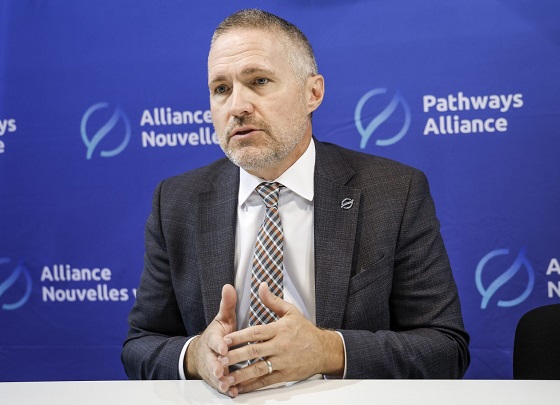
Pathways Alliance CEO Kendall Dilling is interviewed at the World Petroleum Congress in Calgary, Monday, Sept. 18, 2023.THE CANADIAN PRESS/Jeff McIntosh
From Resource Works
Carbon capture gives biggest bang for carbon tax buck CCS much cheaper than fuel switching: report
Canada’s climate change strategy is now joined at the hip to a pipeline. Two pipelines, actually — one for oil, one for carbon dioxide.
The MOU signed between Ottawa and Alberta two weeks ago ties a new oil pipeline to the Pathways Alliance, which includes what has been billed as the largest carbon capture proposal in the world.
One cannot proceed without the other. It’s quite possible neither will proceed.
The timing for multi-billion dollar carbon capture projects in general may be off, given the retreat we are now seeing from industry and government on decarbonization, especially in the U.S., our biggest energy customer and competitor.
But if the public, industry and our governments still think getting Canada’s GHG emissions down is a priority, decarbonizing Alberta oil, gas and heavy industry through CCS promises to be the most cost-effective technology approach.
New modelling by Clean Prosperity, a climate policy organization, finds large-scale carbon capture gets the biggest bang for the carbon tax buck.
Which makes sense. If oil and gas production in Alberta is Canada’s single largest emitter of CO2 and methane, it stands to reason that methane abatement and sequestering CO2 from oil and gas production is where the biggest gains are to be had.
A number of CCS projects are already in operation in Alberta, including Shell’s Quest project, which captures about 1 million tonnes of CO2 annually from the Scotford upgrader.
What is CO2 worth?
Clean Prosperity estimates industrial carbon pricing of $130 to $150 per tonne in Alberta and CCS could result in $90 billion in investment and 70 megatons (MT) annually of GHG abatement or sequestration. The lion’s share of that would come from CCS.
To put that in perspective, 70 MT is 10% of Canada’s total GHG emissions (694 MT).
The report cautions that these estimates are “hypothetical” and gives no timelines.
All of the main policy tools recommended by Clean Prosperity to achieve these GHG reductions are contained in the Ottawa-Alberta MOU.
One important policy in the MOU includes enhanced oil recovery (EOR), in which CO2 is injected into older conventional oil wells to increase output. While this increases oil production, it also sequesters large amounts of CO2.
Under Trudeau era policies, EOR was excluded from federal CCS tax credits. The MOU extends credits and other incentives to EOR, which improves the value proposition for carbon capture.
Under the MOU, Alberta agrees to raise its industrial carbon pricing from the current $95 per tonne to a minimum of $130 per tonne under its TIER system (Technology Innovation and Emission Reduction).
The biggest bang for the buck
Using a price of $130 to $150 per tonne, Clean Prosperity looked at two main pathways to GHG reductions: fuel switching in the power sector and CCS.
Fuel switching would involve replacing natural gas power generation with renewables, nuclear power, renewable natural gas or hydrogen.
“We calculated that fuel switching is more expensive,” Brendan Frank, director of policy and strategy for Clean Prosperity, told me.
Achieving the same GHG reductions through fuel switching would require industrial carbon prices of $300 to $1,000 per tonne, Frank said.
Clean Prosperity looked at five big sectoral emitters: oil and gas extraction, chemical manufacturing, pipeline transportation, petroleum refining, and cement manufacturing.
“We find that CCUS represents the largest opportunity for meaningful, cost-effective emissions reductions across five sectors,” the report states.

Fuel switching requires higher carbon prices than CCUS.
Measures like energy efficiency and methane abatement are included in Clean Prosperity’s calculations, but again CCS takes the biggest bite out of Alberta’s GHGs.
“Efficiency and (methane) abatement are a portion of it, but it’s a fairly small slice,” Frank said. “The overwhelming majority of it is in carbon capture.”

From left, Alberta Minister of Energy Marg McCuaig-Boyd, Shell Canada President Lorraine Mitchelmore, CEO of Royal Dutch Shell Ben van Beurden, Marathon Oil Executive Brian Maynard, Shell ER Manager, Stephen Velthuizen, and British High Commissioner to Canada Howard Drake open the valve to the Quest carbon capture and storage facility in Fort Saskatchewan Alta, on Friday November 6, 2015. Quest is designed to capture and safely store more than one million tonnes of CO2 each year an equivalent to the emissions from about 250,000 cars. THE CANADIAN PRESS/Jason Franson
Credit where credit is due
Setting an industrial carbon price is one thing. Putting it into effect through a workable carbon credit market is another.
“A high headline price is meaningless without higher credit prices,” the report states.
“TIER credit prices have declined steadily since 2023 and traded below $20 per tonne as of November 2025. With credit prices this low, the $95 per tonne headline price has a negligible effect on investment decisions and carbon markets will not drive CCUS deployment or fuel switching.”
Clean Prosperity recommends a kind of government-backstopped insurance mechanism guaranteeing carbon credit prices, which could otherwise be vulnerable to political and market vagaries.
Specifically, it recommends carbon contracts for difference (CCfD).
“A straight-forward way to think about it is insurance,” Frank explains.
Carbon credit prices are vulnerable to risks, including “stroke-of-pen risks,” in which governments change or cancel price schedules. There are also market risks.
CCfDs are contractual agreements between the private sector and government that guarantees a specific credit value over a specified time period.
“The private actor basically has insurance that the credits they’ll generate, as a result of making whatever low-carbon investment they’re after, will get a certain amount of revenue,” Frank said. “That certainty is enough to, in our view, unlock a lot of these projects.”
From the perspective of Canadian CCS equipment manufacturers like Vancouver’s Svante, there is one policy piece still missing from the MOU: eligibility for the Clean Technology Manufacturing (CTM) Investment tax credit.
“Carbon capture was left out of that,” said Svante co-founder Brett Henkel said.
Svante recently built a major manufacturing plant in Burnaby for its carbon capture filters and machines, with many of its prospective customers expected to be in the U.S.
The $20 billion Pathways project could be a huge boon for Canadian companies like Svante and Calgary’s Entropy. But there is fear Canadian CCS equipment manufacturers could be shut out of the project.
“If the oil sands companies put out for a bid all this equipment that’s needed, it is highly likely that a lot of that equipment is sourced outside of Canada, because the support for Canadian manufacturing is not there,” Henkel said.
Henkel hopes to see CCS manufacturing added to the eligibility for the CTM investment tax credit.
“To really build this eco-system in Canada and to support the Pathways Alliance project, we need that amendment to happen.”
Resource Works News

From the Canadian Energy Centre
Canada’s energy landscape changed significantly in 2025, with mounting U.S. economic pressures reinforcing the central role oil and gas can play in safeguarding the country’s independence.
Here are the Canadian Energy Centre’s top five most-viewed stories of the year.
5. Alberta’s massive oil and gas reserves keep growing – here’s why

The Northern Lights, aurora borealis, make an appearance over pumpjacks near Cremona, Alta., Thursday, Oct. 10, 2024. CP Images photo
Analysis commissioned this spring by the Alberta Energy Regulator increased the province’s natural gas reserves by more than 400 per cent, bumping Canada into the global top 10.
Even with record production, Alberta’s oil reserves – already fourth in the world – also increased by seven billion barrels.
According to McDaniel & Associates, which conducted the report, these reserves are likely to become increasingly important as global demand continues to rise and there is limited production growth from other sources, including the United States.
4. Canada’s pipeline builders ready to get to work

Photo courtesy Coastal GasLink
Canada could be on the cusp of a “golden age” for building major energy projects, said Kevin O’Donnell, executive director of the Mississauga, Ont.-based Pipe Line Contractors Association of Canada.
That eagerness is shared by the Edmonton-based Progressive Contractors Association of Canada (PCA), which launched a “Let’s Get Building” advocacy campaign urging all Canadian politicians to focus on getting major projects built.
“The sooner these nation-building projects get underway, the sooner Canadians reap the rewards through new trading partnerships, good jobs and a more stable economy,” said PCA chief executive Paul de Jong.
3. New Canadian oil and gas pipelines a $38 billion missed opportunity, says Montreal Economic Institute

Steel pipe in storage for the Trans Mountain Pipeline expansion in 2022. Photo courtesy Trans Mountain Corporation
In March, a report by the Montreal Economic Institute (MEI) underscored the economic opportunity of Canada building new pipeline export capacity.
MEI found that if the proposed Energy East and Gazoduq/GNL Quebec projects had been built, Canada would have been able to export $38 billion worth of oil and gas to non-U.S. destinations in 2024.
“We would be able to have more prosperity for Canada, more revenue for governments because they collect royalties that go to government programs,” said MEI senior policy analyst Gabriel Giguère.
“I believe everybody’s winning with these kinds of infrastructure projects.”
2. Keyera ‘Canadianizes’ natural gas liquids with $5.15 billion acquisition

Keyera Corp.’s natural gas liquids facilities in Fort Saskatchewan, Alta. Photo courtesy Keyera Corp.
In June, Keyera Corp. announced a $5.15 billion deal to acquire the majority of Plains American Pipelines LLP’s Canadian natural gas liquids (NGL) business, creating a cross-Canada NGL corridor that includes a storage hub in Sarnia, Ontario.
The acquisition will connect NGLs from the growing Montney and Duvernay plays in Alberta and B.C. to markets in central Canada and the eastern U.S. seaboard.
“Having a Canadian source for natural gas would be our preference,” said Sarnia mayor Mike Bradley.
“We see Keyera’s acquisition as strengthening our region as an energy hub.”
1. Explained: Why Canadian oil is so important to the United States

Enbridge’s Cheecham Terminal near Fort McMurray, Alberta is a key oil storage hub that moves light and heavy crude along the Enbridge network. Photo courtesy Enbridge
The United States has become the world’s largest oil producer, but its reliance on oil imports from Canada has never been higher.
Many refineries in the United States are specifically designed to process heavy oil, primarily in the U.S. Midwest and U.S. Gulf Coast.
According to the Alberta Petroleum Marketing Commission, the top five U.S. refineries running the most Alberta crude are:
- Marathon Petroleum, Robinson, Illinois (100% Alberta crude)
- Exxon Mobil, Joliet, Illinois (96% Alberta crude)
- CHS Inc., Laurel, Montana (95% Alberta crude)
- Phillips 66, Billings, Montana (92% Alberta crude)
- Citgo, Lemont, Illinois (78% Alberta crude)

Georgia county admits illegally certifying 315k ballots in 2020 presidential election

Alberta Next Panel calls to reform how Canada works

Canadian government launches trial version of digital ID for certain licenses, permits

End Supply Management—For the Sake of Canadian Consumers
-
International16 hours ago
Georgia county admits illegally certifying 315k ballots in 2020 presidential election
-
 Business2 days ago
ICYMI: Largest fraud in US history? Independent Journalist visits numerous daycare centres with no children, revealing massive scam
-
Alberta1 day ago
Alberta project would be “the biggest carbon capture and storage project in the world”
-
 Energy1 day ago
Canada’s debate on energy levelled up in 2025
-
 Haultain Research18 hours ago
Sweden Fixed What Canada Won’t Even Name
-
 Business17 hours ago
What Do Loyalty Rewards Programs Cost Us?
-
 Business1 day ago
Socialism vs. Capitalism
-
 Energy1 day ago
New Poll Shows Ontarians See Oil & Gas as Key to Jobs, Economy, and Trade