Connect with us

International

Evacuations urged in Tampa Bay ahead of Hurricane Milton

Published

4 minute read

From The Center Square

By 

“We’re talking about storm surge values higher than the ceiling,”  “Please, if you’re in the Tampa Bay area, you need to evacuate.”

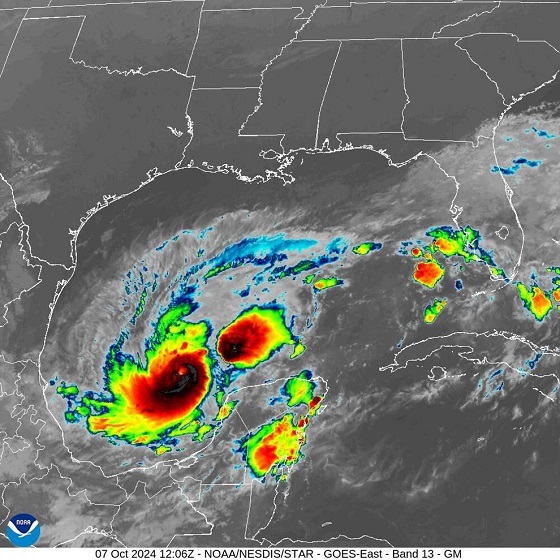
Florida residents in and near Tampa Bay are strongly urged to evacuate ahead of Hurricane Milton, a Category 5 storm that could increase its intensity.

In the Atlantic Basin, Milton at 18 hours is the second-fastest storm to go from Category 1 to 5. Wilma in 2005 needed just 12. Milton’s maximum sustained winds measured Monday morning were 160 mph.

Florida Division of Emergency Management Director Kevin Guthrie in Tallahassee on Monday said the ceilings in the state’s emergency operations center were 10 feet, 8 inches tall. The surge forecast for Tampa Bay from the National Hurricane Center is from 8 to 12 feet.

“We’re talking about storm surge values higher than the ceiling,” Guthrie said. “Please, if you’re in the Tampa Bay area, you need to evacuate. If they have called for your evacuation order, I beg you, I implore you, to evacuate. Drowning deaths due to storm surge are 100% preventable if you leave. We had situations where people died of drowning in Hurricane Ian. Had they just gone across the bridge from Estero Bay, Sanibel Island and so on, just across the bridge to the first available shelter that had capacity, they’d still be alive today.”

According to the National Hurricane Center’s 8 a.m. advisory, the storm is packing winds of 160 mph and is predicted to make landfall on the Gulf Coast of Florida either Wednesday night or Thursday morning. If the storm continues to intensify, it could become a Category 5 storm.

Hurricane Helene landed in the Big Bend region on Sept. 26. While Florida took a wallop, the remnants did the most severe damage in the mountains of North Carolina and Tennessee. At 236, the death toll is fourth most from a hurricane in America since 1950.

Gov. Ron DeSantis discussed Hurricane Helene debris removal from the Tampa Bay area after workers found one of the gates locked and unmanned at the Pinellas County landfall despite the two-term Republican’s executive order that required landfills to remain open 24 hours to accept wreckage.

The Florida Highway Patrol, according to DeSantis, “took matters into their own hands,” fastened some rope to the gate and ripped it open so trucks carrying debris could dump their cargo there. He said crews already hauled 500 truckloads with 9,000 cubic yards of Helene debris from the barrier islands in Pinellas County and 180,000 cubic yards statewide.

“We need as much of this debris picked up as possible, this creates a safety hazard, and it also will increase the damage that Milton could do with flying debris,” DeSantis said. “All local entities should comply with this order and work around the clock to accomplish this mission. We don’t have time for bureaucracy and red tape.”

DeSantis said 800 National Guardsmen have been activated for debris removal in coastal areas affected by Helene, with 5,000 already on duty and 3,000 mobilized prior to Milton’s landfall. He also said the state suspended all tolls in west and central Florida such as the tolled part of Interstate 75 known as Alligator Alley, which connects Naples on the Gulf Coast with Fort Lauderdale on the Atlantic Coast.

DeSantis issued an emergency declaration on Saturday for Alachua, Baker, Bradford, Brevard, Broward, Charlotte, Citrus, Clay, Collier, Columbia, DeSoto, Dixie, Duval, Flagler, Gilchrist, Glades, Hamilton, Hardee, Hendry, Hernando, Highlands, Hillsborough, Indian River, Lafayette, Lake, Lee, Levy, Madison, Manatee, Marion, Martin, Miami-Dade, Monroe, Nassau, Okeechobee, Orange, Osceola, Palm Beach, Pasco, Pinellas, Polk, Putnam, Sarasota, Seminole, St. Johns, St. Lucie Sumter, Suwanee, Taylor, Union and Volusia counties.

Todayville is a digital media and technology company. We profile unique stories and events in our community. Register and promote your community event for free.

Follow Author

Daily Caller

US Supreme Court Has Chance To End Climate Lawfare

Published on


From the Daily Caller News Foundation

By David Blackmon

All eyes will be on the Supreme Court later this week when the justices conference on Friday to decide whether to grant a petition for writ of certiorari on a high-stakes climate lawsuit out of Colorado. The case is a part of the long-running lawfare campaign seeking to extract billions of dollars in jury awards from oil companies on claims of nebulous damages caused by carbon emissions.

In Suncor Energy (U.S.A.) Inc., et al. v. County Commissioners of Boulder County, major American energy companies are asking the Supreme Court to decide whether federal law precludes state law nuisance claims targeting interstate and global emissions. This comes as the City and County of Boulder, Colo. sued a long list of energy companies under Colorado state nuisance law for alleged impacts from global climate change.

The Colorado Supreme Court allowed a lower state trial court decision to go through, improbably finding that federal law did not preempt state law claims. The central question hangs on whether the federal Clean Air Act (CAA) preempts state common law public nuisance claims related to the regulation of carbon emissions. In this case, as in at least 10 other cases that have been decided in favor of the defendant companies, the CAA clearly does preempt Colorado law. It seems inevitable that the Supreme Court, if it grants the cert petition, would make the same ruling.

Dear Readers:

As a nonprofit, we are dependent on the generosity of our readers.

Please consider making a small donation of any amount here.

Thank you!

Such a finding by the Supreme Court would reinforce a 2021 ruling by the Second Circuit Appeals Court that also upheld this longstanding principle of federal law. In City of New York v. Chevron Corp. (2021), the Second Circuit ruled that municipalities may not use state tort law to hold multinational companies liable for climate damages, since global warming is a uniquely international concern that touches upon issues of federalism and foreign policy. Consequently, the court called for the explicit application of federal common law, with the CAA granting the Environmental Protection Agency – not federal courts – the authority to regulate domestic greenhouse gas emissions. This Supreme Court, with its 6-3 conservative majority, should weigh in here and find in the same way.

Boulder-associated attorneys have become increasingly open to acknowledging the judicial lawfare inherent in their case, as they try to supplant federal regulatory jurisdiction with litigation meant to force higher energy prices rise for consumers. David Bookbinder, an environmental lawyer associated with the Boulder legal team, said the quiet part out loud in a recent Federalist Society webinar titled “Can State Courts Set Global Climate Policy. “Tort liability is an indirect carbon tax,” Bookbinder stated plainly. “You sue an oil company, an oil company is liable. The oil company then passes that liability on to the people who are buying its products … The people who buy those products are now going to be paying for the cost imposed by those products.”

Oh.

While Bookbinder recently distanced himself from the case, no notice of withdrawal had appeared in the court’s records as of this writing. Bookbinder also writes that “Gas prices and climate change policy have become political footballs because neither party in Congress has had the courage to stand up to the oil and gas lobby. Both sides fear the spin machine, so consumers get stuck paying the bill.”

Let’s be honest: The “spin machine” works in all directions. Make no mistake about it, consumers are already getting stuck paying the bill related to this long running lawfare campaign even though the defendants have repeatedly been found not to be liable in case after case. The many millions of dollars in needless legal costs sustained by the dozens of defendants named in these cases ultimately get passed to consumers via higher energy costs. This isn’t some evil conspiracy by the oil companies: It is Business Management 101.

Because the climate alarm lobby hasn’t been able to force its long-sought national carbon tax through the legislative process, sympathetic activists and plaintiff firms now pursue this backdoor effort in the nation’s courts. But their problem is that the law on this is crystal clear, and it is long past time for the Supreme Court to step in and put a stop to this serial abuse of the system.

David Blackmon is an energy writer and consultant based in Texas. He spent 40 years in the oil and gas business, where he specialized in public policy and communications.

Continue Reading

Crime

U.S. seizes Cuba-bound ship with illicit Iranian oil history

Published on

MXM logo MxM News

President Trump revealed Wednesday afternoon that U.S. authorities intercepted a Cuba-bound oil tanker off the Venezuelan coast, a dramatic move aimed at tightening the squeeze on illicit oil networks operating throughout the region. Speaking to reporters at the White House, Trump described the vessel as “a very large tanker — the largest one ever seized in action,” hinting that more developments are coming. He declined to get into specifics, saying only that the operation happened “for a very good reason.” When asked about the tanker’s crude, Trump didn’t overcomplicate it. “Well, we keep it, I guess,” he said.

According to a U.S. official familiar with the operation, the seizure was executed by the Coast Guard with support from the U.S. Navy after a federal judge green-lit the warrant roughly two weeks ago. Another official told the New York Times the ship — identified as the Skipper — had been sailing under a falsified flag and has a documented history of trafficking illicit Iranian oil. The vessel, although carrying Venezuelan crude at the time, was seized because of those Iranian smuggling ties, not because of any direct connection to Nicolás Maduro’s regime.

Vanguard, a UK-based maritime risk firm, confirmed Wednesday that the Skipper fits the profile of a tanker previously sanctioned by the United States for operating under the alias Adisa while moving banned Iranian oil. A source speaking to Politico said the ship was on its way to Cuba, where state-run Cubametales intended to flip the cargo to Asian brokers — an increasingly common workaround as U.S. sanctions isolate both Havana and Caracas from traditional buyers. With most Venezuelan product now flowing to China under the sanctions regime, oil traders began recalibrating almost immediately after the news broke. Prices ticked upward modestly as markets waited to learn whether any Venezuelan crude was on board and how much would be effectively taken off the table.

Maduro, for his part, avoided directly mentioning the seizure during a speech later Wednesday, instead railing against the United States and claiming Venezuela’s military stands ready “to break the teeth of the North American empire, if necessary.” His bluster did little to obscure the reality: the Trump administration just disrupted yet another shadowy oil operation linking Caracas, Havana, and Tehran — and sent a clear signal that these networks will be confronted, tanker by tanker.

Continue Reading

Trending

X