
Calgary
Threat or Opportunity? The Pending TRILLION Dollar Wealth Transfer


By Perry Kinkaide, MSc, PhD, CMC – Kinkaide Enterprises Inc.

Winning a lottery can have tragic results.
Millennials and charities may not realize they are about to win a lottery, arguably the most monumental economic, political, and social event of the 21st century.
It will be the largest, broadest, deepest intergenerational transfer of wealth in history: the transfer of $trillions of wealth accumulated by babyboomers as they retire and expire. I’ve been tracking and alerting others to the associated threats and opportunities, namely: financial planners and high-wealth people, government and early-stage entrepreneurs.
Some millennials are already anticipating and pre-spending their inheritance. Most are not!
Hence, the boom underway of financial planners, new investment services, and government’s interest in how to access private capital. What has not been discussed in any depth is the impact of the wealth transfer on innovation and public services such as health and education.
The impact is expected to be profound and should be stirring a public policy discussion engaging those expecting more or less from governments.
Since the end of WWII, we’ve seen an extraordinary growth of government at all levels. Yet, debt worldwide is in the $trillions. The runup of budgets and services has contributed to an increasing sense of entitlement financed by increasing taxes on the wealthy, growing middle class, and debt financing.
Elected officials with access to “free money” have transitioned government and the public to expect “public” service for “free”. Governments have been getting elected on special interest giveaways, pandering to ever more powerful public-sector unions and professions, and blaming billionaires and corporate job creators if the public coffers are empty. The growth of public debt has been unrestrained. But why worry – the economy has been growing? Debt is under control as a portion of growing GDP and interest rates for serving debt are low. But…
A reckoning for this transfer of wealth is unavoidable
The reckoning will be triggered NOT by a crisis but by the huge transfer of $trillions by retiring and expiring babyboomers. The pending transfer should hardly be a surprise given the extraordinary economic boom and accumulation of wealth by middle-class babyboomers since their post-WWII birth. While the event can hardly be surprising, features of the event are SHOCKING and contributing to the reckoning.
Consider:
1. $Trillions are to be transferred. Recent estimates are that $68T – yes trillion US, will be transferred to millennials as babyboomers retire and expire. This number equates to $8.5T Cdn for Canada. It’s a once-in-a-career opportunity for financial planners. Some have speculated that the familiarity of millennials with technology may be good news for fintech including contemporary bitcoin solutions and cryptocurrencies
2. The transfer and its impact will hit quickly. Aging of the population is not smooth. Birthrates climbed rapidly after WWII creating a spike in their proportion of the population. The spike gives the financial industry little time to prepare for increasing usage of automated, self-help, on-line investing.
3. The transfer of wealth should increase the availability of private capital increasing economic activity: stirring innovation and job creation, exports and community enterprise. Economies most likely to gain will be those with a mature innovation ecosystem supporting survival, growth, and retention of innovation. Note. Fraud may also increase as regulators have difficulty keeping up with creative financing options.
4. Baby boomers were the source of demand for public services that continues to rise. Yet, the capacity to sustain the financing of public services through taxation is expected to drop sharply as taxpaying babyboomers retire and expire. The impact would be mitigated IF the wealth transfer were to stir taxable economic activity.
5. The size and aging of the babyboomer market sustain interest in “public” service delivery where health and education dominate government expenditures. These public services also constitute significant sources of employment.
Current levels of service cannot be sustained when babyboomers retire and expire: a) removing them as employees from the workforce, b) reducing demand for client services, and c) reducing the number of taxpayers for financing public services.
6. Babyboomers have fueled North America’s consumer economy. Markets MUST adapt quickly. Technology is more familiar and acceptable to millennials as the recipient of the wealth transfer. Institutional distrust and data accessibility are enabling the personalization of services and products in virtually every service sector.
7. Accumulation of public debt is crushing. Low-interest rates have continued to fuel the growth of public and private sector debt. ANY increase in interest rates and/or a sustained decline in tax revenues would shock public services.
I’ll pull no punches here and tell it as it is.
The debate must begin in anticipation of the looming tsunami. The good news is that the private sector is investing in technologies to accommodate and benefit from the transition and release of accumulated wealth. The bad news is that the public sector wants to sustain the status quo as it is dominated by beholden professionals with few schooled in transition management. Most claiming management status are really administrators – sustaining the profession.
What is needed to prepare?
1. Millennials need financial planning and their offspring need financial literacy. Without a plan, most will take their inheritance as an opportunity to spend, save or invest, driving a short term consumption boom and consequent hangover.
2. Banks will face increased pressure to accommodate the rise in usage of on-line investing, usage of cryptocurrencies, and other innovations in fintech.
3. Knowledge and technology seek a vacuum. Data is fueling the adoption of machine learning and artificial intelligence throughout the economy, necessary to accommodate a shrinking workforce.
4. Governments must rationalize social service standards and/or facilitate their personalization. Innovations in medicine and healthcare and the associated deinstitutionalization must be priorities.
5. As for education, it too must move beyond government as rapid increases in knowledge make lifelong learning necessary. Deinstitutionalization and innovation become essential for supporting service personalization.
6. Professions need relational skills and lifelong learning to complement their role as aides to consumer designed technologies.
7. Governments with any conscience must prepare for the crisis as an opportunity to give the client consumer status. This means personalizing public services: a) monitoring service satisfaction, b) incentivizing innovation contributing to service personalization, c) training and recruiting managers as change agents while d) maintaining public service insurance for the truly disadvantaged.
8. Collaboration among all stakeholders to increase productivity within industry.
9. Recognition that the humanities MUST guide any technology-driven transition thus calling for arts and science, humanities and technology, to work together.
If you’ve read this far, and are breathless, angry, or in denial…then consider the alternative.
Should governments sense that the public in a democracy can’t accommodate the anticipated shocks of a huge wealth transfer and free-spending, market-driven millennial, then government may step in and mitigate. How?
Mitigation may come by reducing the impact of the “free money” wealth transfer by reducing the buying power of millennials.
Do We Need a Wealth Transfer Tax?
This could be done by introducing a wealth transfer tax arguing that the new tax is dedicated to paying down the public debt accumulated while serving the former babyboomer generation. The downside of such intervention is that such measures will impede a critical improvement in productivity and the competitiveness of the affected economies.
Some governments may even declare innovation as a priority so as to preserve public services. Governments are already recognizing that technologies – such as AI, have the potential to dislocate expensive knowledge workers and address: a) increasing demand for service and it’s personalization, b) increased entrepreneurship and global enterprise, and c) a decline in the supply of social service resources. The policy of increased “innovation” typically fails in public services unless introduced with adequate resolve to confront institutionalized professional resistance and the drive/ culture to maintain the status quo.
Regardless – as no one knows the future, it is about time for Vision & Leadership, Creativity & Convergence.
It’s exciting to know that “free money” in the hands of the babyboomer’s offspring may be the very event to trigger an end to the 20th century’s assembly of “public” service supply and transition increase in the “personal” service market.
_________
Perry Kinkaide, MSc, PhD, CMC is the Founder and Past President of the Alberta Council of Technologies. He is the co-founder of several Alberta technology alliances for advancing cell therapy, cleantech, and fusion technology. He also previously served as the Managing Director of KPMG Consulting in Edmonton, Alta., and Assistant Deputy Minister with the Alberta government.
Produced with the assistance of the Government of Alberta, Alberta Media Fund



From LifeSiteNews
It is not yet clear if the flag motion applies to other flags, such as LGBT ones.
Western Canada’s largest city has put in place what amounts to a ban on politically charged flags from flying at city-owned buildings.
“Calgary’s Flag Policy means any country recognized by Canada may have their flag flown at City Hall on their national day,” said Calgary’s new mayor Jeromy Farkas on X last month.
“But national flag-raisings are now creating division. Next week, we’ll move to end national flag-raisings at City Hall to keep this a safe, welcoming space for all.”
The motion to ban foreign flags from flying at government buildings was introduced on December 15 by Calgary councilor Dan McLean and passed by a vote of 8 to 7. He had said the previous policy to allow non-Canadian flags to fly, under former woke mayor Jyoti Gondek, was “source of division within our community.”
“In recent months, this practice has been in use in ways that I’ve seen have inflamed tensions, including instances where flag raisings have been associated with anti-Semitic behavior and messaging,” McLean said during a recent council meeting.
The ban on flag raising came after the Palestinian flag was allowed to be raised at City Hall for the first time.
Farkas, shortly after being elected mayor in the fall of 2025, had promised that he wanted a new flag policy introduced in the city.
It is not yet clear if the flag motion applies to other flags, such as LGBT ones.
Despite Farkas putting forth the motion, as reported by LifeSiteNews he is very much in the pro-LGBT camp. However, he has promised to focus only on non-ideological issues during his term.
McLean urged that City Hall must be a place of “neutrality, unity, and respect” for everyone.
“When City Hall becomes a venue for geopolitical expressions, it places the city in the middle of conflicts that are well beyond our municipal mandates,” he said.
As reported by LifeSiteNews, other jurisdictions in Canada are considering banning non-Canadian flags from flying over public buildings.
Recently a political party in British Columbia, OneBC, introduced legislation to ban non-domestic government flags at public buildings in British Columbia.
Across Canada there has also been an ongoing issue with so-called “Pride” flags being raised at schools and city buildings.

From the Fraser Institute
By Tegan Hill and Austin Thompson
Calgary’s new mayor, Jeromy Farkas, has promised to scrap “blanket rezoning”—a policy enacted by the city in 2024 that allows homebuilders to construct duplexes, townhomes and fourplexes in most neighbourhoods without first seeking the blessing of city hall. In other words, amid an affordability crunch, Mayor Farkas plans to eliminate a policy that made homebuilding easier and cheaper—which risks reducing housing choices and increasing housing costs for Calgarian families.
Blanket rezoning was always contentious. Debate over the policy back in spring 2024 sparked the longest public hearing in Calgary’s history, with many Calgarians airing concerns about potential impacts on local infrastructure, parking availability and park space—all important issues.
Farkas argues that blanket rezoning amounts to “ignoring the community” and that Calgarians should not be forced to choose between a “City Hall that either stops building, or stops listening.” But in reality, it’s virtually impossible to promise more community input on housing decisions and build more homes faster.
If Farkas is serious about giving residents a “real say” in shaping their neighbourhood’s future, that means empowering them to alter—or even block—housing proposals that would otherwise be allowed under blanket rezoning. Greater public consultation tends to give an outsized voice to development opponents including individuals and groups that oppose higher density and social housing projects.
Alternatively, if the mayor and council reform the process to invite more public feedback, but still ultimately approve most higher-density projects (as was the case before blanket rezoning), the consultation process would be largely symbolic.
Either way, homebuilders would face longer costlier approval processes—and pass those costs on to Calgarian renters and homebuyers.
It’s not only the number of homes that matters, but also where they’re allowed to be built. Under blanket rezoning, builders can respond directly to the preferences of Calgarians. When buyers want duplexes in established neighbourhoods or renters want townhomes closer to work, homebuilders can respond without having to ask city hall for permission.
According to Mayor Farkas, higher-density housing should instead be concentrated near transit, schools and job centres, with the aim of “reducing pressure on established neighbourhoods.” At first glance, that may sound like a sensible compromise. But it rests on the flawed assumption that politicians and planners should decide where Calgarians are allowed to live, rather than letting Calgarians make those choices for themselves. With blanket rezoning, new homes are being built in areas in response to buyer and renter demand, rather than the dictates of city hall. The mayor also seems to suggest that city hall should thwart some redevelopment in established neighbourhoods, limiting housing options in places many Calgarians want to live.
The stakes are high. Calgary is not immune to Canada’s housing crisis, though it has so far weathered it better than most other major cities. That success partly reflects municipal policies—including blanket rezoning—that make homebuilding relatively quick and inexpensive.
A motion to repeal blanket rezoning is expected to be presented to Calgary’s municipal executive committee on Nov. 17. If it passes, which is likely, the policy will be put to a vote during a council meeting on Dec. 15. As the new mayor and council weigh changes to zoning rules, they should recognize the trade-offs. Empowering “the community” may sound appealing, but it may limit the housing choices available to families in those communities. Any reforms should preserve the best elements of blanket rezoning—its consistency, predictability and responsiveness to the housing preferences of Calgarians—and avoid erecting zoning barriers that have exacerbated the housing crisis in other cities.

Tegan Hill
Director, Alberta Policy, Fraser Institute

Austin Thompson


“Magnitude cannot be overstated”: Minnesota aid scam may reach $9 billion

Largest fraud in US history? Independent Journalist visits numerous daycare centres with no children, revealing massive scam
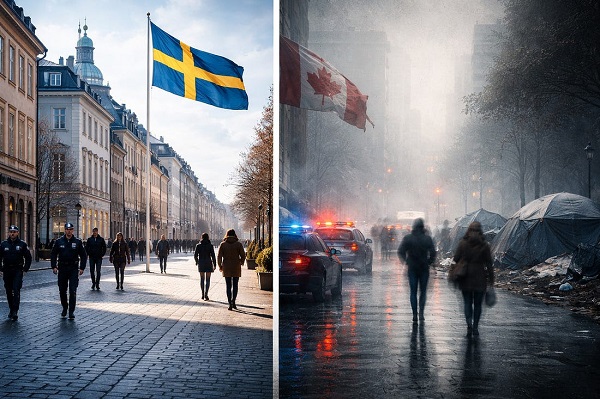
Sweden Fixed What Canada Won’t Even Name

US Under Secretary of State Slams UK and EU Over Online Speech Regulation, Announces Release of Files on Past Censorship Efforts

Socialism vs. Capitalism
Canada’s debate on energy levelled up in 2025

What Do Loyalty Rewards Programs Cost Us?
-
 Addictions2 days ago
Coffee, Nicotine, and the Politics of Acceptable Addiction
-
 Business1 day ago
How convenient: Minnesota day care reports break-in, records gone
-
 Business1 day ago
The great policy challenge for governments in Canada in 2026
-
 Opinion2 days ago
Globally, 2025 had one of the lowest annual death rates from extreme weather in history
-
 International1 day ago
Trump confirms first American land strike against Venezuelan narco networks
-
 Bruce Dowbiggin3 hours ago
The Rise Of The System Engineer: Has Canada Got A Prayer in 2026?
-
 International3 hours ago
Maduro says he’s “ready” to talk
-
 International3 hours ago
LOCKED AND LOADED: Trump threatens U.S. response if Iran slaughters protesters