
Censorship Industrial Complex
Julian Assange laments growing censorship, suppression of truth in the West upon release

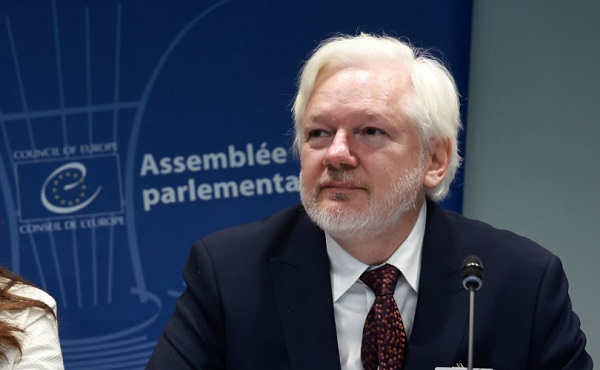

Julian Assange, founder of Wikileaks, attends the European council on October 1, 2024, in Strasbourg, France
From LifeSiteNews
By Frank Wright

Speaking after 12 years of confinement, Julian Assange warned of the erosion of free speech in the West, linking his own prosecution to global censorship, political corruption, and attacks on honest journalism.
On October 1, Julian Assange made his first major speech since his release. In it, he delivered a verdict on how we are governed which is as damning as it is revealing.
“I am not free today because the system worked,” Assange said, “I am free today because after years of incarceration I pled guilty to journalism.”
Julian Assange was convicted under the U.S. Espionage Act and spent 12 years in confinement, first taking refuge in the Ecuadorian embassy in London in 2012, followed by five years in Britain’s maximum-security prison in Belmarsh.
Had his plea not been accepted he faced a sentence of 175 years in prison. He was speaking in Strasbourg, France, at a hearing convened by the Parliamentary Assembly of the European Council – which recognized Assange as a “political prisoner.”
Saying how “incarceration has taken its toll,” Assange noted how the world he had rejoined had changed – for the worse:
I regret how much ground has been lost during that time period. How expressing the truth has been undermined, attacked, weakened, and diminished.
Assange gave a chilling account of the state of the Western world today, saying he now sees “more impunity, more secrecy, more retaliation for telling the truth, and more self-censorship.”
He believes that his own treatment was a turning point for the suppression of freedom of speech in the West:
It is hard not to draw a line from the U.S. government’s prosecution of me – its crossing the Rubicon by internationally criminalizing journalism – to the chill climate for freedom of expression that exists now.
During his speech, Assange alleged that former CIA director Mike Pompeo devised a plan to kill him, following Wikileaks’ revelation in 2017 of CIA operations in Europe.
Citing the testimony of “more than 30 former and current U.S. intelligence officials,” Assange said that “it is a matter of public record that under Pompeo’s explicit direction the CIA drew up plans to kidnap and to assassinate me” while he was in the Ecuadorian embassy in London.
The revelations published by Wikileaks which prompted the plot included evidence of CIA espionage on European governments and industries. In addition, Wikileaks reports “revealed the CIA’s vast production of malware [spy software] and viruses, its subversion of supply chains, its subversion of antivirus software, cars, smart TVs, and iPhones.”
Assange was originally pursued for having publicized U.S. actions in Guantanamo Bay, and alleged war crimes in Iraq, which he explains intensified following Wikileaks’ CIA revelations.
Cracks in our system
Assange’s case and his extraordinary testimony reveals one of many fault lines in the Western world.
“Today, the free world is no longer free.” said Salvadorean President Nayib Bukele, describing also how the West is becoming “more pessimistic,” adding that, “[t]ragically, we can see more evidence of this decline every day.” Speaking at the United Nations on September 30, he said:
When the Free World became free it was due to freedom of expression, freedom before the law. But once a nation abandons the principles that make it free it’s only a question of time before it completely loses its freedom.
The “Free World” is no longer free.
El “Mundo Libre” ya no es libre. pic.twitter.com/IOrLv33KbW
— Nayib Bukele (@nayibbukele) September 30, 2024
His observations are echoed by statements from across the political divide in the U.S.
The former Democrat Tulsi Gabbard warned on October 5 that the party she left now seeks to undermine the First Amendment. She said on X, “People like Hillary Clinton and Kamala Harris do not believe in the First Amendment because they see it as an obstacle to achieving their real goal: ‘total control.’”
Her remarks followed those made by Hillary Clinton in a recent video interview, in which Clinton said “whether it’s Facebook or Twitter/X or Instagram or TikTok … if they don’t moderate and monitor the content, we lose total control.”
Hillary said it: when you allow free speech, “we lose total control.” People like Hillary Clinton and Kamala Harris do not believe in the First Amendment because they see it as an obstacle to achieving their real goal: “total control.” https://t.co/euQJgAVxV4
— Tulsi Gabbard 🌺 (@TulsiGabbard) October 5, 2024
Clinton’s remarks about losing “total control” come after Sen. John Kerry spoke at the World Economic Forum on September 25, saying “our First Amendment stands as a major block to the ability to be able to just hammer [disinformation] out of existence.”
Kerry argued that opposition to the polices of the WEF was fueled by “disinformation” when critics in fact simply dislike its policies. Populism generally is described as a threat to democracy in the West, when it is also simply the preference for popular policies, against the unpopular ones of the current ruling elite.
“Disinformation,” and “misinformation” are terms invented and used by the language and ideological police to hide their malicious intent.
It appears that unpopular policies such as those of permanent war, Net Zero, deindustrialization, and denationalization can only be pursued with “total control” of the information seen by the public.
The meaningful political debate is not about left and right. It is about the meaning of what is right, and the outrage at what is obviously wrong. Assange says “it is uncertain what we can do” about the “impunity” of our leadership, which as yet has faced no meaningful consequences for its pursuit of deeply unpopular policies at the expense of widespread corruption and defended by censorship.

Censorship Industrial Complex
How Wikipedia Got Captured: Leftist Editors & Foreign Influence On Internet’s Biggest Source of Info

Fr0m Stossel TV
I once reported how great Wikipedia is. But now, it’s manipulated by leftists. That’s a big problem because its bad information corrupts AI and search results. Even c0-founder Larry Sanger agrees.
But that’s just the beginning of the problem because “Wikipedia’s information spreads into everything online,” says @ashleyrindsbergmedia of @NPOVmedia .
That means when your ask ChatGPT, Google, or your phone a question, it’ll likely to take leftist spin straight from Wikipedia. Wikipedia bans most right-wing news sources and suggests Donald Trump is an authoritarian fascist (but they don’t even call Fidel Castro’s successor authoritarian).
They’ve turned my Wikipedia page into a smear against me.
I explain in this video.
_ _ _ _ _ _
To make sure you receive the weekly video from Stossel TV, sign up here:
https://www.johnstossel.com/#subscrib…
_ _ _ _ _ _
Censorship Industrial Complex
Death by a thousand clicks – government censorship of Canada’s internet


The Justice Centre for Constitutional Freedoms announces its latest publication, Death by a thousand clicks: The rise of internet censorship and control in Canada, authored by veteran journalist and researcher Nigel Hannaford. The report outlines how recommendations from the Broadcasting and Telecommunications Legislative Review Panel in 2020 set the stage for a series of federal bills that have collectively transformed Canada’s once open internet into a state-managed digital environment that restricts what Canadians may access, share, and say online.
The report highlights the following federal legislation:
Online Streaming Act (C-11): Passed in 2023, this Bill gives the CRTC power to regulate online videos and other content, including material created by everyday Canadians. It also lets the government influence online “discoverability,” meaning it can push certain content to the top of your feeds while making other content harder to find.
Online News Act (C-18): Also passed in 2023, this Bill forces platforms to pay approved news outlets, a measure that led to increased dependence of media organizations on the government and widespread blocking of Canadian news as a result of Meta’s news ban on Facebook and Instagram.
Online Harms Act (C-63): Although this Bill was halted by the 2025 election, it would have empowered a new “Digital Safety Commission” to order content removals, demand platform data, levy severe financial penalties on service providers for non-compliance with regulations created by the federal cabinet, and impose house arrest on Canadians who had not been charged with or convicted of any crime. It also would have allowed the Canadian Human Rights Commission to pursue Canadians over non-criminal “discriminatory” speech, together creating a sweeping censorship regime under the guise of addressing so-called “harms” that were already illegal.
Strong Borders Act (C-2): Introduced in June 2025 and currently at second reading, this Bill authorizes law enforcement to obtain subscriber information and metadata without a warrant, chilling anonymous online expression and eroding digital privacy.
An Act respecting cyber security, amending the Telecommunications Act and making consequential amendments to other Acts (C-8): Introduced in April 2025 and now before committee, this Bill expands government access to private networks and enables federal officials to direct telecommunications providers to kick individual Canadians off the internet without due process or appeal.
Combatting Hate Act (C-9): Introduced in September 2025 and currently before Parliament, this Bill broadens “hate-propaganda” offences, removes Attorney General oversight for prosecutions, encourages widespread self-censorship, and makes Canada more like the United Kingdom, where thousands of citizens are arrested over their social media commentary.
Report author Nigel Hannaford said, “It is important for Canadians to know that these bills are not isolated technical updates. Together they form a coordinated shift toward state-managed digital speech.”
“If we value open debate, privacy, and democratic accountability, we need to repeal the laws already passed and stop the ones now before Parliament,” he added.
Benjamin Klassen, Research and Education Coordinator for the Justice Centre, said, “It is important Canadians stay informed about these important issues. An informed public is essential to a free society.”
“Through research reports like this one, our Education team works to explain complex legislation in a way that empowers Canadians to participate in the national debate around important policies and defend their rights and freedoms,” he added.
To protect free expression online, Canadians should demand the repeal of Bills C-11 and C-18, insist that MPs vote against Bills C-2, C-8, and C-9, and elect representatives committed to restoring a free and open internet.

The Recall Trap: 21 Alberta MLA’s face recall petitions
Canada considers creating national ID system using digital passports for domestic use

Claims about ‘unmarked graves’ don’t withstand scrutiny

Here’s why city hall should save ‘blanket rezoning’ in Calgary

Too nice to fight, Canada’s vulnerability in the age of authoritarian coercion

UNDRIP now guides all B.C. laws. BC Courts set off an avalanche of investment risk
MPs who cross the floor are dishonourable members
-
 Business1 day ago
Ottawa Pretends To Pivot But Keeps Spending Like Trudeau
-
 Daily Caller2 days ago
Paris Climate Deal Now Decade-Old Disaster
-
 Energy1 day ago
Liberals Twisted Themselves Into Pretzels Over Their Own Pipeline MOU
-
Censorship Industrial Complex1 day ago
How Wikipedia Got Captured: Leftist Editors & Foreign Influence On Internet’s Biggest Source of Info
-
 Indigenous2 days ago
Residential school burials controversy continues to fuel wave of church arsons, new data suggests
-
 Alberta2 days ago
Alberta’s huge oil sands reserves dwarf U.S. shale
-
 International2 days ago
FBI didn’t think it had cause to raid Trump but DOJ did it anyway
-
 Health2 days ago
Saskatchewan woman approved for euthanasia urged to seek medical help in Canada rather than US