
Censorship Industrial Complex
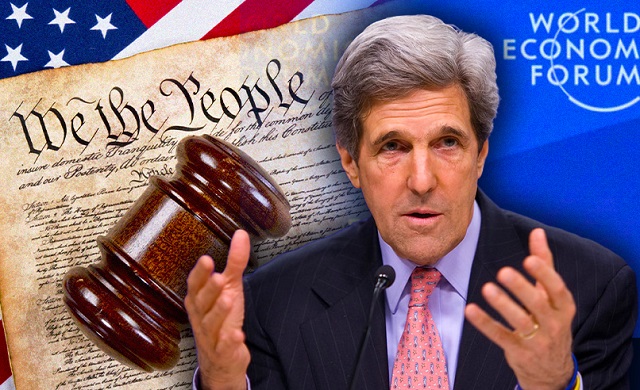
John Kerry tells WEF panel that First Amendment is ‘major block’ to pushing leftist climate agenda


From LifeSiteNews
By Stephen Kokx

John Kerry complained to a World Economic Forum meeting that the First Amendment ‘stands as a major block’ that prevents the government from being able to ‘hammer’ disfavored opinions ‘out of existence.’
Former Biden climate czar John Kerry told a World Economic Forum meeting this week that free speech is an obstacle to forcing green ideology onto the world’s population.
Kerry, 80, was speaking about energy on Wednesday when he expressed a desire to “curb” the flow of information about environmentalism in order to “have some accountability” for persons he believes are not promoting the facts.
“If people only go to one source, and the source they go to is sick, and, you know, has an agenda, and they’re putting out disinformation, our First Amendment stands as a major block to be able to just, you know, hammer it out of existence,” Kerry said.
Kerry has been one of the loudest voices in the Western world to push the green agenda in recent years. During his many public appearances, he has promoted the “Great Reset,” advocated for people receiving the experimental COVID-19 shot, warned about the so-called dangers of overpopulation, and has claimed that 15 million people are dying every year because of greenhouse gas emissions.
In further disturbing comments on Wednesday, Kerry lamented that there is not a centralized authority that can determine truth from fiction.
“Democracies around the world now are struggling with the absence of a sort of truth arbiter, and there’s no one who defines what facts really are,” he said. “So what we need is to win the ground, win the right to govern, by hopefully winning enough votes that you’re free to be able to implement change.”
Kerry provided additional remarks about this year’s presidential race between Kamala Harris and Donald Trump.
“I think democracies are very challenged right now and have not proven they can move fast enough of big enough to deal with the challenges they are facing, and to me, that is part of what this election is all about. Will we break the fever in the United States?”
Kerry has been widely criticized on social media by an array of public figures for his comments, which betray an autocratic mindset.
Kerry is “correct” in that the First Amendment “does stand as a major roadblock to them right now,” former presidential contender Robert F. Kennedy Jr. noted.
John Kerry is correct. The 1st Amendment DOES stand as a major roadblock to them right now. https://t.co/1QJX2fbw3B
— Robert F. Kennedy Jr (@RobertKennedyJr) September 30, 2024
“John Kerry is saying he wants to violate the Constitution,” X owner Elon Musk recalled.
John Kerry is saying he wants to violate the Constitution https://t.co/im1BJNlfNI
— Elon Musk (@elonmusk) September 30, 2024
“John Kerry says the quiet part out loud,” Townhall columnist Phil Holloway observed. “The [First Amendment] and the entire Bill of Rights was designed as a ‘roadblock’ against a tyrannical government. It’s a feature, not a bug.”
Kerry was succeeded in his role as special presidential envoy for climate by former Clinton adviser John Podesta in March 2024. He was previously a Democratic U.S. senator from Massachusetts and secretary of state under Barack Obama. During his lengthy career in public life, Kerry has worked to expand pro-abortion and pro-LGBT policies in opposition to his self-professed Catholic faith.

Censorship Industrial Complex
US Under Secretary of State Slams UK and EU Over Online Speech Regulation, Announces Release of Files on Past Censorship Efforts


Sarah Rogers’ comments draw a new line in the sand between America’s First Amendment and Europe’s tightening grip on online speech.
|
|
Censorship Industrial Complex
Canadian university censors free speech advocate who spoke out against Indigenous ‘mass grave’ hoax
From LifeSiteNews
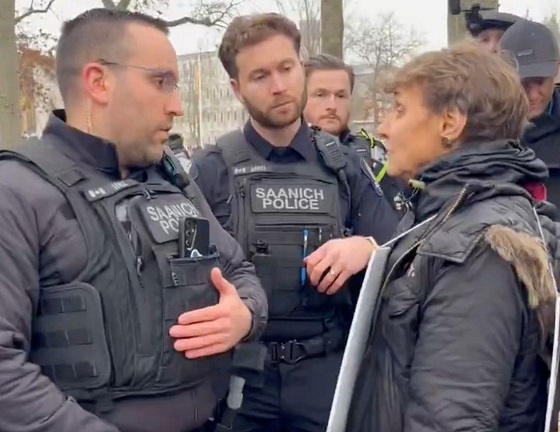
Dr. Frances Widdowson was arrested and given a ticket at the University of Victoria campus after trying to engage in conversation about ‘the disputed claims of unmarked graves in Kamloops.’
A Canadian academic who spoke out against claims there are mass unmarked graves of kids on former Indigenous residential schools, and who was arrested on a university campus as a result for trespassing, is fighting back with the help of a top constitutional group.
Dr. Frances Widdowson was arrested and given a ticket on December 2, 2025, at the University of Victoria (UVic) campus after trying to engage in conversation about “the disputed claims of unmarked graves in Kamloops,” noted the Justice Centre for Constitutional Freedoms (JCCF) in a recent news release.
According to the JCCF, Widdowson was trying to initiate a “good faith” conversation with people on campus, along with the leader of OneBC provincial party, Dallas Brodi.
“My arrest at the University of Victoria is an indication of an institution that is completely unmoored from its academic purpose,” said Widdowson in a statement made available to LifeSiteNews.
She added that the “institution” has been “perpetuating the falsehood” of the remains of 215 children “being confirmed at Kamloops since 2021, and is intent on censoring any correction of this claim.”
“This should be of concern for everyone who believes that universities should be places of open inquiry and critical thinking, not propaganda and indoctrination,” she added.
UVic had the day before Widdowson’s arrest warned on its website that those in favor of free speech were “not permitted to attend UVic property for the purpose of speaking publicly.”
Despite the warning, Widdowson, when she came to campus, was met with some “100 aggressive protesters assembled where she intended to speak at Petch Fountain,” noted the JCCF.
The protesters consisted of self-identified Communists, along with Antifa-aligned people and Hamas supporters.
When Widdowson was confronted by university security, along with local police, she was served with a trespass notice.
“When she declined to leave, she was arrested, detained for about two hours, and charged under British Columbia’s Trespass Act—an offence punishable by fines up to $2,000 or up to six months’ imprisonment,” said the JCCF.
According to Constitutional lawyer Glenn Blackett, UVic actions are shameful, as it “receives hundreds of millions of taxpayer dollars annually while it facilitates the arrest of Canadians attempting to engage in free inquiry on campus.”
Widdowson’s legal team, with the help of the JCCF, will be defending her ticket to protect her “Charter-protected freedoms of expression and peaceful assembly.”
Widdowson served as a tenured professor at Mount Royal University in Calgary, Alberta, before she was fired over criticism of her views on identity politics and Indigenous policy, notes the JCCF. She was vindicated, however, as an arbitrator later found her termination was wrongful.
In 2021 and 2022, the mainstream media ran with inflammatory and dubious claims that hundreds of children were buried and disregarded by Catholic priests and nuns who ran some Canadian residential schools. The reality is, after four years, there have been no mass graves discovered at residential schools.
However, as the claims went unfounded, over 120 churches, most of them Catholic and many of them on Indigenous lands that serve the local population, have been burned to the ground, vandalized, or defiled in Canada since the spring of 2021.
Last year, retired Manitoba judge Brian Giesbrecht said Canadians are being “deliberately deceived by their own government” after blasting the former Trudeau government for “actively pursuing” a policy that blames the Catholic Church for the unfounded “deaths and secret burials” of Indigenous children.
As reported by LifeSiteNews, new private members’ Bill C-254, “An Act To Amend The Criminal Code” introduced by New Democrat MP Leah Gazan, looks to give jail time to people who engage in so-called “Denialism.” The bill would look to jail those who question the media and government narrative surrounding Canada’s “Indian Residential School system” that there are mass graves despite no evidence to support this claim.

The “Disruptor-in-Chief” places Canada in the crosshairs

UK Police Pilot AI System to Track “Suspicious” Driver Journeys

Judge Declares Mistrial in Landmark New York PRC Foreign-Agent Case

Canadian government launches trial version of digital ID for certain licenses, permits

World-leading biochemist debunks evolutionary theory

Ottawa-Alberta agreement may produce oligopoly in the oilsands

Warning Canada: China’s Economic Miracle Was Built on Mass Displacement
-
 Haultain Research1 day ago
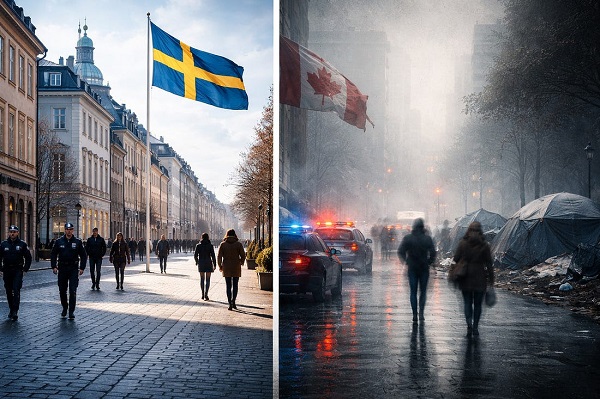
Sweden Fixed What Canada Won’t Even Name
-
 Business1 day ago
What Do Loyalty Rewards Programs Cost Us?
-
 Business19 hours ago
Land use will be British Columbia’s biggest issue in 2026
-
 Energy20 hours ago
Why Japan wants Western Canadian LNG
-
 Business16 hours ago
Mainstream media missing in action as YouTuber blows lid off massive taxpayer fraud
-
 Business16 hours ago
Stripped and shipped: Patel pushes denaturalization, deportation in Minnesota fraud
-
 Energy8 hours ago
Rulings could affect energy prices everywhere: Climate activists v. the energy industry in 2026
-
 Digital ID6 hours ago
The Global Push for Government Mandated Digital IDs And Why You Should Worry