
Business
Enbridge to purchase three U.S. utilities for $14 billion in cash and debt



The Enbridge logo is shown at the company’s annual meeting in Calgary on May 9, 2018. Enbridge Inc. says it has signed a US$14 billion cash-and-debt deal to purchase three U.S.-based utility companies. THE CANADIAN PRESS/Jeff McIntosh

Calgary
Enbridge Inc. says it has signed a US$14 billion cash-and-debt deal to purchase three U.S.-based utility companies.
The Calgary-based energy infrastructure giant says the three utilities, owned by Dominion Energy, Inc., are The East Ohio Gas Company, Questar Gas Company and its related Wexpro companies, and the Public Service Company of North Carolina.
Enbridge says it will finance the deal through a combination of $US9.4 billion of cash consideration and US$4.6 billion of assumed debt.
The Canadian company says the deal will double the scale of its gas utility business and will serve to balance its asset mix evenly between natural gas and renewables, and liquids.
Enbridge says following the transaction, its gas utility business will be the largest by volume in North America with a combined rate base of over C$27 billion and about 7,000 employees delivering over nine billion cubic feet per day of gas to approximately seven million customers.
The deal is subject to regulatory approval and expected to close in 2024.
This report by The Canadian Press was first published Sept. 5, 2023.



From the Daily Caller News Foundation
A resurfaced 2018 video from a Minneapolis-area TV station shows how Somali scammers allegedly bilked Minnesota out of millions of dollars for services that they never provided.
Independent journalist Nick Shirley touched off a storm on social media Friday after he posted a photo of one day-care center, which displayed a banner calling it “The Greater Learing Center” on X, along with a 42-minute video that went viral showing him visiting that and other day-care centers. The surveillance video, which aired on Fox 9 in 2018 after being taken in 2015, showed parents taking kids into the center, then leaving with them minutes later, according to Fox News.
“They were billing too much, they went up to high,” Hennepin County attorney Mike Freeman told Fox 9 in 2018. “It’s hard to imagine they were serving that many people. Frankly if you’re going to cheat, cheat little, because if you cheat big, you’re going to get caught.”
Dear Readers:
As a nonprofit, we are dependent on the generosity of our readers.
Please consider making a small donation of any amount here.
Thank you!
Democratic Gov. Tim Walz of Minnesota was accused of engaging in “systemic” retaliation against whistleblowers in a Nov. 30 statement by state employees. Assistant United States Attorney Joe Thompson announced on Dec. 18 that the amount of suspected fraud in Minnesota’s Medicaid program had reached over $9 billion.
After Shirley’s video went viral, FBI Director Kash Patel announced the agency was already sending additional resources in a Sunday post on X, citing the case surrounding Feeding Our Future, which at one point accused the Minnesota government of racism during litigation over the suspension of funds after earlier allegations of fraud.
KSTP reported that the Quality Learning Center, one of the centers visited by Shirley, had 95 citations for violations from one Minnesota agency between 2019 to 2023.
President Donald Trump announced in a Nov. 21 post on Truth Social that he would end “Temporary Protected Status” for Somalis in the state in response to allegations of welfare fraud and said that the influx of refugees had “destroyed our country.”
Business
Disclosures reveal Minnesota politician’s husband’s companies surged thousands-fold amid Somali fraud crisis


Rep. Ilhan Omar’s latest financial disclosures reveal seemingly sudden wealth accumulation inside her household, even as Minnesota grapples with revelations of massive fraud that may have siphoned more than $9 billion from government programs. The numbers, drawn from publicly filed congressional reports, show two companies tied to Omar’s husband, Tim Mynett, surging in value at a pace that raises more questions than answers.
According to the filings, Rose Lake Capital LLC — a business advisory firm Mynett co-founded in 2022 — jumped from an assessed range of $1 to $1,000 in 2023 to between $5 million and $25 million in 2024. Even using the most conservative assumptions allowed under Congress’ broad valuation ranges, the company’s value would have increased thousands of times in a single year. The firm advertises itself as a facilitator of “deal-making, mergers and acquisitions, banking, politics and diplomacy.”
Archived versions of Rose Lake’s website once showcased an eye-catching lineup of political heavyweights: former Ambassador to Bahrain Adam Ereli, former Sen. Max Baucus, and prominent Democratic National Committee alumni William Derrough and Alex Hoffman. But as scrutiny surrounding Omar intensifies — particularly over whether her political network intersected with sprawling fraud schemes exposed in Minnesota — the company has quietly scrubbed its online footprint. Names and biographies of team members have vanished, and the firm has not clarified whether these figures remain involved. Omar’s office offered no comment when asked to explain the company’s sudden growth or the removal of its personnel listings.
Mynett, Omar’s third husband, has long been a controversial presence in her political orbit, but the dramatic swell in his business holdings comes at a moment when trust in Minnesota’s oversight systems is already badly shaken. Federal and state investigators now estimate that fraud involving pandemic-era and nonprofit programs may exceed $9 billion, a staggering figure for a state often held up as a model of progressive governance. For many residents, the revelation that Omar’s household wealth soared during the same period only deepens skepticism about who benefited from Minnesota’s expansive social-spending apparatus.
The financial story doesn’t stop with Rose Lake. A second Mynett-linked entity, ESTCRU LLC — a boutique winery registered in Santa Rosa, California — reported an assessed value of $1 million to $5 million in 2024. Just a year earlier, Omar disclosed its worth at $15,000 to $50,000. Despite the dramatic valuation spike, ESTCRU’s online storefront does not appear to function, its last social media activity dates back to early 2023, and the phone number listed on its website is no longer in service. As with Rose Lake, Omar’s office declined to comment on the winery’s sudden rise in reported value.
The House clerk has yet to release 2025 disclosures, leaving unanswered how these companies are performing today — and how such explosive growth materialized in the first place.


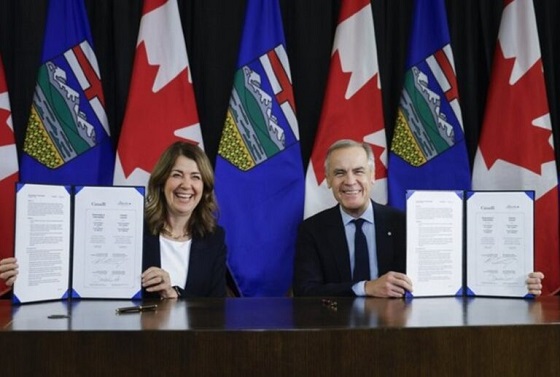
Ottawa-Alberta agreement may produce oligopoly in the oilsands

‘The electric story is over’
The Top News Stories That Shaped Canadian Energy in 2025 and Will Continue to Shape Canadian Energy in 2026

Western Canada’s supply chain for Santa Claus

Some Of The Wackiest Things Featured In Rand Paul’s New Report Alleging $1,639,135,969,608 In Gov’t Waste

$2.6 million raised for man who wrestled shotgun from Bondi Beach terrorist

Remembering Afghanistan and the sacrifices of our military families
-
 Business2 days ago
Stripped and shipped: Patel pushes denaturalization, deportation in Minnesota fraud
-
Business10 hours ago
Disclosures reveal Minnesota politician’s husband’s companies surged thousands-fold amid Somali fraud crisis
-
 Energy2 days ago
Rulings could affect energy prices everywhere: Climate activists v. the energy industry in 2026
-
Business10 hours ago
Resurfaced Video Shows How Somali Scammers Used Day Care Centers To Scam State
-
 International2 days ago
China Stages Massive Live-Fire Encirclement Drill Around Taiwan as Washington and Japan Fortify
-
 Digital ID2 days ago
The Global Push for Government Mandated Digital IDs And Why You Should Worry
-
 Business1 day ago
Feds pull the plug on small business grants to Minnesota after massive fraud reports
-
 Business23 hours ago
DOOR TO DOOR: Feds descend on Minneapolis day cares tied to massive fraud