
Business
Biden announces massive new climate goals in final weeks, despite looming Trump takeover


From LifeSiteNews

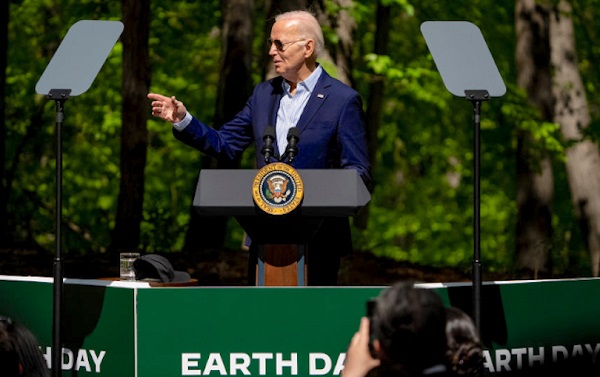
Outgoing President Joe Biden announced a new climate target of reducing American carbon emissions from 61-66% over the next decade, even though President Trump would be able to undo it as soon as next month.
Outgoing President Joe Biden announced December 19 a new climate target of reducing American carbon emissions of more than 60% over the next decade, even though returning President Donald Trump would be able to undo it as soon as next month.
“Today, as the United States continues to accelerate the transition to a clean energy economy, President Biden is announcing a new climate target for the United States: a 61-66 percent reduction in 2035 from 2005 levels in economy-wide net greenhouse gas emissions,” the White House announced, the Washington Free Beacon reports. The new target will be formally submitted to the United Nations Climate Change secretariat.
“President Biden’s new 2035 climate goal is both a reflection of what we’ve already accomplished,” Biden climate adviser John Podesta added, “and what we believe the United States can and should achieve in the future.”
The announcement may be little more than a symbolic gesture in the end, however, as Trump is widely expected to withdraw the United States from the Paris Climate Agreement upon resuming office in January, in the process voiding related climate obligations.
Trump formally pulled out of the Paris accords in August 2017, the first year of his first term, with then-U.S. Ambassador to the United Nations Nikki Haley stating that the administration would be “open to re-engaging in the Paris Agreement if the United States can identify terms that are more favorable to it, its business, its workers, its people, and its taxpayers.”
Such terms were never reached, however, leaving America out until Biden re-committed the nation to the Paris Agreement on the first day of his presidency, obligating U.S. policy to new economic regulations to cut carbon emissions.
In June, the Trump campaign confirmed Trump’s intentions to withdraw from Paris again. At the time, Trump’s team was reportedly mulling a number of non-finalized drafts of executive orders to do so.
Left-wing consternation on the matter is based on certitude in “anthropogenic global warming” (AGW) or “climate change,” the thesis that human activity, rather than natural phenomena, is primarily responsible for Earth’s changing climate and that such trends pose a danger to the planet in the form of rising sea levels and weather instability.
Activists have long claimed there is a “97 percent scientific consensus” in favor of AGW, but that number comes from a distortion of an overview of 11,944 papers from peer-reviewed journals, 66.4 percent of which expressed no opinion on the question; in fact, many of the authors identified with the AGW “consensus” later spoke out to say their positions had been misrepresented.
AGW proponents suffered a blow in 2010 with the discovery that their leading researchers at the Intergovernmental Panel on Climate Change, East Anglia Climate Research Unit, and National Oceanic and Atmospheric Administration had engaged in widespread data manipulation, flawed climate models, misrepresentation of sources, and suppression of dissenting findings in order to make the so-called “settled science” say what climate activists wanted it to.

Business
Vacant Somali Daycares In Viral Videos Are Also Linked To $300 Million ‘Feeding Our Future’ Fraud


From the Daily Caller News Foundation
Multiple Somali daycare centers highlighted in a viral YouTube exposé on alleged fraud in Minnesota have direct ties to a nonprofit at the center of a $300 million scam, the Minnesota Star Tribune reported Thursday.
The now-infamous videos from YouTube influencer Nick Shirley, posted Dec. 26, showed several purported Somali-run daycare centers receiving millions in taxpayer funds despite little evidence that children were actually present at the facilities. Now it turns out that five of the 10 daycare centers Shirley visited operated as meal sites for Feeding Our Future, the Minnesota-based nonprofit implicated in a massive fraud scheme that has already produced dozens of convictions, the outlet reported.
Between 2018 and 2021, those five businesses received nearly $5 million from Feeding Our Future, the outlet reported. While none of the centers in Shirley’s video have been legally accused of wrongdoing, the revelations underscore the sprawling web of fraud engulfing the state. (RELATED: Somalis Reportedly Filled Ohio Strip Mall With Potential Fraudulent Childcare Centers)
Dear Readers:
As a nonprofit, we are dependent on the generosity of our readers.
Please consider making a small donation of any amount here.
Thank you!
🚨 Here is the full 42 minutes of my crew and I exposing Minnesota fraud, this might be my most important work yet. We uncovered over $110,000,000 in ONE day. Like it and share it around like wildfire! Its time to hold these corrupt politicians and fraudsters accountable
We ALL… pic.twitter.com/E3Penx2o7a
— Nick shirley (@nickshirleyy) December 26, 2025
Federal prosecutors have charged over 70 individuals — mostly from the Somali community — with stealing more than $300 million from the Federal Child Nutrition Program through Feeding Our Future. During the COVID-19 pandemic, the program funded sites across Minnesota to provide meals to children. Prosecutors say leaders of Feeding Our Future, along with dozens of associates who ran sponsored “meal sites,” submitted false or inflated meal counts to claim reimbursements.
One facility featured in Shirley’s video, the Minnesota Best Childcare Center, received $1.5 million from Feeding Our Future, according to the Minnesota Star Tribune.
Minnesota Best Childcare Center, which has been licensed by the state since 2013, did not respond to the Daily Caller News Foundation’s request for comment.
Other daycares featured in Shirley’s video have been cited dozens of times for rule violations while continuing to receive millions in state funding. The now-infamous Quality “Learing” Center was cited for 121 violations in the past three years, including for failing to report a “death, serious injury, fire or emergency as required,” according to the Star-Tribune.
The paper’s investigation found that six of the facilities featured by Shirley were either closed or employees did not open their doors.
Following that exposé, which has accumulated more than 135 million views on X, the Trump administration announced it would freeze all childcare disbursements to Minnesota while federal officials review how taxpayer dollars have flowed to licensed providers.
The fraud allegations extend beyond childcare, with prosecutors claiming millions in taxpayer funds were also stolen from Minnesota’s Housing Stabilization Services and autism treatment programs. Federal prosecutors also estimate that as much as half of the roughly $18 billion Minnesota has spent since 2018 on 14 Medicaid programs may have been siphoned off by fraudsters.
Even the state’s assisted living program has come under scrutiny, with Republican state Rep. Kristin Robbins warning that individuals connected to the Feeding Our Future scheme continue to receive millions in taxpayer funds.

From the Fraser Institute
According to a recent study, living standards in Canada have declined over the past five years. And the country’s economic growth has been “ugly.” Crucially, all 10 provinces are experiencing this economic stagnation—there are no exceptions to Canada’s “ugly” growth record. In 2026, reversing this trend should be the top priority for the Carney government and provincial governments across the country.
Indeed, demographic and economic data across the country tell a remarkably similar story over the past five years. While there has been some overall economic growth in almost every province, in many cases provincial populations, fuelled by record-high levels of immigration, have grown almost as quickly. Although the total amount of economic production and income has increased from coast to coast, there are more people to divide that income between. Therefore, after we account for inflation and population growth, the data show Canadians are not better off than they were before.
Let’s dive into the numbers (adjusted for inflation) for each province. In British Columbia, the economy has grown by 13.7 per cent over the past five years but the population has grown by 11.0 per cent, which means the vast majority of the increase in the size of the economy is likely due to population growth—not improvements in productivity or living standards. In fact, per-person GDP, a key indicator of living standards, averaged only 0.5 per cent per year over the last five years, which is a miserable result by historic standards.
A similar story holds in other provinces. Prince Edward Island, Nova Scotia, Quebec and Saskatchewan all experienced some economic growth over the past five years but their populations grew at almost exactly the same rate. As a result, living standards have barely budged. In the remaining provinces (Newfoundland and Labrador, New Brunswick, Ontario, Manitoba and Alberta), population growth has outstripped economic growth, which means that even though the economy grew, living standards actually declined.
This coast-to-coast stagnation of living standards is unique in Canadian history. Historically, there’s usually variation in economic performance across the country—when one region struggles, better performance elsewhere helps drive national economic growth. For example, in the early 2010s while the Ontario and Quebec economies recovered slowly from the 2008/09 recession, Alberta and other resource-rich provinces experienced much stronger growth. Over the past five years, however, there has not been a “good news” story anywhere in the country when it comes to per-person economic growth and living standards.
In reality, Canada’s recent record-high levels of immigration and population growth have helped mask the country’s economic weakness. With more people to buy and sell goods and services, the overall economy is growing but living standards have barely budged. To craft policies to help raise living standards for Canadian families, policymakers in Ottawa and every provincial capital should remove regulatory barriers, reduce taxes and responsibly manage government finances. This is the great policy challenge for governments across the country in 2026 and beyond.

Ben Eisen
Senior Fellow, Fraser Institute

Jake Fuss
Director, Fiscal Studies, Fraser Institute

Sweden Fixed What Canada Won’t Even Name

What Do Loyalty Rewards Programs Cost Us?

China Stages Massive Live-Fire Encirclement Drill Around Taiwan as Washington and Japan Fortify
The Canadian Energy Centre’s biggest stories of 2025

Rulings could affect energy prices everywhere: Climate activists v. the energy industry in 2026

In Contentious Canada Reality Is Still Six Degrees Of Hockey
Land use will be British Columbia’s biggest issue in 2026
-
 International1 day ago
Maduro says he’s “ready” to talk
-
Business5 hours ago
Vacant Somali Daycares In Viral Videos Are Also Linked To $300 Million ‘Feeding Our Future’ Fraud
-
International6 hours ago
“Captured and flown out”: Trump announces dramatic capture of Maduro
-
 International5 hours ago
Trump Says U.S. Strike Captured Nicolás Maduro and Wife Cilia Flores; Bondi Says Couple Possessed Machine Guns
-
 Bruce Dowbiggin1 day ago
The Rise Of The System Engineer: Has Canada Got A Prayer in 2026?
-
 International1 day ago
LOCKED AND LOADED: Trump threatens U.S. response if Iran slaughters protesters
-
 International24 mins ago
US Justice Department Accusing Maduro’s Inner Circle of a Narco-State Conspiracy
-
Energy8 mins ago
The U.S. Just Removed a Dictator and Canada is Collateral Damage