
National
War against the US? Chrystia Freeland says Canada, allies need to build ‘New World Order’ to combat Trump

From LifeSiteNews
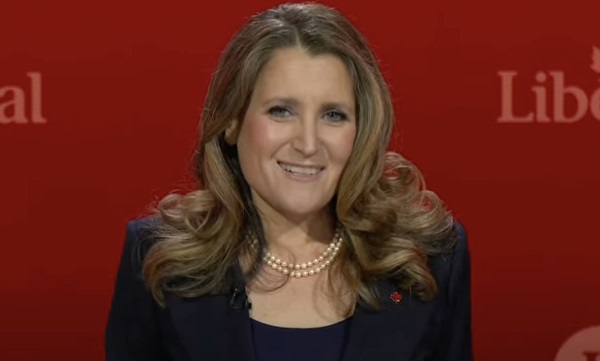
During last night’s Liberal leadership debate, candidate Chrystia Freeland called for ‘democratic’ countries to ‘build a New World Order’ to combat Trump and his threat of making Canada the 51st U.S. state.
Former finance minister and deputy prime minister Chrystia Freeland has called on “democratic” countries to “build a New World Order” to combat U.S. President Donald Trump.
During the February 25 English-language Liberal Party leadership debate, Freeland, who is running for party leadership to replace Prime Minister Justin Trudeau, declared that Canada and its allies must “build a New World Order” to protect against U.S. President Donald Trump’s threat to turn the nation into the 51st U.S. state.
“We need to recognize President Trump has said dozens of times he wants us to be the 51st state,” Freeland stated around the 36 minute mark of last night’s debate. “I don’t think any of us wants to be the leader who was asleep at the wheel and didn’t get Canada defended, did not work with our democratic allies to protect our borders.”
“They want to work with us it’s time for us to step up at home to urgently reach out to them and build a New World Order where democracy and Canadian sovereignty is protected,” she declared.
Media outlets have long described talk of a “New World Order” as a conspiracy theory, but globalist organizations such as the World Economic Forum (WEF) and the United Nations (UN) continue to give credence to the concept, by publicly calling for and working towards a worldwide “Great Reset” or other similarly named agendas.
To that end, former WEF chairman Klaus Schwab has insisted for decades that “stakeholder capitalism” is the optimal form of global governance in a “reset” world, allowing the biggest corporations to partner with political leaders in deciding key policy agendas, and relegating the governments’ voice to “one among many, without always being the final arbiter.”
Freeland is not the only politician to admit that plans to establish the New World Order are underway. As LifeSiteNews reported in 2021, during the height of the COVID “pandemic,” a senior Australian health officer said that authorities will consider what contact tracing looks like “in the New World Order.” The term has also been used by former U.S. President Joe Biden, former Polish Prime Minister Mateusz Morawiecki and others.
Freeland’s comments caused a stir on social media, with many accusing the mainstream political sphere of hypocrisy for labelling the term “New World Order” a “conspiracy theory” while actively advocating for it.
“Liberals: ‘A New World Order is a conspiracy theory. Stop spreading misinformation,’” one user posted on X. “Also Liberals: ‘We need a new world order to protect ourselves from Donald Trump.’”
Liberal Party ties to the WEF and ‘New World Order’ ideology
During the last few years, during which time Freeland served as deputy prime minister and finance minister, the Liberal Party has routinely come under fire for its ties to globalist organizations like the World Economic Forum.
In fact, Freeland’s own ties to the WEF seem extensive, with her receiving a personal commendation from former WEF leader Klaus Schwab.
Others have also pointed out that right around the time she announced her bid for Liberal leader, the WEF’s profile on Freeland disappeared from the group’s website.
Another Liberal leadership candidate, Mark Carney, also has ties to the WEF, as does outgoing Prime Minister Justin Trudeau.

Media
Reporters determined to drive their industry and its reputation into the abyss one Tweet at a time


Last week, my column for The Hub was about why journalists, for the sake of journalism, should avoid posting on Twitter/X.
It took mere hours for my advice to be wrapped up in a ball and shoved right back at me when Robert Fife, a reporter of many years experience (he’s even older than I am) and the Globe and Mail’s Ottawa bureau chief, posted in response to the House of Commons’ vote on a Conservative motion to approve pipelines that:
“Conservatives persist with cute legislative tricks, while the government tries to run a country.”
The Rewrite is a reader-supported publication.
To receive new posts and support my work, consider becoming a free or paid subscriber.
While he’s free to do so and obviously views things differently, it is quite beyond me why the bureau chief of a distinguished journalism organization would expose himself so casually to accusations of bearing a bias – particularly given public concern about government funding of media – and so I responded by sharing Fife’s post with the comment:
“I’m old-fashioned enough to think reporters shouldn’t be blatantly stating biases. Not a great way to retain public trust.”
Now, I was aware that Fife was sharing a headlined opinion column by a colleague, Robyn Urback. But Urback is perfectly capable of promoting her own work and if Fife’s sole motivation was to neutrally share her column, it would’ve been fine if he had posted something like: “Here’s one perspective on yesterday’s House of Commons vote.”
Some people suggested the post was OK because it was only sharing someone else’s viewpoint and a headline. But Fife’s appearance on CBCNN’s Power and Politics – in which he enthusiastically described the Opposition as “childish” and criticized it for criticizing the government – made it appear the Tweet was otherwise motivated. Not everyone in today’s newsrooms shares my view that reporters should do everything in their power to be viewed as objective. Fair enough. While the aspiration remains popular with the public, it is no longer favoured by many, maybe even most, modern journalists.
Fife’s been a good reporter for decades going back to long before Twitter. He’s been announced as the 2026 recipient of the Public Policy Forum’s Hy Solomon award for excellence in public policy journalism. There are also some exceptionally good reporters at the Globe and Mail such as Grant Robertson, who has won nine National Newspaper Awards – more than anyone, ever, and eight more than me. There is no evidence I can find that Robertson, like a lot of other very good journalists, even has an account on X/Twitter. I have absolutely no idea or suspicions concerning what he thinks about anything going on in the world and I think that is how journalists should aspire to be perceived. But when social media posts by other reporters bring into question journalists’ reputations as fair brokers of the events of the day, his prudent behaviour isn’t enough to keep the entire craft from suffering reputational damage. As the old saying goes, newspapers don’t report when airplanes land safely – a phrase that applies equally to reporters, of which, according to the latest Global Media and Internet Concentration Project report, there were 1,600 fewer in Canada last year.
All that said, I don’t think anyone cares enough to do anything about it. Despite considerable evidence detailing journalism’s decline as a trusted institution, the overwhelming majority of its practitioners appear to me to have no intention whatsoever of altering course.
It looks like time has passed me by. As Leonard Cohen sang, “I’m old and the mirrors don’t lie.” So I will just continue to tilt at windmills for a little longer and then decide if there aren’t more rewarding things to do.
So Tweet away, journos, Tweet away. Tweet all the way into the abyss.
The colloquial nature of many newsrooms continues to fascinate, the latest example being treatment of Bill C-9, which expands the powers of Canada’s hate criminal speech legislation. Already problematic from a free speech perspective, the deal Justice Minister Sean Fraser struck with the Bloc Quebecois to ensure its passage has alarmed both the Canadian Conference of Catholic Bishops and the National Council of Canadian Muslims.
That’s because in exchange for the Bloc’s support, Fraser will amend C-9 so that it removes the exemption given to statements made based on sincerely held religious beliefs. The exemption states: “if, in good faith, the person expressed or attempted to establish by an argument an opinion on a religious subject or an opinion based on a belief in a religious text.”
But, just as our media refuse to acknowledge developments beyond our borders on trans issues and health care models, they remain rube-ishly reluctant to look at what happens when quoting from the Bible becomes a police matter. I wrote about it elsewhere and, given that I am planning a Christmas break, will re-post that piece next week. In the meantime it will be interesting to see if any Canadian media or commentators pick up on the case of Päivi Räsänen, a medical doctor and Member of the Finnish Parliament. She and Bishop Juhana Pohjola of the Evangelical Lutheran Mission Diocese of Finland, twice acquitted, are awaiting the outcome of their third trial on allegations of criminal hate for quoting passages of the Bible regarding a church Pride event. If found guilty, they will face up to two years in prison, the same as in Canada.
The bad news for journalists working within traditional media structures continues.
The Nieman Lab predictions for 2026 forecast that Artificial Intelligence will continue to grow as a source of information for the public.
The good news?
“Tech companies will face pressure in the year ahead to bolster the information ecosystem.”
The bad news?
“Tech companies will realize they don’t need journalism to give people the answers they need.”
The conclusion?
“The threats we (journalists) face are existential, but we can reframe them as opportunities.”
Postmedia columnist Brian Lilley is definitely playing journalism with his elbows up these days.
Last week, he challenged his colleagues in the industry to question the activist group Coastal First Nations on its funding by US interests.
“Here’s an open challenge to the Parliamentary Press Gallery who will be covering the CEO of Coastal First Nations appearing in Ottawa,” he posted on Twitter. “Ask them what rights and title they hold to any of the land in question.
“Ask them about American funding.”
Near as I could tell, he didn’t get any takers and the industry will continue to present the anti-pipeline group as organic. But, just in case, I checked and Lilley’s response was “Hahahahahahhaha!”
Earlier, he firmly put CBCNN Power and Politics host David Cochrane in his place with a Facebook post stating “I’ve never seen an anchor in any country, on any network, push left-wing Liberal talking points as hard as Cochrane.”
Whew! Brian won’t be popular at parties.
Finally, a bouquet to Peter Mazereeuw of The Hill Times for the literary flourish with which he described the anonymous sources so routinely used by press gallery journalists who pretend they aren’t authorized to speak.
Justice Minister Sean “Fraser is currently in a bit of hot water with the PMO, which sent forth some of its anonymous flying monkeys yesterday to tell the CBC that he had not gotten its approval for his deal with the Bloc Québécois ….”
Remember that term.
Happy Hannukah. May your candles burn bright.
Readers will notice a new DONATE button has been added. Please consider making use of it and help us save journalism from bad journalism.
(Peter Menzies is a commentator and consultant on media, Macdonald-Laurier Institute Senior Fellow, a past publisher of the Calgary Herald, a former vice chair of the CRTC and a National Newspaper Award winner.)
The Rewrite is a reader-supported publication.
To receive new posts and support my work, consider becoming a free or paid subscriber.


When Democratic Tools Become Weapons
A Canadian politician once kept his legislative seat while serving time in prison.
Gilles Grégoire, a founding figure in Quebec’s nationalist movement, was convicted in 1983 of multiple counts of sexual assault against minors, mostly girls between the ages of 10 and 14. He inhabited a cell yet remained a member of the National Assembly. A representative of free citizens could no longer walk among them.
Grégoire became the kind of figure who seems made for a recall law. His presence in office after conviction insulted the very notion of a democratic mandate. Yet Quebec lacked recall legislation, and the Assembly chose not to intervene. The episode lingers as a reminder that even robust democracies sometimes fail to protect themselves from rare, glaring contradictions.
Such cases hold powerful sway over the political imagination. They tempt reformers to believe that recall is the cure for democratic injustice, giving it exceptional weight it does not deserve. A constitution shaped by anomalies becomes a constitution shaped by distortion.
We are grateful that you’re enjoying Haultain Research.
For the full experience, and to help us bring you more quality research and commentary, please upgrade your subscription.
Alberta’s own history proves the point, though the lesson has been forgotten. William Aberhart’s rise in 1935 owed more to spiritual magnetism and Depression-era desperation than to prudent reform. He promised Social Credit prosperity through monthly dividends to all citizens. The electorate believed that a new economic order would arrive at a cheerful pace. It did not. Within eighteen months of taking office, Aberhart found himself the target of what he himself had created. His government had passed recall legislation in its first session, fulfilling a campaign promise to democratize Alberta’s government. When the promised dividends failed to materialize, his own constituents in Okotoks-High River began gathering signatures for his removal. The charge was not misconduct but failure to deliver miracles.
Faced with this threat, Aberhart’s government retroactively repealed the recall legislation rather than allow him to be forced from his seat. He thus became the first Canadian politician to institute recall and to be threatened with it. History recorded the episode as a cautionary tale rather than a triumph of democratic vigilance. It showed how easily recall could slip from a tool for integrity to a weapon for frustration, revealing a truth that democratic societies often forget: mechanisms designed for exceptional cases seldom remain limited to them.
Those two stories frame Alberta’s problem today. The province revived recall legislation under Premier Jason Kenney in 2021, with the law taking effect later that year. The measure returned with assurances that high thresholds would prevent misuse. Its defenders claimed recall would restrain arrogance and encourage accountability, offering ordinary Albertans a way to hold politicians accountable between elections. Then, facing discontent within his own party over COVID mandates, Kenney himself became the subject of a different form of recall, a leadership review that undermined his power. Premier Danielle Smith, who succeeded him, amended the recall legislation in July 2025 to make it easier to use. She lowered the signature threshold and extended the collection period, changes that would soon work against her own government.
The result has been quite different from what either leader intended. On October 23, 2025, Alberta approved its first recall petition of the modern era, targeting Education Minister Demetrios Nicolaides in Calgary-Bow. The applicant, Jennifer Yeremiy of a group called AB Resistance, told reporters that their goal was “to put forward enough recalls to trigger an early election.” This was not a response to corruption or criminality. It was an explicit strategy to overturn the results of the 2023 provincial election.
The floodgates opened from there. As of December 10, 2025, twenty-one MLAs face active recall petitions. The list now includes Premier Smith herself, as well as multiple cabinet ministers, backbenchers, and even one NDP opposition member. None confronts allegations of criminality. None confronts evidence of corruption. None resembles Gilles Grégoire. Their adversaries object to education funding decisions, the government’s use of the notwithstanding clause during a teachers’ strike, and various claims of insufficient constituent engagement. These are matters of policy disagreement, not grounds for judicial removal from office.
The principled case for recall legislation deserves some consideration. A democratic society must guard against officeholders whose conduct becomes so egregious that the public cannot wait for the next scheduled election. A mechanism for such removal, carefully designed and narrowly applied, reflects respect for citizenship and the dignity of democratic representation. The theory imagines a vigilant electorate using a sharp tool with care, meeting the rare case with a rare response.
Reality seldom matches this ideal. British Columbia has maintained recall legislation since 1995—thirty years during which not a single MLA has been successfully recalled, despite no shortage of controversial politicians and unpopular decisions. When recall petitions have been attempted there, they have almost exclusively targeted MLAs from close ridings over policy disputes rather than serious misconduct. The pattern is remarkably consistent. Recall becomes a tool for the sore losers of close elections, not a mechanism for removing the genuinely unfit.
This should not surprise us. Most political conflicts involve competing policy visions rather than breaches of trust. Legislators are elected precisely to judge the merits of those visions over a defined term. Elections confer authority because they settle disputes for a time, allowing governments to govern and oppositions to organize for the next contest. A recall mechanism that permits policy quarrels to trigger removal undermines the very purpose of elections. It invites factions to overturn results they dislike through extraordinary means, weakening the equilibrium that representative government tries to protect.
The Aberhart episode illustrates this tendency with clarity. His opponents did not claim he had abused office or engaged in corruption. They claimed he had failed to conjure prosperity, which was entirely true; his promise of monthly dividends proved impossible to deliver. Their frustration stemmed from disappointment rather than betrayal, from unmet expectations rather than broken trust. Yet they seized on the recall mechanism to express that disappointment, nearly removing him on that basis alone. The effort had nothing to do with the integrity of public office and everything to do with the volatility of public expectation during desperate times.
The contemporary Alberta law requires signatures from sixty percent of voters who participated in the last election, collected within 90 days. This appears to be a significant threshold designed to prevent frivolous attempts. The appearance misleads in several ways. First, the threshold is lower than it sounds because it requires sixty percent of actual voters rather than eligible voters—a crucial distinction that substantially reduces the number needed. Second, even petitions that fall short of this threshold can inflict severe political damage. The mere existence of an active recall petition marks an MLA with the taint of public disapproval, regardless of whether the petition succeeds.
The scale and coordination of current efforts reveal something more troubling than isolated expressions of constituent dissatisfaction. A website called Operation Total Recall provides organizational infrastructure for a systematic campaign targeting all 44 MLAs who voted to use the notwithstanding clause during the teachers’ strike. This is not spontaneous grassroots democracy. It is coordinated political warfare using recall as a weapon to overturn electoral outcomes. The effort aims not at removing individual members for cause, but at destabilizing an elected government through mass petitions. Analysis of the 2023 election results shows that five UCP MLAs won by fewer than 1,000 votes, with roughly a dozen more winning by fewer than 2,000. Multiple successful recalls could topple a government with only an 11-seat majority, precisely the outcome the organizers openly seek.
Each successful petition would trigger not just a referendum but also, if that referendum passes, a by-election costing taxpayers between $500,000 and $1 million. This is public money spent not to address disqualifying conduct but to re-litigate policy disagreements that voters already decided in 2023. The financial cost alone should give pause. But the deeper costs run to the foundations of representative government itself.
Prudence counsels caution here. Stable institutions exist precisely to restrain public passions rather than reflect them in every heated moment. Legislators must make decisions that sometimes contradict immediate popular sentiment, particularly when facing complex policy files or managing competing interests across diverse constituencies. A system that keeps them in constant survival mode, forever fighting off recall petitions over unpopular but necessary decisions, cannot foster the kind of judgment that good governance requires. Hayek warned that societies often overestimate their ability to redesign the political order according to the impulses of the moment, mistaking the intensity of feeling for the wisdom of action. Recall legislation embodies exactly this temptation, pretending to offer precise accountability while producing disorder and instability.
The concerns of those organizing these recall campaigns may well be sincere. Many genuinely believe that government policies on education funding or the use of constitutional override powers represent serious failures deserving extraordinary remedy. But sincerity of belief does not make the remedy appropriate. These matters played out during the 2023 election campaign. Voters heard the arguments on both sides. They weighed the competing visions. They made their choices. Those choices produced a government with a mandate to govern according to its platform, which included the education policies and approach to constitutional questions now under attack through recall petitions.
A representative who steals public funds or breaks criminal law betrays the trust voters placed in him. Recall aimed at such behaviour may have genuine merit, providing a necessary safeguard against serious malfeasance. But a representative who supports an unpopular policy does not betray his office—he exercises the judgment he was elected to exercise. That is the political job. Voters who disagree may vote him out at the end of his term. They ought not demand his eviction for legislative disagreement over education funding levels or the appropriate use of constitutional tools in labour disputes.
The shift that recall produces goes beyond individual cases. It fundamentally alters the character of political engagement, moving energy away from long-term relationship building and toward short-term confrontation. Petition campaigns demand signatures rather than solutions. They mobilize resentment rather than reflection. They organize anger rather than deliberation. The timing of the first modern recall petition makes this dynamic clear—it launched during a province-wide teachers’ strike, piggybacking on existing mobilization and emotion. But teachers’ strikes happen. Contract negotiations sometimes get contentious. Should every education minister facing difficult bargaining face recall? Should every healthcare minister dealing with doctors’ disputes become a petition target? This path leads to governance by perpetual crisis, where every unpopular but necessary decision triggers a removal campaign.
The effect on the dignity and effectiveness of public work deserves particular attention. Legislators must confront complex files that rarely offer clearly correct answers. They must choose among imperfect options while balancing competing demands from local constituents and provincial interests. Recall turns these unavoidable difficulties into personal liabilities. Taking a principled but unpopular stand risks triggering a petition. The pressure to remain popular at all times can overwhelm the responsibility to remain principled, inverting the proper relationship between representative and constituency.
If Albertans are genuinely dissatisfied with their government’s direction, a perfectly functional mechanism exists to express that dissatisfaction: the next general election, scheduled for October 2027. That is less than two years away—hardly an eternity in democratic terms. In the meantime, voters retain numerous other tools for making their voices heard. They may contact their MLAs directly, organize politically through parties and interest groups, attend town halls and constituency meetings, and build support for the opposition. These traditional channels require patience and persuasion. They require building actual majority support rather than mobilizing intense minorities. Recall petitions short-circuit this democratic process, allowing well-organized groups to force expensive special votes over disputes that were already litigated during the last election. The NDP opposition, which came close but ultimately fell short in 2023, appears in a hurry to open a back door to reverse its electoral fortune through extraordinary means.
The case of Gilles Grégoire illuminates a genuine weakness in democratic systems—the inability to remove someone whose continued presence in office becomes morally intolerable. This reveals a fundamental flaw. But the solution lies in targeted remedies: clear rules for automatic expulsion upon conviction for serious offences, for instance, rather than a broad recall system that allows every policy grievance to become a removal campaign. Such targeted measures would correct specific defects without inviting the broader turmoil that comprehensive recall legislation produces.
Alberta’s present situation echoes the Aberhart lesson with remarkable fidelity. Recall laws seldom remain tied to their original purpose. They drift toward unintended uses, shifting from instruments of moral accountability to weapons of political agitation. They reward passion rather than judgment at precisely the time when there is already far too much passion and not nearly enough good political judgment. They trade stability for drama and substitute the illusion of democratic empowerment for the reality of weakened institutions that guard freedom.
When Jason Kenney introduced recall legislation in 2021, Alberta had twenty-six years of British Columbia evidence showing how these laws function in practice. That evidence pointed clearly in one direction. Yet the UCP proceeded anyway, and in July 2025, the Smith government made recalls even easier, lowering thresholds and extending signature periods precisely when the government enjoyed a comfortable majority. Now, multiple petitions target UCP cabinet ministers and backbenchers while organizers openly seek to force an early election. The NDP leader’s response captured the irony perfectly: “Hoisted on your own petard.”
A healthy political community requires transparent elections that produce precise results, firm mandates that allow governments to govern, and representatives who can exercise judgment with appropriate stability between electoral contests. It requires citizens who understand that disagreement over policy, much less tit for tat, does not warrant removal. It requires carefully designed safeguards against genuine abuse of office rather than mechanisms that allow temporary frustration to masquerade as a permanent principle. Recall legislation promises a swift cure for democratic ailments while delivering turbulence and rewarding radical impatience.
Democracy depends on accepting election results even when we disagree with them. It depends on waiting for our turn to make our case to voters at the next scheduled opportunity. The recall weapon undermines these basic norms in the service of immediate partisan advantage, encouraging precisely the kind of political mischief that corrodes public trust. This is not democratic vitality expressing itself through new channels. It is democratic exhaustion, the permanent campaign that prevents anyone from governing.
Alberta stands at a point where history speaks with unusual clarity. The Grégoire case shows us the moral outlier who truly deserved immediate removal from office. The Aberhart episode shows us the grave danger of using recall for anything less serious. The voters of this province should draw the correct lesson from both stories. They should protect democracy by resisting the recall illusion—not by eliminating all accountability mechanisms, but by insisting that extraordinary remedies be reserved for truly remarkable circumstances rather than routine policy disputes. That distinction makes all the difference between a legitimate tool and a partisan weapon.
We are grateful that you’re enjoying Haultain Research.
For the full experience, and to help us bring you more quality research and commentary, please upgrade your subscription.


Wisdom of Our Elders: The Contempt for Memory in Canadian Indigenous Policy

Terror in Australia: 12 killed after gunmen open fire on Hanukkah celebration

Tanker ban politics leading to a reckoning for B.C.

Egypt, Iran ‘completely reject’ World Cup ‘Pride Match’ plan
-
Crime1 day ago
Terror in Australia: 12 killed after gunmen open fire on Hanukkah celebration
-
 Crime1 day ago
Hero bystander disarms shooter in Australian terror attack
-
 Business1 day ago
Inflation Reduction Act, Green New Deal Causing America’s Energy Crisis
-
 Daily Caller2 days ago
‘There Will Be Very Serious Retaliation’: Two American Servicemen, Interpreter Killed In Syrian Attack
-
 Business2 days ago
Fuelled by federalism—America’s economically freest states come out on top
-
 Automotive2 days ago
Politicians should be honest about environmental pros and cons of electric vehicles
-
Media1 day ago
Reporters determined to drive their industry and its reputation into the abyss one Tweet at a time