Great Reset
Trudeau gov’t paid WEF nearly $500k for report justifying its climate agenda, documents show
From LifeSiteNews
The report, which cost taxpayers $493,937, was meant to make an economic case in favor of Trudeau’s environmental agenda, including his ever-increasing carbon tax.
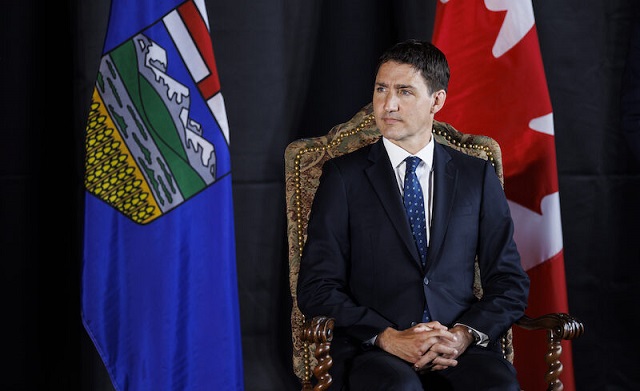
Documents have revealed that Prime Minister Justin Trudeau’s government paid the World Economic Forum (WEF) to produce a report justifying its radical “climate change” policies, including the infamous carbon tax.
According to documents obtained by Conservative MP Leslyn Lewis through an Order Paper Question, Trudeau’s Environment and Climate Change (ECC) department’s then-minister, Catherine McKenna, commissioned the socialist WEF to produce a report supporting Trudeau’s environmental agenda in August 2019.
“Trudeau paid the WEF nearly $500K of Canadian taxpayer money for the New Nature Economy Report justifying his carbon tax,” Lewis wrote in a March 18 post on X, formerly known as Twitter.
“This was revealed through a question I submitted to the government,” she added. “Global interest groups should not be trusted to care about the prosperity of Canadians.”
Trudeau paid the WEF nearly $500K of Canadian taxpayer money for the New Nature Economy Report justifying his carbon tax. This was revealed through a question I submitted to the government. Global interest groups should not be trusted to care about the prosperity of Canadians. pic.twitter.com/dt4pBOdqwm
— Dr. Leslyn Lewis (@LeslynLewis) March 18, 2024
The report, which cost taxpayers $493,937, was meant to make an economic case for Trudeau’s environmental agenda, including his ever-increasing carbon tax.
According to the newly revealed documents, the ECC commissioned the report “to enable [the WEF] to produce and disseminate a report that will establish the business and economic case for safeguarding nature.”
“This report will be directed at senior decision makers in governments and businesses who have the influence and ability to shift business-as-usual approach,” it added.
The report, titled New Nature Economy Report Series, was published six months later, providing everything the Trudeau government had requested.
The WEF report recommended that “carbon pricing should also be introduced” as a way “to tackle rampant levels of deforestation and combat climate change simultaneously.”
“Ultimately, to make nature-positive models investable, explicitly pricing in and articulating environmental cost factors to penalize unsustainable practices – such as through carbon taxes, for example – will be a game changer,” it claimed.
The report further suggested that, “If 12 other countries rolled out a tropical carbon tax like those of Costa Rica and Colombia, together they could raise a total of $1.8 billion each year to invest in natural-climate solutions.”
The newly revealed documents come as Trudeau has refused to pause the carbon tax hike scheduled for April 1 despite appeals from seven of ten provincial premiers.
Trudeau’s carbon tax, framed as a way to reduce carbon emissions, has cost Canadian households hundreds of dollars annually despite rebates.
The increased costs are only expected to rise, as a recent report revealed that a carbon tax of more than $350 per tonne is needed to reach Trudeau’s net-zero goals by 2050.
Currently, Canadians living in provinces under the federal carbon pricing scheme pay $65 per tonne, but the Trudeau government has a goal of $170 per tonne by 2030.
The April 1 tax hike will increase the federal carbon tax to 17 cents per liter of gasoline, 21 cents per liter of diesel, and 15 cents per cubic meter of natural gas.
In addition to seven out of ten of Canada’s premiers opposing the tax hike, a recent survey found that 70 percent of Canadians likewise oppose Trudeau’s carbon tax increase.
However, despite appeals from politicians and Canadians alike, Trudeau remains determined to increase the carbon tax regardless of its effects on Canadians’ lives.
“My job is not to be popular – although it helps. My job is to do the right things for Canada. Now. And do the right things for Canadians,” he declared.
The Trudeau government’s current environmental goals – which are in lockstep with the United Nations’ 2030 Agenda for Sustainable Development – include phasing out coal-fired power plants, reducing fertilizer usage, and curbing natural gas use over the coming decades.
The reduction and eventual elimination of so-called “fossil fuels” and a transition to unreliable “green” energy has also been pushed by the World Economic Forum – the aforementioned group famous for its socialist “Great Reset” agenda – in which Trudeau and some of his cabinet are involved.
Great Reset
Surgery Denied. Death Approved.
Canada’s assisted-death regime has reached a point most people assumed was dystopian fiction and it’s doing so with bureaucratic calm. A woman in Saskatchewan, Jolene Van Alstine, suffering from a rare but treatable parathyroid disease, has applied for MAiD not because she is dying, but because she can’t access the surgery that would let her live.
Read that again. Not terminal. Not untreatable. Just abandoned by a system that has the audacity to call itself “universal.”
Kelsi Sheren is a reader-supported publication.
To receive new posts and support my work, consider becoming a free or paid subscriber.
Her assisted death is scheduled for January 7, 2026.
And the country shrugs. Van Alstine described spending years curled on a couch, nauseated, in agony, isolated, and pushed past endurance. The disease is brutal, but treatable a surgery here, a specialist there. The kind of medical intervention that in a functional system wouldn’t even make the news.
But in Saskatchewan? There are no endocrinologists accepting new patients. Without one, she can’t get referred. Without a referral, she can’t get surgery. Without surgery, she loses her life either slowly through suffering, or quickly through state-sanctioned death.
If you’ve ever lived through pain that warps time…
If you’ve ever had your mind hijacked by trauma…
If you’ve ever stared down suffering with no end in sight…
You know how thin the line can get between endurance and surrender.
And that’s why this story hits differently: it reveals how fragile people become when the system meant to protect them becomes an accomplice in their despair.
Canada frames MAiD as empowerment. As compassion. As choice.
But choice is only real when the alternatives are viable.
If your options are slow agony or assisted death, that’s not autonomy it’s coercion with a friendly tone.
Disability advocates, chronic-pain patients, the elderly, and low-income Canadians have been sounding the alarm for years: MAiD is expanding faster than support systems can catch up. Every expansion widens the chasm between the rhetoric of compassion and the lived experience of those who actually need help.
The Canadian Human Rights Commission itself warned that MAiD is being accessed because people cannot get the services required to live with dignity. And dignity matters. Anyone who has lived on the edge knows this: humans don’t just need survival, we need a reason to keep surviving.
When the healthcare system withholds that, death can look like mercy. This is the part polite society doesn’t want to confront.
Canada’s healthcare system is collapsing. Not strained. Not overburdened. Collapsing.
We have a growing list of citizens choosing death because medicine has become a lottery →
• a quadriplegic woman who applied for MAiD because she couldn’t secure basic home-care support
• veterans offered MAiD instead of trauma treatment
• homeless Canadians considering MAiD because they can’t survive winter
And now a woman denied a simple, lifesaving surgery.
At some point, we have to call this what it is: a nation outsourcing its failures to death. I’ve sat with veterans who couldn’t find themselves inside their own minds after war. I’ve watched people suffer silently because bureaucracy didn’t move fast enough to keep up with their pain.
I’ve coached clients who were one dropped ball, one missed appointment, one shut door away from losing the will to fight.
The lesson is the same every time. People don’t break because they’re weak. People break because they’re left alone with their suffering.
Van Alstine wasn’t offered community.
She wasn’t offered care.
She was offered an exit.
And she took it.
Not because she wanted to die but because Canada didn’t give her any path to live.
We need to stop pretending this is compassionate. Compassion is presence. Compassion is support. Compassion is a surgeon who actually exists, a referral that actually happens, a system that catches someone before they fall into the dark.
If MAiD is going to exist, it must be the last, quiet, grave option not the discounted aisle Canada sends you to when the cost of real care is too high.
A society reveals its soul by how it treats the people who can’t fight for themselves.
Right now, Canada is revealing something hollow.
People will debate the ethics of assisted dying forever. Fine. Debate it. But this is the wrong battleground. The real question is this →
What does it say about a country when death is easier to access than medical care?
Until Canada answers that honestly, we’re going to see more names on the calendar scheduled deaths, stamped and approved — for people who didn’t want to die. They just wanted someone to give them a chance to live.
Canada has failed every single citizen, and not a single person seems to care.
KELSI SHEREN
– – – – – – – – – – – –
SOURCE: https://righttolife.org.uk/
– – – – – – – – – – – –
One Time Donation! – Paypal – https://paypal.me/
Buy me a coffee! – https://buymeacoffee.com/
Let’s connect!
Youtube – https://www.youtube.com/@
Substack: https://substack.com/@
TikTok – https://x.com/KelsiBurns
Business
The EU Insists Its X Fine Isn’t About Censorship. Here’s Why It Is.
Europe calls it transparency, but it looks a lot like teaching the internet who’s allowed to speak.
|
When the European Commission fined X €120 million on December 5, officials could not have been clearer. This, they said, was not about censorship. It was just about “transparency.”
They repeat it so often you start to wonder why.
The fine marks the first major enforcement of the Digital Services Act, Europe’s new censorship-driven internet rulebook.
It was sold as a consumer protection measure, designed to make online platforms safer and more accountable, and included a whole list of censorship requirements, fining platforms that don’t comply.
The Commission charged X with three violations: the paid blue checkmark system, the lack of advertising data, and restricted data access for researchers.
None of these touches direct content censorship. But all of them shape visibility, credibility, and surveillance, just in more polite language.
Musk’s decision to turn blue checks into a subscription feature ended the old system where establishment figures, journalists, politicians, and legacy celebrities got verification.
The EU called Musk’s decision “deceptive design.” The old version, apparently, was honesty itself. Before, a blue badge meant you were important. After, it meant you paid. Brussels prefers the former, where approved institutions get algorithmic priority, and the rest of the population stays in the queue.
The new system threatened that hierarchy. Now, anyone could buy verification, diluting the aura of authority once reserved for anointed voices.
Reclaim The Net is sustained by its readers.
Your support fuels the fight for privacy, free speech and digital civil liberties while giving you access to exclusive content, practical how to guides, premium features and deeper dives into freedom-focused tech.
Become a supporter here.
However, that’s not the full story. Under the old Twitter system, verification was sold as a public service, but in reality it worked more like a back-room favor and a status purchase.
The main application process was shut down in 2010, so unless you were already famous, the only way to get a blue check was to spend enough money on advertising or to be important enough to trigger impersonation problems.
Ad Age reported that advertisers who spent at least fifteen thousand dollars over three months could get verified, and Twitter sales reps told clients the same thing. That meant verification was effectively a perk reserved for major media brands, public figures, and anyone willing to pay. It was a symbol of influence rationed through informal criteria and private deals, creating a hierarchy shaped by cronyism rather than transparency.
Under the new X rules, everyone is on a level playing field.
Government officials and agencies now sport gray badges, symbols of credibility that can’t be purchased. These are the state’s chosen voices, publicly marked as incorruptible. To the EU, that should be a safeguard.
The second and third violations show how “transparency” doubles as a surveillance mechanism. X was fined for limiting access to advertising data and for restricting researchers from scraping platform content. Regulators called that obstruction. Musk called it refusing to feed the censorship machine.
The EU’s preferred researchers aren’t neutral archivists. Many have been documented coordinating with governments, NGOs, and “fact-checking” networks that flagged political content for takedown during previous election cycles.
They call it “fighting disinformation.” Critics call it outsourcing censorship pressure to academics.
Under the DSA, these same groups now have the legal right to demand data from platforms like X to study “systemic risks,” a phrase broad enough to include whatever speech bureaucrats find undesirable this month.
The result is a permanent state of observation where every algorithmic change, viral post, or trending topic becomes a potential regulatory case.
The advertising issue completes the loop. Brussels says it wants ad libraries to be fully searchable so users can see who’s paying for what. It gives regulators and activists a live feed of messaging, ready for pressure campaigns.
The DSA doesn’t delete ads; it just makes it easier for someone else to demand they be deleted.
That’s how this form of censorship works: not through bans, but through endless exposure to scrutiny until platforms remove the risk voluntarily.
The Commission insists, again and again, that the fine has “nothing to do with content.”
That may be true on a direct level, but the rules shape content all the same. When governments decide who counts as authentic, who qualifies as a researcher, and how visibility gets distributed, speech control doesn’t need to be explicit. It’s baked into the system.
Brussels calls it user protection. Musk calls it punishment for disobedience. This particular DSA fine isn’t about what you can say, it’s about who’s allowed to be heard saying it.
TikTok escaped similar scrutiny by promising to comply. X didn’t, and that’s the difference. The EU prefers companies that surrender before the hearing. When they don’t, “transparency” becomes the pretext for a financial hammer.
The €120 million fine is small by tech standards, but symbolically it’s huge.
It tells every platform that “noncompliance” means questioning the structure of speech the EU has already defined as safe.
In the official language of Brussels, this is a regulation. But it’s managed discourse, control through design, moderation through paperwork, censorship through transparency.
And the louder they insist it isn’t, the clearer it becomes that it is.
|
|
|
|
Reclaim The Net Needs Your
With your help, we can do more than hold the line. We can push back. We can expose censorship, highlight surveillance overreach, and amplify the voices of those being silenced.
If you have found value in our work, please consider becoming a supporter.
Your support does more than keep us independent. It also gives you access to exclusive content, deep dive exploration of freedom focused technology, member-only features, and practical how-to posts that help you protect your rights in the real world.
You help us expand our reach, educate more people, and continue this fight.
Please become a supporter today.
Thank you for your support.
|
-
National13 hours agoLiberal bill “targets Christians” by removing religious exemption in hate-speech law
-
Business1 day agoThe EU Insists Its X Fine Isn’t About Censorship. Here’s Why It Is.
-
Focal Points2 days agoCommon Vaccines Linked to 38-50% Increased Risk of Dementia and Alzheimer’s
-
Business1 day agoCanada invests $34 million in Chinese drones now considered to be ‘high security risks’
-
Health1 day agoCDC Vaccine Panel Votes to End Universal Hep B Vaccine for Newborns
-
Economy1 day agoAffordable housing out of reach everywhere in Canada
-
Business22 hours agoThe Climate-Risk Industrial Complex and the Manufactured Insurance Crisis
-
Business10 hours agoLooks like the Liberals don’t support their own Pipeline MOU