
Crime
Here’s How A Venezuelan Gang Was Able To Infiltrate The US And Wreak Havoc In Major Cities

From the Daily Caller News Foundation

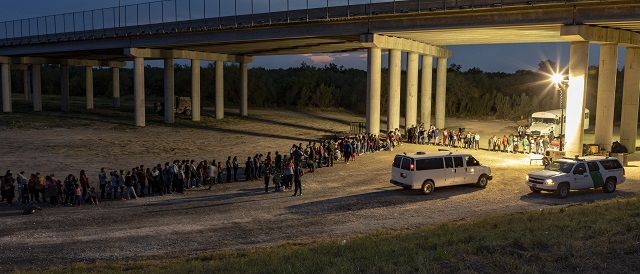
A notorious Venezuelan gang is extending its tentacles into the U.S. on the back of the Biden-Harris administration’s border crisis, and experts say that immigration authorities have no way of identifying the criminal group’s members before they hit American soil.
The gang, known as Tren de Aragua, has made headlines in recent weeks with its criminal activities in multiple states, according to multiple reports. Yet, border authorities have virtually zero tools to detect Venezuelan migrants’ affiliations with the gang, as the U.S.’ diplomatic relationship with the beleaguered country is effectively on ice, experts told the Daily Caller News Foundation.
“We have next to no vetting for the Venezuelans who are entering the country, because we have no relationship with the government of Venezuela and that’s true of other migrant nationalities,” Jessica Vaughan, director of policy studies at the Center for Immigration Studies, told the DCNF. “We have no way of knowing whether they were in prison in Venezuela. We have no idea if they’ve been living in a third-world country for years before they tried to come to the United States. We’re essentially letting them in on their word.”
A hotel in El Paso, Texas, was shut down on Sept. 9 following an investigation into Tren de Aragua and other gangs’ use of the complex where alleged incidents of drug use and prostitution occurred, according to the El Paso Times. Additionally, the Dallas Police Department confirmed to the DCNF that there is an ongoing investigation into the gang’s activities in the area.
“We’re really not seeing Tren de Aragua operate in McAllen or Del Rio, or anything else like that,” Ammon Blair, former Customs and Border Patrol (CBP) agent and senior fellow at the Texas Public Policy Foundation, told the DCNF. “But they are operating in El Paso, because it’s a major city … there’s a large diaspora of Venezuelans there.”
In Aurora, Colorado, 10 Tren de Aragua members were identified by police on Sept. 11 as part of an investigation into a string of alleged criminal incidents at apartment complexes in the city, according to FOX 31. The alleged crimes include felony menacing, assault, motor vehicle theft and numerous shootings.
The property management company overseeing the complexes said the gang had effectively “taken over” the buildings, according to The Denver Post.
Tren de Aragua’s nefarious presence has even managed to draw the gaze of the Biden Treasury Department, which declared the gang a transnational criminal organization and announced sanctions in July, citing its involvement in human trafficking, drug trafficking and money laundering. Tren de Aragua started as a prison gang in the Venezuelan state of Aragua in 2013, taking over the Torocon prison and making it their base of operations, growing to around 5,000 members in 2023, according to Insight Crime.
Unlike other gangs, Tren de Aragua doesn’t have a defined set of tattoos that would make it easy for law enforcement to identify members, according to the El Paso Times. The gang’s main target is Venezuelan migrants, who they extort, smuggle and sex traffic to other countries, including the U.S., according to Insight Crime.
In order for CBP to get criminal records from Venezuelans, they would have to use Interpol data, as the U.S. doesn’t have a memorandum of agreement with Venezuela to exchange criminal records, Blair told the DCNF. Moreover, CBP often has to release the detainee before they can obtain criminal records from Interpol.
“Once Biden came into office and offered catch and release policies, temporary protected status, you name it, the Venezuelans started fleeing to the U.S. from all the other countries as well,” Blair told the DCNF. “So when we receive a lot of Venezuelans at the border, we’ll see that many Venezuelans have multiple identification cards from multiple countries, and so it’s very difficult to ascertain who they are.”
From fiscal year 2021 to 2023, CBP saw a 421% increase in Venezuelans encountered at the southern border, according to CBP data.
CBP told the DCNF that the agency has enhanced measures to screen for gangs, and any person deemed a threat is referred for prosecution or investigation as required. It also cited the Biden administration’s initiatives to curtail illegal immigration from the southern border, saying that the majority of southern border encounters in the last three fiscal years have resulted in a removal, return or expulsion.
“They’re now going to be in every diaspora of Venezuelans or Venezuelan communities inside the United States,” Blair added. “And now that we’ve imported over half a million Venezuelans since Biden’s been in office, they’re going to be in every one of those communities.”
Republican Texas Gov. Greg Abbott announced Monday he would designate Tren de Aragua a terrorist organization and bring the “full weight of the government” on the gang, according to The Texas Tribune. The gang has been active in the state since 2021, and more than 3,000 illegal immigrants from Venezuela have been arrested since then, according to Abbott.
“When it comes to migration from South America and Venezuela, I think that’s somewhere where they have a comparative advantage that they’ve taken advantage of,” Zack Smith, senior legal fellow at the Heritage Foundation told the DCNF. “And then I think also, in that same way, drug trafficking seems to be something that they’re able to tap into as well.”
In 2023, the Department of Homeland Security Investigations (HSI) partnered with Peru to create a “Transnational Crime Investigation Unit” to combat Tren de Aragua, according to Dialogo Americas. Peru is one of the many South American countries involved in the gang’s network for trafficking people and drugs.
“We’re not heavily scrutinizing anyone coming in,” Blair told the DCNF. “We’re not detaining them. We’re using alternatives to detention, so no one’s really being vetted.”
A U.S. Department of State spokesperson told the DCNF that the agency is working to contain the threat from the gang nationwide, citing efforts from the Biden administration to curtail illegal border crossings. The agency also said they partner with the Department of Homeland Security and the Department of Justice to disrupt the gang’s activity abroad and have improved their vetting tools.
The El Paso Police Department did not respond to the DCNF’s requests for comment.
Featured Image: Mani Albrecht U.S. Customs and Border Protection Office of Public Affairs Visual Communications Division




Vancouver police say they have seized a grenade launcher, four guns, and nearly 500 grams of fentanyl and other hard drugs from a fortified Downtown Eastside rooming house that was allegedly feeding a synthetic opioid supply line through the city’s most drug-ravaged blocks.
“Task Force Barrage has come to an end, but our work to curb violence and disrupt organized crime in the Downtown Eastside continues,” Sergeant Steve Addison said, adding “the proliferation of violence and weapons in some residential buildings continues to put the neighbourhood at risk.”
The latest investigation began November 13, when a 42-year-old man suffered serious injuries in an assault near Carrall Street and East Cordova and was taken to hospital. Officers followed leads to a rooming house at 50 East Cordova Street, in the heart of a street-level open drug market that has become notorious in photos and news clips around the world.
On November 18, police say they uncovered a stockpile of illicit drugs, guns and weapons in three rooms of the East Cordova building. According to Addison, there are signs that parts of the property, which is supposed to house low-income residents, were repurposed as a hub to store weapons and distribute contraband throughout the neighbourhood, with some areas “fortified with countersurveillance measures to avoid detection from law enforcement.”
Items seized include four firearms, two imitation guns, a grenade launcher, a firearm suppressor, seven machetes, four flare guns, bullwhips, baseball bats, body armour, handcuffs and ammunition. Officers also seized 486 grams of fentanyl, cannabis, Dilaudid pills and methamphetamine – a quantity police say represents more than 2,500 single doses.
Meanwhile, in a separate update posted November 26 — the day before VPD announced the Cordova Street raid — Vancouver Fire Rescue Services said that on Tuesday, November 21, firefighters responded to 54 overdoses, the highest single-day total in the department’s history. The service said it averaged about 16 overdose calls per day in May, but that figure has surged in recent weeks, and during the most recent income-assistance week, firefighters were averaging roughly 45 overdose responses per day.
While police have not publicly linked the East Cordova seizure to any specific cartel, the mix of fentanyl, fortified real estate and a small armoury of weapons closely tracks the profile of a separate, high-profile British Columbia case in which provincial authorities say a Sinaloa Cartel–aligned cell embedded itself just south of Vancouver.
In that case, a civil forfeiture lawsuit alleged a Sinaloa Cartel–linked fentanyl and cocaine trafficking group set up in a multi-million-dollar mansion near the U.S. border, capable of negotiating major cocaine import deals with Ismael Garcia—known as “El Mayo”—the reputed Sinaloa Cartel chief. According to the filings, the Canada-based syndicate involved at least three men, and belonged to a violent drug trafficking organization that “used and continues to use violence, or threats of violence, to achieve its aims.”
Investigators alleged the Surrey-based group trafficked ketamine, methamphetamine, Xanax, oxycodone, MDMA and fentanyl. “As part of these efforts, the drug trafficking organization has agreed to, and made arrangements to, purchase cocaine from the Cártel de Sinaloa in Mexico,” the filings stated. They added: “the Sinaloa Cartel is a terrorist entity, and the government of Canada listed it as such on February 20, 2025.”
RCMP said they uncovered a substantial cache of weapons and narcotics during a search of the Surrey property on 77th Avenue on September 23, 2024. Opioids seized from the mansion included 400 grams of counterfeit Xanax, 810 oxycodone pills, 5.5 grams of fentanyl and nearly a kilogram of Ecstasy. The province is now seeking forfeiture of the house, which sits about 20 minutes from the Peace Arch border crossing north of Seattle.
Court submissions detailed an arsenal of 23 weapons – ten handguns, two sawed-off shotguns, two hunting rifles, seven assault rifles (two reportedly fitted with screw-on suppressors), and a speargun – alongside about 3.5 kilograms of ketamine and methamphetamine hidden in a compartment in one suspect’s room, hundreds of counterfeit alprazolam pills, a stash of oxycodone, and nearly CAD 15,000 in bundled cash “not consistent with standard banking practices.”
Viewed together, the Downtown Eastside raid and the Surrey mansion case sketch out different ends of what appears to be the same continuum, ultimately pointing to senior criminal leaders in Mexico and China.
The Bureau is a reader-supported publication.
To receive new posts and support my work, consider becoming a free or paid subscriber.
Crime
B.C.’s First Money-Laundering Sentence in a Decade Exposes Gaps in Global Hub for Chinese Drug Cash

Port Coquitlam Mayor Brad West met with Biden Secretary of State Antony Blinken in 2023, to discuss Canada’s enforcement gap on fentanyl money laundering.
Chinese underground-banking conviction is a baby step in a jurisdiction that some experts see as North America’s center of gravity for transnational crime.
In a milestone that is staggering for its rarity in a jurisdiction regarded as a global nexus of Chinese transnational money laundering that facilitates fentanyl trafficking for Mexican and Iranian gangs, British Columbia’s anti-gang unit has finally secured its first money laundering sentencing in a decade.
On Monday, a B.C. Supreme Court judge sentenced 37-year-old Richmond resident Alexandra Joie Chow to 18 months in jail for laundering the proceeds of crime, following a six-year investigation that targeted illegal Chinese underground casinos and unlicensed money transfer businesses in Metro Vancouver. The court also ordered the forfeiture of cash and bank drafts seized during the probe, the Combined Forces Special Enforcement Unit of B.C. (CFSEU) says.
Chow’s case marks the first time in roughly ten years that a money-laundering investigation in British Columbia has actually resulted in a sentencing — a remarkable data point in a province where hundreds of billions have washed through casinos, banks and real estate, according to The Bureau’s estimates, yet almost no one has been successfully prosecuted for the underlying financial crime.
While Chow’s case in itself is relatively small in dollar terms, it followed the catastrophic collapse of the RCMP’s E-Pirate probe into a Richmond underground bank called Silver International, which was alleged to have laundered over $1 billion through a network of Chinese Triad leaders known as “Sam Gor” or “The Company” — a scheme that moved drug cash collected in Chinese diasporas across North and Latin America, cycling the funds back to hundreds of accounts in China, in part through lending gang cash to Asian high-rollers who washed massive sums through B.C. government casinos.
The collapse of E-Pirate raised significant concerns in Washington around Canada’s capacity to prosecute fentanyl money laundering and trafficking. Vancouver-area Mayor Brad West has told The Bureau that the failure of Canadian authorities to secure convictions in that case was explicitly noted in 2023 by senior figures in the Biden administration, including Secretary of State Antony Blinken, in discussions about Canada’s role in North American drug trafficking.
Chow pleaded guilty in February 2025 to one count of laundering proceeds of crime after prosecutors alleged she was part of an underground loan-sharking and money-services scheme that operated in the Lower Mainland. Her plea came almost two years after B.C.’s Joint Illegal Gaming Investigation Team first announced charges.
The trail to that conviction began in August 2019, when B.C.’s Joint Illegal Gaming Investigation Team (JIGIT) quietly launched an investigation into the alleged loan-sharking and money-laundering activities of a man and a woman. Investigators believed the suspects were charging criminal interest rates and operating an unlicensed money services business.
Over the course of the probe, police say they developed evidence that the suspects allegedly laundered more than $828,000 in Canadian cash. On November 5, 2021, JIGIT executed a series of search warrants on properties in Richmond and Burnaby, as well as three vehicles associated to the investigation.
The searches resulted in the seizure of a number of items believed to be tied to money laundering and loan-sharking, including score sheets with client names and payment due dates, four cellular phones, two bank drafts totaling $50,000, and $10,680 in Canadian currency and three high-end vehicles.
Two years later, on November 1, 2023, the B.C. Prosecution Service approved four sets of charges against Chow: money laundering, possessing proceeds of crime, and entering into agreements to receive criminal-rate interest — classic loan-sharking. No other individuals were ultimately charged in the case.
As CFSEU-BC media officer Sgt. Sarbjit Sangha put it in the unit’s statement Monday, this is “the first time in a decade that a money laundering investigation in British Columbia has resulted in a sentencing,” and it “underscores the impact of collaborative investigative work” and JIGIT’s mandate to tackle illegal gaming tied to organized crime, loan-sharking and sophisticated bookmaking.
The scale of the enforcement gap this case exposes is critical to understanding current irritants between Washington and Ottawa, and the Trump administration’s leverage of tariffs on Canada. That campaign of economic pressure, some U.S. and Canadian officials have informed The Bureau, apparently extends from deep concerns in both the Biden and Trump administrations over Ottawa’s lack of meaningful action against massive money laundering through Canada’s financial system — including the TD Bank fentanyl money laundering case prosecuted in the Tri-State area, which exposed transactions similar to those revealed in the Chow investigation in Richmond.
The Cullen Commission into money laundering in B.C. found that by 2014, casinos in the province were accepting nearly $1.2 billion in cash transactions of $10,000 or more in a single year, many involving patrons who showed classic indicators of criminal cash — bricks of small bills delivered in bags by couriers closely watched by organized-crime investigators. JIGIT itself was created as part of the province’s response to that crisis. In a 2021 presentation to the Cullen Commission, then-Unit Commander Staff Sgt. Joel Hussey explained that JIGIT’s money-laundering and loan-sharking probes were focused on “top-tier” organized criminals exploiting casinos and banks, particularly at Richmond’s River Rock Casino Resort, Vancouver’s Parq Casino and Burnaby’s Grand Villa, where investigators saw the most entrenched high-roller criminal activity.
Yet the province’s record in actually getting such cases to the finish line has been abysmal. The most notorious example remains E-Pirate, the massive RCMP investigation that targeted Silver International, a Richmond underground bank alleged to be moving over $1 billion a year in drug and casino cash for Chinese and Mexican cartels and Middle Eastern networks. That case collapsed in 2018–2019 after federal prosecutors mistakenly exposed a confidential informant, leading to a stay of charges despite years of work and huge evidence seizures.
International bodies such as the Financial Action Task Force later used E-Pirate as a case study, describing a “professional” Richmond-hub laundering network that allegedly used B.C. casinos and real estate to clean and move drug proceeds on a global scale. Cullen’s final report, released in 2022, concluded that sophisticated money-laundering networks were moving “staggering amounts” of illicit funds through B.C., while law-enforcement and regulatory agencies failed to respond in a timely or coordinated way.
Whether Chow’s 18-month sentence becomes a template for future Vancouver Model prosecutions — or remains an isolated success in a province still struggling to hold money launderers to account — will be the next test for B.C.’s anti-gang and financial-crime enforcement regime.
Those questions are not just academic in Ottawa. As The Bureau has previously reported, senior officials in Washington — Democrats and Republicans alike — have for years warned that Canada’s failure to deliver sustained proceeds-of-crime prosecutions, and its lack of a RICO-style racketeering law, has turned the country into a structural weak point in North America’s fight against cartel-linked fentanyl networks.
As reported previously by The Bureau, in a high-level meeting in 2023, according to Vancouver-area Mayor Brad West, a longstanding critic of transnational drug networks in his province, Secretary of State Antony Blinken stressed that Washington believes Beijing is effectively weaponizing fentanyl against North Americans—and that Canada stands out as a worrisome weak link in the global supply chain.
West, reflecting on his encounter with Blinken, argued that only bold legislative change, coupled with a willingness to challenge entrenched legal barriers, can dispel the U.S. government’s unease over Canada’s approach. “Secretary Blinken specifically noted the lack of a RICO-style law in Canada,” West said. “He talked about how, in the United States, that law had been used to take down large portions of the mafia. Then he looked at us—one of America’s closest allies—and saw a very concerning weak link.”
According to West, Blinken pointed to China’s role in funneling precursor chemicals into fentanyl labs. He warned that China’s government, if inclined, could stem the flow but has little interest in doing so. “He was incredibly candid,” West recalled. “He confirmed the connection between the Chinese Communist Party, the triads, and the Mexican cartels, telling me these groups are working together—and it’s Canada where they’re finding a safe operating base.”
Blinken also conveyed to West that U.S. agencies had grown hesitant to share certain intelligence with their Canadian counterparts. “He told me that U.S. intelligence and law enforcement are withholding some evidence because they don’t believe we’ll act on it,” West explained. “They’ve lost confidence.”
West added that in ongoing communications, he had learned American officials are shocked that major figures in Asian organized crime “seem to have so much access to our political class. They’re basically saying, ‘What’s going on in Canada?’”
A major concern, according to West, is how known criminals manage to appear at political events or fundraisers with little oversight. “It’s not necessarily that politicians are complicit, but our political structures have weak guardrails,” West said. “The Americans see pictures of transnational criminals mingling at official gatherings and find it baffling.”
The Bureau is a reader-supported publication.
To receive new posts and support my work, consider becoming a free or paid subscriber.


A look inside the ‘floatel’ housing B.C.’s LNG workforce
Trump Deals Biden’s EV Dreams A Death Blow

FBI may have finally nabbed the Jan. 6 pipe bomber

Alberta will use provincial laws to stop Canadian gov’t from trying to confiscate legal firearms
-
Automotive1 day ago
Trump Deals Biden’s EV Dreams A Death Blow
-
 Alberta1 day ago
Premier Smith: Canadians support agreement between Alberta and Ottawa and the major economic opportunities it could unlock for the benefit of all
-
 Focal Points1 day ago
Pharma Bombshell: President Trump Orders Complete Childhood Vaccine Schedule Review
-
 Censorship Industrial Complex2 days ago
Frances Widdowson’s Arrest Should Alarm Every Canadian
-
 Opinion1 day ago
Country music star Paul Brandt asks Parliament to toughen laws against child porn
-
 Automotive1 day ago
Canada’s EV Mandate Is Running On Empty
-
 Alberta2 days ago
A Memorandum of Understanding that no Canadian can understand
-
 Aristotle Foundation2 days ago
The extreme ideology behind B.C.’s radical reconciliation agenda