
Bruce Dowbiggin
Getting Real About Justin’s Real Estate Economy. It Won’t Last

Have you ever been to a concert where a hot new product like Tesla is mentioned and many in the crowd applaud in approval? Have you been at a dinner party when you say you went to a new Thai restaurant, and everyone at the table explodes in rhapsodic glee? Have you ever been to see a comic and he mentions he has the latest iPhone with the nifty camera and people actually cheer?
You see those people cheering a piece of tech or a style of cuisine? Those are the people who believed Justin Trudeau when he told them to sink everything into real estate when interest rates were near zero. They. Will. Believe. Anything. So long as they think it makes them cool kids. Trudeau could say he can control the weather by stopping cows from farting, and they’ll be wearing a bovine flatulence T-shirts pronto.

Now, we can hear you laughing in derision at our skepticism about the real estate-economy that has taken over the nation— the new economy that Justin fed, watered and then bragged about. (To the exclusion of the other cornerstones of our once-dynamic nation state.) The one that will be going to Market one of these days for a meeting with an air compressor.
Again, you laugh. Despite the housing shortage Justin says we can easily accommodate two million new souls a year, no problem. He says Trump was a vile racist for wanting to exclude unhinged radicals from zombie countries back in 2017. The freshly-arrived from Trump’s “shithole countries” with “shithole value systems” and “shithole economies’ will prop up the value of Canada’s two-million dollar cash-cow bungalow in West Van or Etobicoke. And the Happy People believe.
Why? Because Justin and his cabinet are in Control, and they’ll just rein in these types when they get here and start asking that Jews be exterminated or white people surrender the merit system to DEI droogs. That little dustup at the universities where nervous trust-fund virgins claim to be onside with systemic rape? Justin can stop them anytime. Everything is cool. After all, Canada is the model for a postmodern state.
And that stuff about how the Canadian real estate market being 80 percent propped up by drug money, kleptocracy profits and Blackrock? Pshaw. That is just the Far Right Diagolons trying to panic you into hiding your money from the government which just wants to send it to the “shithole” countries in a kickback loop. If nothing else, the banks will save you— if there’s any shareholder value left after this deranged DEI diversion.
Can’t happen here? We know people who were around the EU in 2008 when the U.S. mortgage debacle cratered economies around the world. For years they’d been served by Poles in the service industry, Spaniards in the restaurant kitchens and Bulgarians doing the physical labour. Life was good. Everyone drove a Beemer and owned a condo overlooking the sea.
Then, one day, they noticed that all the airport parking lots were overflowing with Beemers that went unclaimed. No one had paid rent in months. The banks noticed that all these lovely fellow citizens of the EU had drained their savings, reached their cash credit limit on the Mastercard and skedaddled with the dough. Funny, they all must have gone on holidays to once, no?

No. They were gone. Bye bye. Adios. And the credit bubbles in Ireland, Norway, Iceland, France and other EU worthies popped like the champagne they’d been sipping for years on easy credit and idiotic notions of productivity. Nations like Iceland went bankrupt overnight. Counties in England threw their keys on the table. People’s life savings evaporated.
But Justin says that won’t happen here on his co-watch with Jagmeet the Bespoke. Sure, no one under the age of 40 can afford those two-million dollar cash-cow bungalows in West Van or Etobicoke. But those old Boomer geezers will die soon, and after we tax the daylights out of the estate, the kiddos will inherit the house. Probably after we turn it into a four-plex or fine them for having empty bedrooms because they couldn’t afford kids.
One of the ferocious beauties of market economies is their way of periodically turning on themselves when too many people are getting rich too easily. The Canadian RE economy of Justin Trudeau is one of them. It’s about a decade old without any sign of dropping. Life is good. Everyone drives a Tesla and rents a condo overlooking the sea.
Little wonder. Everything he and his faculty lounge of dimwits like Chrystia Freeland, Melanie Joly and Steven Guilbeault have done this decade has been to prop up the value of real estate owned by their real pals in Asia, Europe, the assorted kleptocracies in Africa or the sub-continent. It was like an ad for Chlorox the way these “investors” blithely laundered their dirty money in Canadian condos and low-rises. When news leaked out that mobsters were using casinos in B.C. (where Justin’s maternal side came from) as a laundering station it was covered up very quickly.
But the clock ticks. Even Justin’s former finance minister Bill Morneau is warning that the bubble is going to pop if Justin keeps printing more money to keep the real estate values so unsupportably high. The entire middle class of Canada, which has ridden the real estate train, will see their life savings evaporate like Jody Wilson Raybould’s political career.

No matter. Justin’s been living in government housing since 2015 (some of it with his Mommy). What does a trust-fund nit know about making rent cheques or a mortgage payment? Without Sophie spending like a dervish, he never needs to look at an America Express card again. He’s got 17 more months to build up credits with his future benefactors, and he’s not applying the handbrake now.
Okay, you can applaud now.
Bruce Dowbiggin @dowbboy is the editor of Not The Public Broadcaster A two-time winner of the Gemini Award as Canada’s top television sports broadcaster, he’s a regular contributor to Sirius XM Canada Talks Ch. 167. Now for pre-order, new from the team of Evan & Bruce Dowbiggin . Deal With It: The Trades That Stunned The NHL & Changed Hockey. From Espo to Boston in 1967 to Gretz in L.A. in 1988 to Patrick Roy leaving Montreal in 1995, the stories behind the story. Launching in paperback and Kindle on #Amazon this week. Destined to be a hockey best seller. https://www.amazon.ca/Deal-Trades-Stunned-Changed-Hockey-ebook/dp/B0D236NB35/

““He knows nothing; and he thinks he knows everything. That points clearly to a political career.” George Bernard Shaw
In the days immediately following Donald Trump’s rude intervention into the 2025 Canadian federal election— suggesting Canada might best choose American statehood— two schools of thought emerged.
The first and most impactful school in the short term was the fainting-goat response of Canadian’s elites. Sensing an opening in which to erode Pierre Poilievre’s massive lead in the 2024 polls over Justin Trudeau, the Laurentian elite concocted Elbows Up, a self-pity response long on hurt feelings and short on addressing the issues Trump had cited in his trashing of the Canadian nation state.
In short order they fired Trudeau into oblivion, imported career banker Mark Carney as their new leader in a sham convention and convinced Canada’s Boomers that Trump had the tanks ready to go into Saskatchewan at a moment’s notice. The Elbows Up meme— citing Gordie Howe— clinched the group pout.

(In fact, Trump has said that America is the world’s greatest market, and if those who’ve used it for free in the past [Canada] want to keep special access they need to pay tariffs to the U.S. or drop protectionist charges on dairy and more against the U.S.)
The ruse worked out better than they could have ever imagined with Trump even saying he preferred to negotiate with Carney over Poilievre. In short order the Tories were shoved aside, the NDP kneecapped and the pet media anointed Carney the genius skewing Canada away from its largest trade partner to the Eurosphere. We remain in that bubble, although the fulsome promises of Carney’s first days are now coming due.
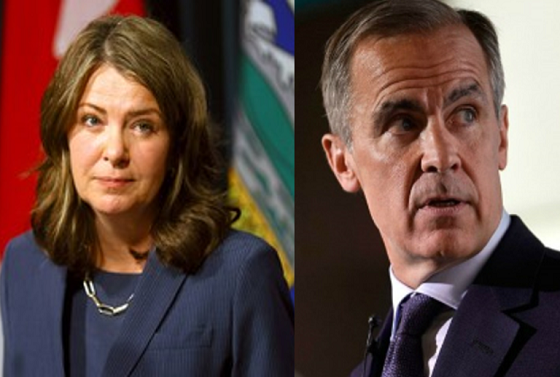
Which brings us to the second reaction. That was Alberta premier Danielle Smith bolting to Mar A Lago in the days following Trump’s comments. Her goal was to put pride aside and accept that a new world order was in play for Canada. She met with U.S. officials and, briefly, with Trump to remind them that Canada’s energy industry was integral to American prosperity and Canadian stability.
Needless to say, the fainting goats pitched a fit that not everyone was clutching pearls and rending garments in the wake of Trump’s dismissive assessment of his northern neighbours. Their solution to Trump was to join China in retaliatory tariffs— the only two nations to do so— and to boycott American products and travel. Like the ascetic monks they cut themselves off from real life. Trump has yet to get back to Carney the Magnificent

And Smith? She was a “traitor” or a “subversive” who should be keel hauled in the North Saskatchewan. For much of the intervening months she has been attacked at home in Alberta by the N-Deeps and in Ottawa by just about everyone on CBC, CTV, Global and the Globe & Mail. “How could she meet with the Cheeto?”
Nonetheless conservatives in the province moved toward a more independence within Canada. Smith articulated her demands for Alberta to prevent a referendum on whether to remain within Confederation. At the top of her list were pipelines and access to tidewater. Ergo, a no-go for BC’s squish premier David Eby who is the process of handing over his province to First Nations.
It became obvious that for all of Carney’s alleged diplomacy in Europe and Asia (is the man ever home?) he had a brewing disaster in the West with Alberta and Saskatchewan growing restless. In a striking move against the status quo, Nutrien announced it would ship its potash to tidewater via the U.S., thereby bypassing Vancouver’s strike-prone, outdated port and denying them billions.

Suddenly, Smith’s business approach began making eminent good sense if the goal is to keep Canada as one. So we saw last week’s “memorandum of understanding” between Alberta and Ottawa trading off carbon capture and carbon taxes for potential pipelines to tidewater on the B.C. coast. A little bit of something for everyone and a surrender on other things.
The most amazing feature of the Mark Carney/Danielle Smith MOU is that both politicians probably need the deal to fail. Carney can tell fossil-fuel enemy Quebec that he tried to reason with Smith, and Smith can say she tried to meet the federalists halfway. Failure suits their larger purposes. Which is for Carney to fold Canada into Euro climate insanity and Smith into a strong leverage against the pro-Canada petitioners in her province.
Soon enough, at the AFN Special Chiefs Assembly, FN Chief Cindy Woodhouse Nepinak told Carney that “Turtle Island” (the FN term for North America popularized by white hippy poet Gary Snyder) belongs to the FN people “from coast to coast to coast.” The pusillanimous Eby quickly piped up about tanker bans and the sanctity of B.C. waters etc.
Others pointed out the massive flaw in a plan to attract private interests to build a vital bitumen pipeline if the tankers it fills are not allowed to sail through the Dixon Entrance to get to Asia.
But then Eby got Nutrien’s message that his power-sharing with the indigenous might cause other provinces to bypass B.C. (imagine California telling Texas it can’t ship through its ports over moral objections to a product). He’s now saying he’s open to pipelines but not to lift the tanker ban along the coast. Whatever.
Meanwhile the kookaburras of isolation back east continue with virtue signalling on American booze— N.S. to sell off its remains stocks — while dreaming that Trump’s departure will lead to the good-old days of reliance on America’s generosity.
But Smith looks to be wining the race. B.C.’s population shrank 0.04 percent in the second quarter of 2025, the only jurisdiction in Canada to do so. Meanwhile, Alberta is heading toward five million people, with interprovincial migrants making up 21 percent of its growth.
But what did you expect from the Carney/ Eby Tantrum Tandem? They keep selling fear in place of GDP. As GBS observed, “You have learnt something. That always feels at first as if you have lost something.”
Bruce Dowbiggin @dowbboy is the editor of Not The Public Broadcaster A two-time winner of the Gemini Award as Canada’s top television sports broadcaster, his new book Deal With It: The Trades That Stunned The NHL And Changed hockey is now available on Amazon. Inexact Science: The Six Most Compelling Draft Years In NHL History, his previous book with his son Evan, was voted the seventh-best professional hockey book of all time by bookauthority.org . His 2004 book Money Players was voted sixth best on the same list, and is available via brucedowbigginbooks.ca.

@PaulChampLaw So, Wayne Gretzky flew on an FBI jet in April 2025 with Kash Patel to watch the Capitals? We all make choices…
Canadians always liked to see themselves as a reflective people. Not hurried into extremes. Slow to anger, quick to act on danger. Humble guys like Wayne Gretzky or Bobby Orr.
If there’s one thing that pissed them off it was anyone sucking up to Americans. Unless… they make it BIG in the U.S.. There was a big exemption for Canadians like Gretzky or Orr or Mike Myers who went south to make a fortune. For them the standards didn’t apply. They were heroes of the nation.
Until Donald Trump. Any Canadian hero not calling him Cheeto or Orange Man Bad or Hitler can expect to receive the mark of Cain from the Left huddling in the Great White North. Anyone excoriating POTUS 45/ 47 , however, is given a lifetime hall pass. No exceptions.

As Gretzky has learned again. Sunday a new photo emerged of the greatest offensive star in NHL history playing golf with the president at his Jupiter, Florida, golf course— the one where Ryan Wesley Routh tried to assassinate Trump. This led to the same predictable rending of garments and clutching of pearls that greeted Gretzky’s earlier declaration of loyalty to The Worst Human Being Ever®. Traitor is now the mildest description of 99 chez nous.
Give the Gretzkys credit, they didn’t disguise their decision. After Trump’s stunning (to some) win last November, Janet Gretzky cooed, “Congratulations Mr. President Donald J Trump ♥️🤍💙🇺🇸 You did it, You deserved it, you earned every bit of it. The world is a better place to have you as our Leader. Proud to be an American. Thank you for being such a great friend. May God keep watching over you ♥️🙏🏻♥️ Love our family to yours !”

The incensed Canadian left swung into action. “University of Alberta professor Robert Summers @RJSCity: “He’s been a pretty unlikable guy for a long time, this just further solidifies it. @ktownkeith: “Gretzky is disgusting and pathetic. I will celebrate when Ovechkin breaks his record. Also FYI, Mario was the best hockey player ever, not Whine Gretzky.” “People should burn all their old hockey jersey and cards of this guy. A shame”. And those were the nice ones.
The bile harkened to Orr supporting Trump in 2020. In our column at the time we noted the furious aftermath from Canadian hockey worshippers. Canadian sports media called Trump a “monster”, a “racist” and “a totalitarian”. You could heat most of the GTA with the steam emitted by their indignation at Orr having the temerity to speak out politically.

Orr has taken a low profile since, as even some in his hometown of Parry Sound wants nothing to do with him. “Poor Parry Sound,” tweeted Mary Lou George on Oct. 31, 2020. “What a disgrace #BobbyOrr has turned out to be. Guess he believes bragging about assaulting women really is just locker room talk since he wants Trump on his team. Sad.”
As with everything in the current McCoys vs Hartfields feud between the countries the venom launched at Gretzky’s decision to support Trump is underscored by the quaint notion that Canada is anything like it was when Gretzky’s 1988 wedding was a national celebration in Canada.
As the polling from the 2025 Canadian federal election showed young people are fed up with their Boomer parents’ nostalgia for the nation that smuggled the American diplomats out of Iran in 1979. They want economic opportunities and the ability to buy homes. What successive Liberal governments have given them is trans insanity, cities overrun by Hamas protesters and national debt backloaded on their shoulders.
To say nothing of Chinese infiltration of the economy and trade. No wonder they keep trying to change the words to O Canada all the time.
The decisions by Gretzky and Orr, among many expats, is partially due to Trump’s contrarian stance. But it also reflects a distance from the land where they grew up. Mike Myers and Elbows Up played on this sentimental loyalty to help Mark Carney succeed Justin Trudeau. But as more and more financial and talent stacks head south for opportunity (see Nutrien’s decision to ship Saskatchewan potash via the U.S., ignoring B.C.) it’s becoming clear that a reckoning is coming.
Trump’s brusque brushoff of Canada as no better than a 51st state was like an intervention with a friend or family member who’s gotten lost. It was a chance for self examination as we said in this 2018 column, Sometimes An Ingrate Nation.
Instead they bought the fake line that Trump would “invade” the country. Canadians lamented their treatment of “loyal old friend Canada”. But since the Iran heroics what has Canada done to help the U.S.? America has guarded Canada militarily. It has protected the trade lanes where Canadian goods are shipped. It has accepted hundreds of thousands of health patients unable to receive timely treatment in Canada’s single payer system.
It has encouraged Canada an automobile industry. It has allowed Canada’s film and TV industry subsidies. It has (so far) tolerated Canada’s dairy cartels. And it has welcomed Canadians by the millions to holiday or invest in America.
Now list the selfless deeds Canada has performed for America since Ken Taylor squirrelled the diplomats out of Tehran. Um… give us time. We sent Orr and Gretzky to the U.S. to jumpstart hockey. And all the SCTV folks. Canada also became the home for every foaming leftist in America seeking to escape Trump. Beyond that? Diddly squat.
So instead of the prolonged lamentations of the women and men and others of Canada, perhaps Elbows Up should listen to VPOTUS J.D. Vance. “And with all due respect to my Canadian friends, whose politics focus obsessively on the United States: your stagnating living standards have nothing to do with Donald Trump or whatever bogeyman the CBC tells you to blame. The fault lies with your leadership, elected by you.”
Bruce Dowbiggin @dowbboy is the editor of Not The Public Broadcaster A two-time winner of the Gemini Award as Canada’s top television sports broadcaster, his new book Deal With It: The Trades That Stunned The NHL And Changed hockey is now available on Amazon. Inexact Science: The Six Most Compelling Draft Years In NHL History, his previous book with his son Evan, was voted the seventh-best professional hockey book of all time by bookauthority.org . His 2004 book Money Players was voted sixth best on the same list, and is available via brucedowbigginbooks.ca.


A look inside the ‘floatel’ housing B.C.’s LNG workforce

Canada Needs an Alternative to Carney’s One Man Show

FBI may have finally nabbed the Jan. 6 pipe bomber

This new Canada–Alberta pipeline agreement will cost you more than you think
-
Energy2 days ago
A look inside the ‘floatel’ housing B.C.’s LNG workforce
-
 National2 days ago
Alberta will use provincial laws to stop Canadian gov’t from trying to confiscate legal firearms
-
 Energy2 days ago
ELZABETH MAY HAS IT WRONG: An Alberta to Prince Rupert Oil Pipeline Will Contribute to Greater Global Oil Tanker Safety
-
 illegal immigration1 day ago
While Trump has southern border secure, hundreds of thousands of illegal immigrants still flooding in from Canada
-
 Censorship Industrial Complex1 day ago
Canadian bishops condemn Liberal ‘hate speech’ proposal that could criminalize quoting Scripture
-
 COVID-192 days ago
Canadian legislator introduces bill to establish ‘Freedom Convoy Recognition Day’ as a holiday
-
 Business2 days ago
US Energy Secretary says price of energy determined by politicians and policies
-
 Censorship Industrial Complex1 day ago
Foreign Leaders Caught Orchestrating Campaign To Censor American Right-Wing Media Companies