
Opinion
Climate Murder? Media Picks Up Novel Legal Theory Suggesting Big Oil Is Homicidal


 From the Daily Caller News Foundation
By Nick Pope
A new narrative is making its way through major media outlets about major oil corporations: climate change that they purportedly caused is taking lives, and they could be held liable for homicide.
In recent weeks, numerous outlets have run stories or opinion pieces promoting or otherwise examining the novel legal theory, which is the subject of a new paper published by the Harvard Environmental Law Review, according to a Tuesday E&E News report detailing the architects’ efforts to market their idea to prosecutors. The Boston Globe, The Guardian, Newsweek, Inside Climate News and other outlets have all recently published pieces promoting the idea that leading oil companies could or should be charged with murder for their role in climate change, which the theory’s architects claim has caused thousands of deaths in the U.S.
David Arkush, who runs Public Citizen’s climate program, and Donald Braman, a professor at George Washington University’s law school, articulated the theory in a March paper. Public Citizen is a left-of-center organization founded by failed Green Party presidential candidate Ralph Nader that, among other things, pressures American International Group (AIG) to stop providing insurance coverage for fossil fuel companies, according to its website and Influence Watch.
“Activists and journalists have called executives of major oil companies ‘mass murderers,’ lamenting that ‘millions of human beings will die so that they can have private planes and huge mansions,’ and a growing chorus of communities devastated by [fossil fuel companies’] lethal conduct have begun to demand accountability,” the authors state in their paper. “But as of this writing, no prosecutor in any jurisdiction has charged [fossil fuel companies] with any form of homicide over climate-related deaths. They should.”
The paper also suggests that the American Petroleum Institute (API), a leading trade association for the oil and gas industry, was involved in the industry’s purported attempts to obscure the effects of emissions.
“The record of the past two decades demonstrates that the industry has achieved its goal of providing affordable, reliable American energy to U.S. consumers while substantially reducing emissions and our environmental footprint,” a spokesperson for API told the Daily Caller News Foundation. “Any suggestion to the contrary is false.”
The two authors contend that energy corporations were aware of the warming that emissions from their products and operations would cause for decades, and that those companies decided to mislead the public and obscure what effects those emissions may have. A similar narrative lies at the heart of climate lawsuits that have been filed against energy companies in numerous jurisdictions across the U.S. in recent years.
Arkush wrote a Wednesday piece for Newsweek laying out his theory and referencing these climate lawsuits, opining that the fossil fuel industry’s purported “crimes may be among the, if not the, most consequential in human history.” The Boston Globe ran a similar opinion piece authored by Arkush and another official for Public Citizen on March 17.
The Guardian ran its own piece about the climate homicide theory on March 21, using the headline “Fossil fuel firms could be tried in US for homicide over climate-related deaths, experts say.” Clean Technica, a site that promotes green energy, ran a March 16 piece on the new legal theory with the headline “Climate Criminals — Prosecuting Big Oil For Environmental Crimes.”
Inside Climate News published an April 4 story on the subject, using the headline “Should Big Oil Be Tried for Homicide?” and including excerpts from interviews with the two architects of the climate homicide theory. The pair suggested that the aim is not to punish individuals or seek vengeance, but instead achieve results that would prompt companies to shift their investments away from fossil fuels, according to Inside Climate News’ story.
However, Inside Climate News did quote legal experts who expressed skepticism about the theory’s merits.
“I do not believe that a criminal prosecution on homicide charges against the major oil companies is appropriate or can be sustained,” John Coffee Jr., a professor at Columbia Law School who specializes in corporate law, told the outlet.
Nick Pope is a contributor at The Daily Caller.


From the Fraser Institute
By Nadeem Esmail and Mackenzie Moir
It’s an exciting time in Canadian health-care policy. But even the slew of new reforms in Alberta only go part of the way to using all the policy tools employed by high performing universal health-care systems.
For 2026, for the sake of Canadian patients, let’s hope Alberta stays the path on changes to how hospitals are paid and allowing some private purchases of health care, and that other provinces start to catch up.
While Alberta’s new reforms were welcome news this year, it’s clear Canada’s health-care system continued to struggle. Canadians were reminded by our annual comparison of health care systems that they pay for one of the developed world’s most expensive universal health-care systems, yet have some of the fewest physicians and hospital beds, while waiting in some of the longest queues.
And speaking of queues, wait times across Canada for non-emergency care reached the second-highest level ever measured at 28.6 weeks from general practitioner referral to actual treatment. That’s more than triple the wait of the early 1990s despite decades of government promises and spending commitments. Other work found that at least 23,746 patients died while waiting for care, and nearly 1.3 million Canadians left our overcrowded emergency rooms without being treated.
At least one province has shown a genuine willingness to do something about these problems.
The Smith government in Alberta announced early in the year that it would move towards paying hospitals per-patient treated as opposed to a fixed annual budget, a policy approach that Quebec has been working on for years. Albertans will also soon be able purchase, at least in a limited way, some diagnostic and surgical services for themselves, which is again already possible in Quebec. Alberta has also gone a step further by allowing physicians to work in both public and private settings.
While controversial in Canada, these approaches simply mirror what is being done in all of the developed world’s top-performing universal health-care systems. Australia, the Netherlands, Germany and Switzerland all pay their hospitals per patient treated, and allow patients the opportunity to purchase care privately if they wish. They all also have better and faster universally accessible health care than Canada’s provinces provide, while spending a little more (Switzerland) or less (Australia, Germany, the Netherlands) than we do.
While these reforms are clearly a step in the right direction, there’s more to be done.
Even if we include Alberta’s reforms, these countries still do some very important things differently.
Critically, all of these countries expect patients to pay a small amount for their universally accessible services. The reasoning is straightforward: we all spend our own money more carefully than we spend someone else’s, and patients will make more informed decisions about when and where it’s best to access the health-care system when they have to pay a little out of pocket.
The evidence around this policy is clear—with appropriate safeguards to protect the very ill and exemptions for lower-income and other vulnerable populations, the demand for outpatient healthcare services falls, reducing delays and freeing up resources for others.
Charging patients even small amounts for care would of course violate the Canada Health Act, but it would also emulate the approach of 100 per cent of the developed world’s top-performing health-care systems. In this case, violating outdated federal policy means better universal health care for Canadians.
These top-performing countries also see the private sector and innovative entrepreneurs as partners in delivering universal health care. A relationship that is far different from the limited individual contracts some provinces have with private clinics and surgical centres to provide care in Canada. In these other countries, even full-service hospitals are operated by private providers. Importantly, partnering with innovative private providers, even hospitals, to deliver universal health care does not violate the Canada Health Act.
So, while Alberta has made strides this past year moving towards the well-established higher performance policy approach followed elsewhere, the Smith government remains at least a couple steps short of truly adopting a more Australian or European approach for health care. And other provinces have yet to even get to where Alberta will soon be.
Let’s hope in 2026 that Alberta keeps moving towards a truly world class universal health-care experience for patients, and that the other provinces catch up.

From the Frontier Centre for Public Policy
Livestock contribute far less to emissions than activists claim, and eliminating them would weaken nutrition, resilience and food security
The war on livestock pushed by Net Zero ideologues is not environmental science; it’s a dangerous, misguided campaign that threatens global food security.
The priests of Net Zero 2050 have declared war on the cow, the pig and the chicken. From glass towers in London, Brussels and Ottawa, they argue that cutting animal protein, shrinking herds and pushing people toward lentils and lab-grown alternatives will save the climate from a steer’s burp.
This is not science. It is an urban belief that billions of people can be pushed toward a diet promoted by some policymakers who have never worked a field or heard a rooster at dawn. Eliminating or sharply reducing livestock would destabilize food systems and increase global hunger. In Canada, livestock account for about three per cent of total greenhouse gas emissions, according to Environment and Climate Change Canada.
Activists speak as if livestock suddenly appeared in the last century, belching fossil carbon into the air. In reality, the relationship between humans and the animals we raise is older than agriculture. It is part of how our species developed.
Two million years ago, early humans ate meat and marrow, mastered fire and developed larger brains. The expensive-tissue hypothesis, a theory that explains how early humans traded gut size for brain growth, is not ideology; it is basic anthropology. Animal fat and protein helped build the human brain and the societies that followed.
Domestication deepened that relationship. When humans raised cattle, sheep, pigs and chickens, we created a long partnership that shaped both species. Wolves became dogs. Aurochs, the wild ancestors of modern cattle, became domesticated animals. Junglefowl became chickens that could lay eggs reliably. These animals lived with us because it increased their chances of survival.
In return, they received protection, veterinary care and steady food during drought and winter. More than 70,000 Canadian farms raise cattle, hogs, poultry or sheep, supporting hundreds of thousands of jobs across the supply chain.
Livestock also protected people from climate extremes. When crops failed, grasslands still produced forage, and herds converted that into food. During the Little Ice Age, millions in Europe starved because grain crops collapsed. Pastoral communities, which lived from herding livestock rather than crops, survived because their herds could still graze. Removing livestock would offer little climate benefit, yet it would eliminate one of humanity’s most reliable protections against environmental shocks.
Today, a Maasai child in Kenya or northern Tanzania drinking milk from a cow grazing on dry land has a steadier food source than a vegan in a Berlin apartment relying on global shipping. Modern genetics and nutrition have pushed this relationship further. For the first time, the poorest billion people have access to complete protein and key nutrients such as iron, zinc, B12 and retinol, a form of vitamin A, that plants cannot supply without industrial processing or fortification. Canada also imports significant volumes of soy-based and other plant-protein products, making many urban vegan diets more dependent on long-distance supply chains than people assume. The war on livestock is not a war on carbon; it is a war on the most successful anti-poverty tool ever created.
And what about the animals? Remove humans tomorrow and most commercial chickens would die of exposure, merino sheep would overheat under their own wool and dairy cattle would suffer from untreated mastitis (a bacterial infection of the udder). These species are fully domesticated. Without us, they would disappear.
Net Zero 2050 is a climate target adopted by federal and provincial governments, but debates continue over whether it requires reducing livestock herds or simply improving farm practices. Net Zero advocates look at a pasture and see methane. Farmers see land producing food from nothing more than sunlight, rain and grass.
So the question is not technical. It is about how we see ourselves. Does the Net Zero vision treat humans as part of the natural world, or as a threat that must be contained by forcing diets and erasing long-standing food systems? Eliminating livestock sends the message that human presence itself is an environmental problem, not a participant in a functioning ecosystem.
The cow is not the enemy of the planet. Pasture is not a problem to fix. It is a solution our ancestors discovered long before anyone used the word “sustainable.” We abandon it at our peril and at theirs.
Dr. Joseph Fournier is a senior fellow at the Frontier Centre for Public Policy. An accomplished scientist and former energy executive, he holds graduate training in chemical physics and has written more than 100 articles on energy, environment and climate science.


Argentina’s Milei delivers results free-market critics said wouldn’t work

Australian PM booed at Bondi vigil as crowd screams “shame!”

‘Almost Sounds Made Up’: Jeffrey Epstein Was Bill Clinton Plus-One At Moroccan King’s Wedding, Per Report

There’s No Bias at CBC News, You Say? Well, OK…
-
 Alberta1 day ago
Alberta Next Panel calls to reform how Canada works
-
 Automotive2 days ago
Canada’s EV gamble is starting to backfire
-
 International6 hours ago
Georgia county admits illegally certifying 315k ballots in 2020 presidential election
-
 Digital ID23 hours ago
Canadian government launches trial version of digital ID for certain licenses, permits
-
 Business22 hours ago
The “Disruptor-in-Chief” places Canada in the crosshairs
-
 Agriculture1 day ago
End Supply Management—For the Sake of Canadian Consumers
-
 Alberta6 hours ago
Calgary’s new city council votes to ban foreign flags at government buildings
-
 Alberta9 hours ago
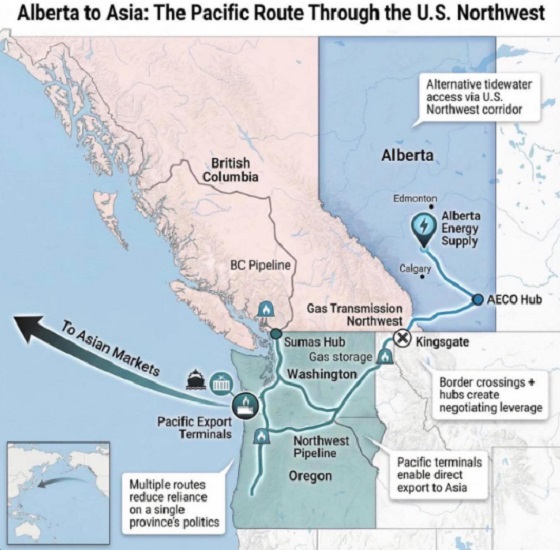
What are the odds of a pipeline through the American Pacific Northwest