Connect with us

National

New Quebec bill would prohibit teachers, school staff from wearing a crucifix

Published

4 minute read

From LifeSiteNews

By Anthony Murdoch

‘In Quebec, we made the decision that the state and the religions are separate and today we say the schools, the public schools are separate from religion’

The Canadian province of Quebec is moving ahead to expand its so-called religious symbols ban to now include all school staff, meaning no one who works at a school would be allowed to wear crucifixes or crosses of any kind. 

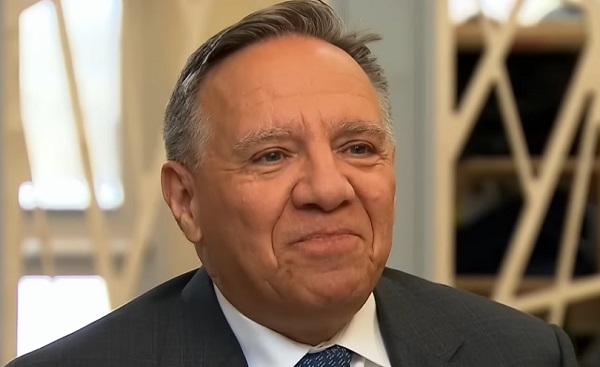
On March 20, the Quebec provincial government of Premier François Legault tabled a bill which, if passed, would expand the province’s current religious symbols ban to stop “any religious indoctrination.”

“In Quebec, we made the decision that the state and the religions are separate and today we say the schools, the public schools are separate from religion,” said Minister of Education Bernard Drainville to reporters Thursday.  

The new bill would update Quebec’s Education Act and would mandate that all students and staff at schools have their faces uncovered. It would also mandate teachers submit all of their educational plans to school principals so that they could be evaluated each year. 

According to Drainville, the “idea” of the new bill is “to protect students from any religious indoctrination.”  

He said, “If we are going to be coherent with this idea that a figure of authority should not wear a religious symbol, well, any adult can be a figure of authority and therefore no adults who are working within the school system should be allowed to wear a religious symbol.” 

The Chair of the English Montreal School Board, Joe Ortona, blasted the bill as “a smokescreen for this government who’s sinking in the polls to try to show that they’re doing something.” 

“And again, they’re not. They’re just coming up with phony solutions that really play to their base, which seems to be intolerant of any mention or of any public display of any religion whatsoever,” he added.  

The announcement of the new proposed law comes after Premier François Legault in December of 2024 tasked his top cabinet officials with putting in place a law that would ban all praying in public in Canada’s only historically and culturally Catholic province. 

In 2019, Quebec passed its so-called secularism law, or Bill 21, that bans all public servants, public school teachers, police officers, government lawyers, and wildlife officials from wearing any religious symbols while at work, including crosses or crucifixes. 

The province’s highest court upheld the law earlier this year after an appeal to overturn it failed. 

Canada’s notwithstanding clause, which is in section 33 of the Canadian Charter of Rights and Freedoms, allows provinces to temporarily override sections of the Charter of Rights and Freedoms to protect new laws from being scrapped by the courts. 

Canada’s leading constitutional freedom group, the Justice Centre for Constitutional Freedoms (JCCF), late last year sent a “demand letter” to Legault regarding his plan to ban public prayer. 

“Such a ban is a totalitarian suppression of the freedoms of expression and of conscience and religion,” the JCCF said regarding its notice of sending the demand letter. 

Quebec has been historically a Catholic province, however, since Vatican II, Mass attendance has plummeted and the provinces birth rate has nosedived to all-time lows. The province also has high abortion and euthanasia numbers, indicating a serious departure from the practice of the Catholic faith.

Todayville is a digital media and technology company. We profile unique stories and events in our community. Register and promote your community event for free.

Follow Author

Business

Land use will be British Columbia’s biggest issue in 2026

Published on

By Resource Works

Tariffs may fade. The collision between reconciliation, property rights, and investment will not.

British Columbia will talk about Donald Trump’s tariffs in 2026, and it will keep grinding through affordability. But the issue that will decide whether the province can build, invest, and govern is land use.

The warning signs were there in 2024. Land based industries still generate 12 per cent of B.C.’s GDP, and the province controls more than 90 per cent of the land base, and land policy was already being remade through opaque processes, including government to government tables. When rules for access to land feel unsettled, money flows slow into a trickle.

The Cowichan ruling sends shockwaves

In August 2025, the Cowichan ruling turned that unease into a live wire. The court recognized the Cowichan’s Aboriginal title over roughly 800 acres within Richmond, including lands held by governments and unnamed third parties. It found that grants of fee simple and other interests unjustifiably infringed that title, and declared certain Canada and Richmond titles and interests “defective and invalid,” with those invalidity declarations suspended for 18 months to give governments time to make arrangements.

The reaction has been split. Supporters see a reminder that constitutional rights do not evaporate because land changed hands. Critics see a precedent that leaves private owners exposed, especially because unnamed owners in the claim area were not parties to the case and did not receive formal notice. Even the idea of “coexistence” has become contentious, because both Aboriginal title and fee simple convey exclusive rights to decide land use and capture benefits.

Market chill sets in

McLTAikins translated the risk into advice that landowners and lenders can act on: registered ownership is not immune from constitutional scrutiny, and the land title system cannot cure a constitutional defect where Aboriginal title is established. Their explanation of fee simple reads less like theory than a due diligence checklist that now reaches beyond the registry.

By December, the market was answering. National Post columnist Adam Pankratz reported that an industrial landowner within the Cowichan title area lost a lender and a prospective tenant after a $35 million construction loan was pulled. He also described a separate Richmond hotel deal where a buyer withdrew after citing precedent risk, even though the hotel was not within the declared title lands. His case that uncertainty is already changing behaviour is laid out in Montrose.

Caroline Elliott captured how quickly court language moved into daily life after a City Richmond letter warned some owners that their title might be compromised. Whatever one thinks of that wording, it pushed land law out of the courtroom and into the mortgage conversation.

Mining and exploration stall

The same fault line runs through the critical minerals push. A new mineral claims regime now requires consultation before claims are approved, and critics argue it slows early stage exploration and forces prospectors to reveal targets before they can secure rights. Pankratz made that critique earlier, in his argument about mineral staking.

Resource Works, summarising AME feedback on Mineral Tenure Act modernisation, reported that 69.5 per cent of respondents lacked confidence in proposed changes, and that more than three quarters reported increased uncertainty about doing business in B.C. The theme is not anti consultation. It is that process, capacity, and timelines decide whether consultation produces partnership or paralysis.

Layered on top is the widening fight over UNDRIP implementation and DRIPA. Geoffrey Moyse, KC, called for repeal in a Northern Beat essay on DRIPA, arguing that Section 35 already provides the constitutional framework and that trying to operationalise UNDRIP invites litigation and uncertainty.

Tariffs and housing will still dominate headlines. But they are downstream of land. Until B.C. offers a stable bargain over who can do what, where, and on what foundation, every other promise will be hostage to the same uncertainty. For a province still built on land based wealth, Resource Works argues in its institutional history that the resource economy cannot be separated from land rules. In 2026, that is the main stage.

Resource Works News

Continue Reading

Energy

Why Japan wants Western Canadian LNG

Published on

From Resource Works

From Tokyo’s perspective, Canada offers speed, stability, and insulation from global energy shocks

In a Dec. 22, 2025 article, influential Japanese newspaper Asahi Shimbun laid out why Japan is placing growing strategic weight on liquefied natural gas exports from Western Canada – and why the start of full-scale operations at LNG Canada marks a significant shift in Japan’s energy-security calculus.

The article, written by staff writer Shiki Iwasawa, approaches Canadian LNG not as a climate story or an industrial milestone, but as a response to the vulnerabilities Japan has experienced since Russia’s invasion of Ukraine upended global gas markets.

1. Shorter distance and faster delivery

The most immediate advantage identified is geography. LNG shipped from British Columbia’s Pacific coast reaches Japan in about 10 days, roughly half the time required for cargoes originating in the Middle East or the U.S. Southeast, which can take 16 to 30 days.

For Japan – the world’s largest LNG importer – shorter voyages mean lower transportation costs, tighter inventory management, and reduced exposure to disruptions while cargoes are at sea.

2. Avoidance of global maritime choke points

Just as important, Canadian LNG avoids the world’s most precarious shipping bottlenecks.

The Asahi report emphasizes that shipments from B.C. do not pass through either:

  • the Strait of Hormuz, increasingly volatile amid Middle East conflict, or
  • the Panama Canal, where climate-driven water shortages have already led to passage restrictions.

Japanese officials explicitly frame these routes as strategic liabilities. As one senior government official responsible for energy security told the newspaper: “We, the government, have high hopes. It means a lot not having to go through the choke points.”

From Japan’s perspective, Canada’s Pacific-facing terminals offer a rare combination of proximity and route resilience.

3. Political reliability and allied status

The article contrasts Canada sharply with Russia, once a significant LNG supplier to Japan through the Sakhalin-2 project.

Before the Ukraine war, Russia accounted for about 10 per cent of Japan’s LNG imports. When Japan joined international sanctions, Moscow responded by restructuring the project’s ownership – a move that underscored how energy supplies can be weaponized.

A government source reflected on that experience bluntly: “We had thought it would be OK if we diversified procurement sources, but we were at risk of power outages even if only 10 percent (of LNG) didn’t reach Japan.”

Canada, by contrast, is described as a friendly and politically stable nation, free from sanctions risk and viewed as a long-term, rules-based partner.

4. Scale, certainty, and investment momentum

The Asahi article devotes considerable attention to the fundamentals of LNG Canada itself.

Key features highlighted include:

  • approximately $14 billion in total development costs,
  • 14 million tonnes per year of production capacity,
  • two liquefaction trains already operating,
  • natural gas sourced from inland Canada and transported via a 670-kilometre pipeline to the coast,
  • and the successful shipment of first cargoes in mid-2025.

Mitsubishi Corp., which holds a 15 per cent stake, has rights to market 2.1 million tonnes annually to Japan and other Asian buyers. Mitsubishi expects the project to generate tens of billions of yen in annual profits starting in the fiscal year beginning April 2026.

At a Nov. 4 news conference, Mitsubishi president Katsuya Nakanishi said the company is actively considering additional investment to expand capacity, with internal sources indicating output could eventually double.

5. LNG’s continuing role in Japan’s energy system

The article situates Canadian LNG within Japan’s broader energy strategy. Under Japan’s Economic Security Promotion Law, LNG is designated a “specified critical product.” The government maintains dedicated funds to secure supply during emergencies.

While nuclear power remains central to long-term planning, officials acknowledge LNG’s indispensable role. A senior economy ministry official told Asahi: “Nuclear power is the key player in the spotlight, but thermal power (mainly fueled by LNG) is the key player behind the scenes.”

Japan’s latest Basic Energy Plan projects LNG imports rising to 74 million tonnes by 2040, roughly 10 per cent higher than today, underscoring why secure, politically insulated suppliers matter.

What Japan’s view tells Canada

In a recent Canada-Japan leaders’ meeting on the sidelines of APEC, Prime Minister Mark Carney and Prime Minister Sanae Takaichi discussed expanding economic ties, with energy cooperation specifically highlighted around the LNG Canada project as a key element of their bilateral relationship. While Takaichi didn’t make a detailed public statement about Canadian LNG itself, the joint statement underscored Japan’s interest in stable and diversified LNG supplies—of which Canadian exports are a part of the broader Indo-Pacific energy security context.

What emerges from Asahi Shimbun’s reporting is a pragmatic assessment shaped by recent shocks. Japan values Canadian LNG because it is closer, less exposed to conflict-prone routes, backed by a stable political system, and already delivering cargoes at scale.

For Canadian readers, the message is unambiguous: Western Canadian LNG is not being embraced because of rhetoric or aspiration, but because it aligns with the operational, geopolitical, and economic priorities of one of the world’s most energy-dependent nations.

Continue Reading

Trending

X