
Also Interesting
Canadian Energy Companies Benefiting From Global Turbulence

The world is going through a lot of chaos right now. From a war in Ukraine to a looming recession back home, people are struggling to live as normal. But through this all, the biggest Canadian energy stocks are getting stronger. Why is this and should you invest?
Before getting into the specifics of the stock market and why commodities are benefiting, it is important to go through every global event that is having a major impact.
The glut of global turbulence
Russia’s Invasion of Ukraine
To start with, Russia’s invasion of Ukraine is the most obvious factor in global turbulence at the moment. The world was not ready to deal with such an invasion. Negotiations were expected to keep Russia from choosing this approach, considering what they would have to lose. Massive sanctions would cripple Russia’s economy, and a war would not seem worth it.
However, they went ahead and global sanctions went into place. Unfortunately, these sanctions do not only affect Russia. Rather, they impact just about every other country as well. Russia bears the biggest brunt, but without the resources they provide to other
countries, the world is struggling to cope.
This is hurting developing countries more than any other, as they do not have the resources to spend on low supplies of energy in high demand. Locals are paying the price, with costs rising dramatically. However, developed nations are struggling as well, including the US and Canada. We’re seeing record high inflation that is making life difficult for everyone. We may face shortages if this war continues for much longer.
China’s COVID Lockdowns
While it has started to feel like COVID is finally over, China has been implementing new lockdowns to control another wave. This has led to a low supply of goods coming from China, impacting trade around the world at a time in which supply of almost every
commodity is low.
It’s not just the lack of production on Chinese shores that is impacting the rest of the world. The reality they are going through is causing a lot of unease. The pandemic started there, after all, and their inability to contain it led to the events of the past two and a half years. Fears that they will trigger a new wave with disastrous consequences are not unfounded.
Supply-chain issues caused by the pandemic around the world have still not returned to normal. If lockdowns go into place globally, these issues will get worse once again and it will be even more difficult to recover.
Global Recession
The threat of a global recession that rivals the Great Recession is looming over us. In the US, out-of-control inflation in spite of high interest rates, along with highly overvalued properties, are driving fears.
Whether a recession will occur and how bad it will be is impossible to determine at this point. But the potential is causing people to make decisions with huge financial consequences. This leaves us all the more at risk of chaos.
In this context, why are the biggest Canadian energy companies benefiting? What does this mean for stock traders?
Energy is in high demand
The above events have all impacted the supply of many commodities. Whether it is due to sanctions or lockdowns in China, it is becoming extremely difficult to get hold of just about any consumables. However, there is nothing in higher demand than energy.
Energy is by far Russia’s biggest export. Russia is also one of the biggest exporters of energy in the world, especially when it comes to crude oil. For this reason, sanctions are not all-encompassing. Many European countries simply cannot function without importing Russian energy.
The same is not true for the US, who have been able to cut off all energy imports from Russia. But it is still not comfortable, and all kinds of energy are in high demand.
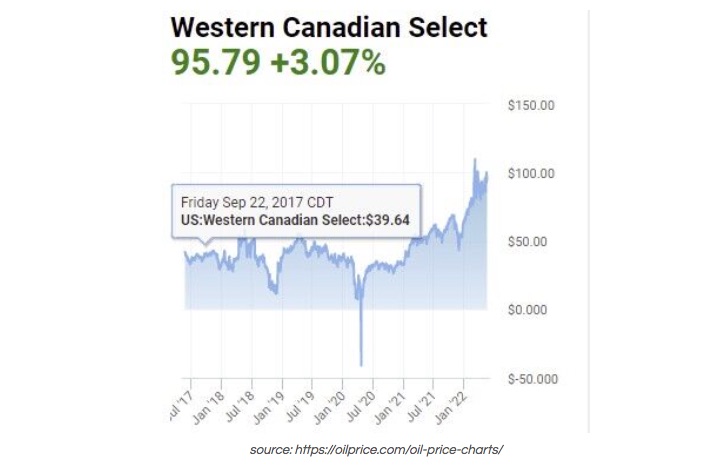
This is particularly good for the biggest Canadian energy companies. One of the reasons the US can survive without importing Russian energy is due to the supply of energy from Canada. With such high demand, and supply that is limited to an extent, the price of
Canadian energy has risen rapidly.
The strength of the US dollar
With all of that being said, you may be wondering why Canadian energy companies are benefiting so much while US companies are not having as much luck. This has a lot to do with the strength of the US dollar.
The US dollar is considered a safe haven currency. It tends to stay strong regardless of what is happening in the world. This becomes a self-fulfilling property, as currency traders flock to buy US dollars in times of trouble, causing it to strengthen in spite of economic downturns.
China’s difficulties also boost the US currency, as traders turn to the US to import goods unavailable during China’s lockdowns.
The strength of the US dollar is, at least in the short term, great for Canadian energy companies. With demand for their energy in the US higher than ever, they are receiving US dollars that are particularly strong and have more buying power in Canada. The biggest Canadian energy companies are therefore flying higher than their US counterparts, who are earning the same dollars which, due to high inflation, have lower buying power than before.
Of course, this is a double-edged sword. Right now, the strength of the US dollar is great for Canadian energy companies. But over time it will start to impact the cost of all imports from the US, increasing the expenses these companies face and cancelling out any benefits.
Should you invest in Canadian energy stocks?
Bringing this back to the buying and selling of commodities on the stock market, is this the perfect time to invest in the biggest Canadian energy stocks? While it may seem so, the answer is a little more complicated than you might think.
The problem with the current strength of Canadian energy companies is that it is caused by factors that are supposed to be temporary. Sanctions on Russia are not meant as a punishment for their crimes. Rather, they are in place to put pressure on Russia to end the war before their economy collapses and they are bereft of necessary resources.
It is either that or the rest of the world capitulates due to an inability to cope with the rebound effects of the sanctions. Either way, Russian energy exports go back to normal and the price of Canadian energy stocks drops significantly.
The same is true when it comes to China and its COVID lockdowns. They may be driving up the price of the US dollar right now, but things will soon get back to normal. China’s approach of implementing harsh lockdowns ensures that they last the minimum amount of time. This is already happening, with China’s economy just experiencing its best month since February.
This is not to say that Canadian energy stocks are a bad investment. But, if you are to invest in these stocks, you need to be prepared to watch the market carefully. Things can change in an instant, and you can see your investment lose its value.


The Toronto Blue Jays are certainly keeping things interesting this winter. While the calendar might say late December, the front office shows no signs of slowing down. They have already made waves across MLB with some massive acquisitions earlier in the month.
Rather than packing it in for the holidays, the management team is seemingly working overtime. Their goal is to build a roster that can truly compete for a championship in 2026.
Although there are no more signing announcements for the end of the year, the silence is likely temporary. Reports indicate that the team is actively pursuing several more roster improvements before the new year begins.
A Rotation Built To Dominate
The team made their intentions clear in early December. They successfully signed Dylan Cease to a massive seven-year, $210 million contract. This deal, which became official around December 8, instantly transforms the Toronto rotation into one of the strongest in MLB.
Moreover, they did not stop with just one big arm. The front office added significant depth by bringing in KBO MVP Cody Ponce on a three-year deal worth $30 million. This gives the team a level of stability that was missing in previous seasons.
With such dramatic changes to the roster, fans might be looking for a clear overview of licensed Ontario sportsbooks to understand how these moves have impacted the team’s championship odds. It is certainly a different looking team than the one that ended the last season.
Targets for the Bullpen and Lineup
It seems that the focus has now shifted from the starting rotation to other needs. Agents around the league note that the Jays remain “everywhere” in trade talks. The priority is now on finding high-leverage arms and position players to round out the squad.
The front office is reportedly looking at several specific targets:
- Robert Suarez is a primary target to help lock down the late innings.
- Luke Weaver is being considered to add veteran versatility to the staff.
- Depth pieces for the lineup are being sought to support the core hitters.
- Internal extensions remain a key part of the winter strategy.
Due to the heavy spending on Cease and Ponce, these next moves will likely be strategic. The team is looking for the right fit to complement their new stars.
The Future of the Infield and Management
Conversations are actively continuing with free agent Bo Bichette. Bringing him back is a major topic of discussion among the fanbase, even if no deal is imminent yet. Furthermore, the team has been linked to prospect Kyle Tucker, suggesting they are keeping an eye on the future as well as the present.
Manager John Schneider has also expressed optimism regarding his own contract extension. However, he made it clear that building the team comes first. Therefore, while the heavy lifting might seem done, the work continues behind the scenes.
To be sure, the MLB offseason is long. But the Toronto Blue Jays have started fast, and they seem determined to finish strong.

We wanted to know what to do if you came to Canada for temporary or permanent residence. Many Ukrainians have arrived in the country, and many don’t know where to begin their financial journey. People often turn to traditional banks, where they encounter problems due to a lack of language skills and basic understanding of Canadian financial processes. We found an alternative – a credit union in Toronto. Today, we’ll look at one of the most well-known and learn more about what they have to offer Ukrainians.
What is a Credit Union in Toronto
These organisations differ from the typical bank for Ukrainians. They offer more flexible conditions, convenient online management, and a personalised approach.
However, these organisations are just as safe and reliable as banks. Let’s look at reliability using the example of the well-known BCU Financial:
- With over 70 years on the market. This credit union in Toronto has a dedicated client base with decades of experience.
- Extensive experience. Indeed, over more than 7 decades, its specialists have become experts in financial matters.
- Branches available. You can visit the office for face-to-face interaction.
- Active in the social life of the Ukrainian community. Buduchnist Credit Union provides financial support to schools, churches, and communication centres for Ukrainian newcomers.
As you can see, such companies have stability and experience. Now let’s look at how they differ from banks in financial matters.
Ukrainian Credit Union Toronto: Differences from a Traditional Bank
Firstly, such organizations welcome a personalized approach to Ukrainians. They are more flexible when it comes to obtaining a loan. Newcomers in Canada are working on receiving a good credit history. Banks always request one when reviewing a loan application.
Secondly, you can receive advice in your native language. Most Canadian banks don’t have multilingual consultants and respond only to inquiries in English or French. If, for example, you need help with a scholarship card, you’ll have to call a translator.
Third, you’ll get more flexible and understated banking for Ukrainians. It includes the ability to submit an app online. It provides such services as ordering credit cards, applying for a loan, or opening an account.
Conclusions
Credit unions are much easier for Ukrainians to work with. They speak your language, can provide advice on finances and their specific needs in Canada, and offer flexible terms. They also provide full-fledged online banking, so familiar to Ukrainians. You also become part of the community because, as a credit union member, you are, to a certain extent, its co-owner.

Georgia county admits illegally certifying 315k ballots in 2020 presidential election

ICYMI: Largest fraud in US history? Independent Journalist visits numerous daycare centres with no children, revealing massive scam

While Western Nations Cling to Energy Transition, Pragmatic Nations Produce Energy and Wealth

Alberta project would be “the biggest carbon capture and storage project in the world”
-
 Energy17 hours ago
Rulings could affect energy prices everywhere: Climate activists v. the energy industry in 2026
-
 Digital ID18 hours ago
The Global Push for Government Mandated Digital IDs And Why You Should Worry
-
 Bruce Dowbiggin17 hours ago
The Rise Of The System Engineer: Has Canada Got A Prayer in 2026?
-
 International2 days ago
Trump confirms first American land strike against Venezuelan narco networks
-
 International17 hours ago
Maduro says he’s “ready” to talk
-
 Business2 days ago
How convenient: Minnesota day care reports break-in, records gone
-
 Business2 days ago
The great policy challenge for governments in Canada in 2026
-
 International17 hours ago
LOCKED AND LOADED: Trump threatens U.S. response if Iran slaughters protesters