
International
Even the UK’s radical Labour Party leader admits the reality of biological sex

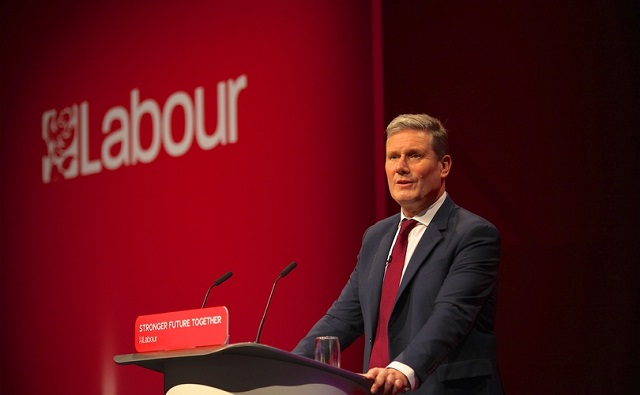

Sir Keir Starmer speaking to the Labour Party Conference in 2021
From LifeSiteNews
The backlash to gender ideology in the U.K. has been so effective that even leader Keir Starmer has now conceded that biology is, in fact, a real thing.
If the polls are right – and I suspect they are – the U.K. Tory party is set for a historic shellacking that could reduce them to a mere handful of seats. After a shambolic, rollicking ride through twelve years and five utterly forgettable prime ministers, the British public appears to be out for blood. Nigel Farage’s new Reform U.K. party is surging, and the Labour Party’s Keir Starmer seems poised for a landslide victory.
It may seem like a small thing, but it is worth noting that despite the radical progressivism of the Labour Party, the backlash to gender ideology in the U.K. has been so effective that even Starmer has now conceded that biology is, in fact, a real thing. This recent headline from The Independent highlights both how insane our culture has become and the silver (sliver?) lining of sanity that may be returning to the debate:
Blair right that a woman has a vagina and a man has a penis, Starmer says
The subtitle is equally magnificent: “The Labour leader has hardened his position on biological sex.” I do wonder how the editors and headline writers got through all that without dissolving helplessly into giggles, or if any veteran journalist stared bug-eyed at the sorts of things once-venerable publications are reduced to covering. But either way, it is unfortunately significant that the man who is likely going to be the U.K.’s next prime minister does, in fact, acknowledge that women have vaginas and men have penises.
Previously, the Independent noted with solemnity, “Sir Keir” has “previously said that ’99.9% of women’ do not have a penis.” Since then, he has come to the epiphany that no women do, an affirmation that has deeply offended a clutch of delusional men in dresses who are quite certain that they are women, penises notwithstanding. Of course, neither the former Labour PM nor the next one oppose sex change surgeries – they’ve just been forced to admit the obvious.

Former prime minister Tony Blair made his comments in recent interview with Holyrood magazine, noting: I don’t know how politics got itself into this muddle. What is a woman? Well, it’s not a very hard thing for me to answer really. I’m definitely of the school that says, biologically, a woman is with a vagina and a man is with a penis. We can say that quite clearly.”
Blair went on: “The point is this: if people want to reassign their gender and say, ‘OK I may be born biologically a male but I want to reassign as female’, that’s absolutely fine and people should be entitled to do that. And there is no doubt at all there are people who genuinely feel that they are in the wrong body. I know this, I’ve dealt with it over the years. I was actually, I think, the first MP [who] ever had a full set of meetings with transgender people. So, I completely get it.”
Obviously, Blair is being somewhat disingenuous here. As an extraordinarily talented and very slippery politician, he knows quite well “how politics got into this muddle”: because the LGBT movement effectively captured the entire left-wing of the political spectrum as well as much of the right and demanded that their premises be implemented in law and that society be restructured to suit them.
But that aside, Starmer was clearly relieved to have Sir Tony weigh in. “Yes, Tony is right about that, he put it very well,” he told reporters. “I saw it reported, I’m not quite sure when he said it, but I agree with him on that.” Previously, Starmer had stated that Labour MP Rosie Duffield – a woman – was “not right” for saying that “only women have a cervix,” but apparently when Tony Blair says it, “he put it very well.”
Of course, it was Tony Blair’s government that passed the Gender Recognition Act back in 2004, legally granting trans-identifying people the right to change their “legal gender.” Blair embraced the premises; he rejects the conclusion. So, for the moment, does Starmer. It may not seem like much, but in the U.K. in 2024, it’s not nothing.


From the Frontier Centre for Public Policy
By Collin May
Targeting comedians is a sign of political insecurity
A democracy that fears its comedians is a democracy in trouble. That truth landed hard when Graham Linehan, the Irish writer behind Father Ted and The IT Crowd, stepped off a plane at Heathrow on Sept. 1, 2025, and was met by five London Metropolitan Police officers ready to arrest him for three posts on X.
Returning to the UK from Arizona, he was taken into custody on the charge of “suspicion of inciting violence”, an allegation levelled with increasing ease in an age wary of offence. His actual “crime” amounted to three posts, the most contentious being a joke about trans-identified men in exclusively female spaces and a suggestion that violated women respond with a swift blow to a very sensitive part of the male’s not-yet-physically-transitioned anatomy.
The reaction to Linehan’s arrest, from J.K. Rowling to a wide array of commentators, was unqualified condemnation. Many wondered whether free speech had become a museum piece in the UK. Asked about the incident, British Prime Minister Keir Starmer defended his country’s reputation for free expression but declined to address the arrest itself.
Canada has faced its own pressures on comedic expression. In 2022, comedian Mike Ward saw a 12-year legal saga end when the Supreme Court of Canada ruled five-to-four that the Quebec Human Rights Commission had no jurisdiction to hear a complaint about comments Ward made regarding a disabled Quebec boy. The ruling confirmed that human rights bodies cannot police artistic expression when no discrimination in services or employment has occurred. In that case, comic licence survived narrowly.
These cases reveal a broader trend. Governments and institutions increasingly frame comedy as a risk rather than a social pressure valve. In an environment fixated on avoiding perceived harm, humour becomes an easy and symbolic target. Linehan’s arrest underscores the fragility of free speech, especially in comedic form, in countries that claim to value democratic openness.
Comedy has long occupied an unusual place in public life. One of its earliest literary appearances is in Homer’s Iliad. A common soldier, Thersites, is ugly, sharp-tongued and irreverent. He speaks with a freedom others will not risk, mocking Agamemnon and voicing the frustrations of rank-and-file soldiers. He represents the instinct to puncture pretension. In this sense, comedy and philosophy share a willingness to speak uncomfortable truths that power prefers to avoid.
Aristotle, in his Poetics, noted that tragedy imitates noble actions and depicts people who are to be taken seriously. Comedy, by contrast, imitates those who appear inferior. Yet this lowly status is precisely what gives comedy its political usefulness. It allows performers to say what respectable voices cannot, revealing hypocrisies that formal discourse leaves untouched.
In the Iliad, Thersites does not escape punishment. Odysseus, striving to restore order, strikes him with Agamemnon’s staff, and the soldiers laugh as Thersites is silenced. The scene captures a familiar dynamic. Comedy can expose authority’s flaws, but authority often responds by asserting its dominance. The details shift across history, but the pattern endures.
Modern democracies are showing similar impatience. Comedy provides a way to question conventions without inviting formal conflict. When governments treat jokes as misconduct, they are not protecting the public from harm. They are signalling discomfort with scrutiny. Confident systems do not fear irreverence; insecure ones do.
The growing targeting of comedians matters because it reflects a shift toward institutions that view dissent, even in comedic form, as a liability. Such an approach narrows the space for open dialogue and misunderstands comedy’s role in democratic life. A society confident in itself tolerates mockery because it trusts its citizens to distinguish humour from harm.
In October, the British Crown Prosecution Service announced it would not pursue charges against Linehan. The London Metropolitan Police Service also said it would stop recording “non-crime hate incidents”, a controversial category used to document allegations of hateful behaviour even when no law has been broken. These reversals are welcome, but they do not erase the deeper unease that allowed the arrest to happen.
Comedy survives, but its environment is shifting. In an era where leaders are quick to adopt moral language while avoiding meaningful accountability, humour becomes more necessary, not less. It remains one of the few public tools capable of exposing the distance between political rhetoric and reality.
The danger is that in places where Agamemnon’s folly, leadership driven by pride and insecurity, takes root, those who speak uncomfortable truths may find themselves facing not symbolic correction but formal sanctions. A democracy that begins by targeting its jesters rarely stops there.
Collin May is a Senior Fellow with the Frontier Centre for Public Policy, a lawyer, and Adjunct Lecturer in Community Health Sciences at the University of Calgary, with degrees in law (Dalhousie University), a Masters in Theological Studies (Harvard) and a Diplome d’etudes approfondies (Ecole des hautes etudes, Paris).


From the Daily Caller News Foundation
Billionaire Michael Dell and his wife, Susan, announced Monday that they will give 25 million American children a $250 deposit as an initial boost to President Donald Trump’s new investment program for children.
The Dells’ pledge totals $6.25 billion and will be routed through the Treasury Department. The goal, they say, is to extend access to the federal Invest America program — referred to as “Trump accounts” — established by the One Big Beautiful Bill Act, signed into law by the president in July.
The federal program guarantees a $1,000 federally funded account for every child born from 2025 through 2028, but the Dells’ money will instead cover children 10 years old and younger in ZIP codes where the median household income is under $150,000, according to Bloomberg.
Dear Readers:
As a nonprofit, we are dependent on the generosity of our readers.
Please consider making a small donation of any amount here.
Thank you!
“What inspired us most was the chance to expand this opportunity to even more children,” the Dells wrote in the press release. “We believe this effort will expand opportunity, strengthen communities, and help more children take ownership of their future.” (RELATED: Trump Media Company To Create Investment Funds With Only ‘America First’ Companies)
Dell, founder and CEO of Dell Technologies with a net worth of about $148 billion, has been one of the most visible corporate leaders championing the Trump accounts. In June, he joined Goldman Sachs CEO David Solomon, Uber CEO Dara Khosrowshahi, and others at a White House roundtable promoting the initiative.
In addition to the new $6.25 billion pledge, Dell Technologies committed to matching the government’s $1,000 contribution for the children of its employees. Other companies, such as Charter Communications, Uber, and Goldman Sachs, have said they are willing to match the government’s contributions when the accounts launch.
“This is not just about what one couple or one foundation or one company can do,” the couple wrote. “It is about what becomes possible when families, employers, philanthropists, and communities all join together to create something transformative.”
Starting July 4, 2026, parents will be able to open one of the accounts and contribute up to $5,000 a year. Employers can put in $2,500 annually without it counting as taxable income.
The money must be invested in low-cost, diversified index funds, and withdrawals are restricted until the child turns 18, when the funds can be used for college, a home down payment, or starting a business. Investment gains inside the account grow tax-free, and taxes are owed only when the money is eventually withdrawn.
The accounts will “afford a generation of children the chance to experience the miracle of compounded growth and set them on a course for prosperity from the very beginning,” according to the Trump administration.
The broader effort was originally spearheaded in 2023 by venture capitalist Brad Gerstner, who launched the nonprofit behind the Invest America concept.
“Starting 2026 & forevermore, every child will directly share in the upside of America! Huge gratitude to Michael & Susan for showing us all what is possible when we come together!” Gerstner wrote on X.


Landmark 2025 Study Says Near-Death Experiences Can’t Be Explained Away

STUDY: TikTok, Instagram, and YouTube Shorts Induce Measurable “Brain Rot”
Blacked-Out Democracy: The Stellantis Deal Ottawa Won’t Show Its Own MPs
Red Deer’s Jason Stephan calls for citizen-led referendum on late-term abortion ban in Alberta
-
 Business1 day ago
Recent price declines don’t solve Toronto’s housing affordability crisis
-
Daily Caller1 day ago
Tech Mogul Gives $6 Billion To 25 Million Kids To Boost Trump Investment Accounts
-
 Alberta24 hours ago
Alberta will defend law-abiding gun owners who defend themselves
-
 Business1 day ago
Ottawa’s gun ‘buyback’ program will cost billions—and for no good reason
-
 Business1 day ago
Canada’s future prosperity runs through the northwest coast
-
 Artificial Intelligence2 days ago
The Emptiness Inside: Why Large Language Models Can’t Think – and Never Will
-
 National1 day ago
Canada Needs an Alternative to Carney’s One Man Show
-
Censorship Industrial Complex23 hours ago
A Democracy That Can’t Take A Joke Won’t Tolerate Dissent